
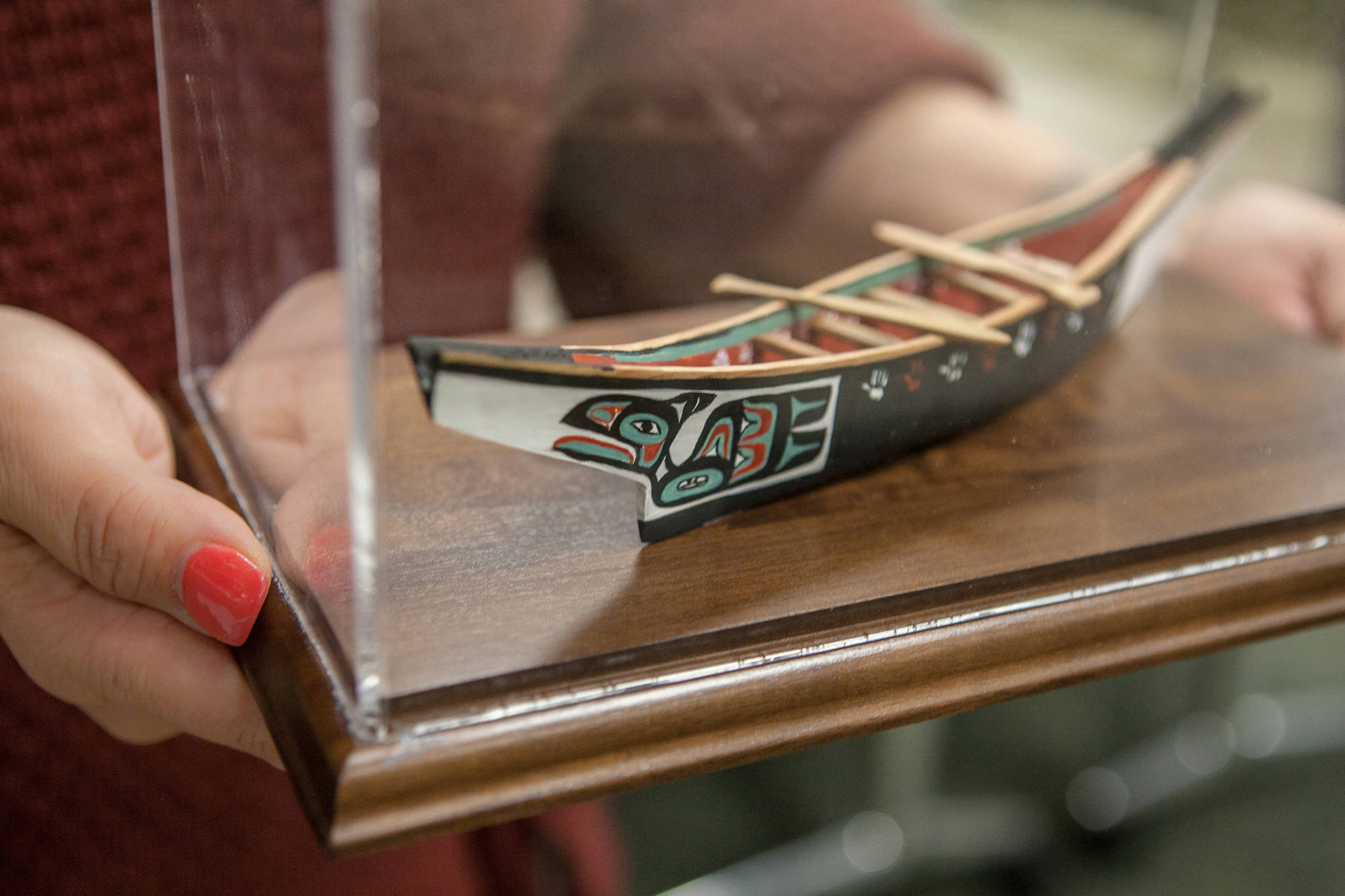
Sitka’s tribal government has donated to Sealaska Heritage Institute (SHI) a small replica of a full-size dugout canoe carved through a project sponsored by SHI, the National Park Service, Alaska State Council on the Arts, the National Endowment for the Arts and a private foundation in 2016.
The replica, which was made by Tsimshian artist Mark Sixbey of Sitka, is a near copy of the 27-foot traditional dugout carved in Sitka by mentor Steve Brown and his apprentices, artists T.J. Young, Tommy Joseph and Jerrod and Nicholas Galanin. Brown, who has studied traditional dugouts for years, identified it as a northern-style ceremonial canoe.
SHI spearheaded the project with Sitka National Historical Park in 2016 to preserve the ancient but endangered knowledge of making the traditional watercraft. Sitka Tribe of Alaska, the Sitka School District, and Sitka National Historical Park developed lesson units about dugout canoes for school students and brought nearly 500 students to the carving site. The finished canoe was officially launched at a dedication ceremony in October 2017.
SHI gifted the full-size dugout to Sitka Tribe of Alaska, and the tribe donated the replica as an expression of gratitude to SHI and Sealaska, which donated the log.
The mentor-apprentice team applied a base coat of paint and the designs were added later by Sixbey. Sitka Elders named the canoe Dachxánx’I Yán Yaagú (Tlingit for Grandchildren’s Canoe) and directed Sixbey to include one Raven, one Eagle and children’s handprints around the vessel.
The replica was added to SHI’s ethnographic collection and will be made available to artists for study.
“The replica is reminiscent of model canoes that were left by the old masters and are studied by carvers today. Only a handful of those survived,” said SHI President Rosita Worl. “We are grateful to have the replica in our collection for study and also as a reminder of the project, which was hugely successful in transferring this ancient knowledge to some of our young carvers.”
Finely crafted dugout canoes have long been an essential component of Southeast Alaska Native culture. Until the modern era, dugout canoes served as the primary transportation method for trading, seasonal travel, hunting, fishing and gathering.
The institute began pursuing the project in earnest after artists who participated in SHI’s first Native Artist Gathering in 2015 ranked dugout canoe carving as one of the most endangered Northwest Coast art practices. SHI secured funding to launch the mentor-apprentice canoe project, to sponsor workshops on how to make model dugouts, and to develop a book on traditional canoes. The book, written by Brown, is scheduled for release in 2019. SHI also made 3-D scans of the canoe so it can be replicated in the future in materials such as fiber glass or carbon fiber.
The project was funded through a cooperative agreement with the National Park Service and in part by a grant from the Alaska State Council on the Arts and the National Endowment for the Arts. It was supported by Sitka Tribe of Alaska and the Sitka School District.
Sealaska Heritage Institute is a private nonprofit founded in 1980 to perpetuate and enhance Tlingit, Haida and Tsimshian cultures of Southeast Alaska. Its goal is to promote cultural diversity and cross-cultural understanding through public services and events. SHI also conducts social scientific and public policy research and advocacy that promotes Alaska Native arts, cultures, history and education statewide. The institute is governed by a Board of Trustees and guided by a Council of Traditional Scholars, a Native Artist Committee and a Southeast Regional Language Committee.
