

In a carving shed in Sitka National Historical Park, a team of five well-known carvers are continuing, and reviving, an art practiced since time immemorial — carving a wooden dugout canoe from the intact trunk of one of the Tongass National Forest’s enormous trees. Pacific Northwest Native peoples once paddled carved spruce and red cedar dugout canoes up and down the coast, but very few people know, now, how to make them.
Haida carver TJ Young, Tlingit carver Tommy Joseph, and Tlingit/Unangan carvers Nicholas Galanin and Jerrod Galanin are all carving under the direction of Steve Brown, who’s taught the art up and down the Northwest Coast. (Brown has been adopted by the Stikine Kiksadi.)
“I have a love of the ocean, I have a love of the water, I have a love of boats — and, also, my people’s history,” said Jerrod Galanin, who went to school for traditional wooden boat-building. “It’s one of the most exciting things and greatest things I’ve ever been a part of.”
For the Galanin brothers, it’s a continuance of their recent family heritage, as well.
Their uncle Will Burkhart carved the last canoe to come out of Sitka about fifteen years ago, and their great grandfather, George Benson, built the one before that, they said.
“I would go there throughout the whole process of it… and sweep up chips, and just help out how I could,” Jerrod said. “I remember doing that, and that was a big impact on me.”
Nicholas Galanin got his start as an artist carving wood. Working on a canoe has been a dream of his, he said.
“A canoe is kind of bringing our culture full circle, back directly to the land,” he said. “It’s a utilitarian piece that has a lot of important value and purpose to our communities, history and trade.”
Joseph has worked on a canoe before, but is learning new things this time around, he said. He’s had a cracked red cedar log in his shed for the last fifteen years, and though he’s repaired totem poles that are hundreds of years old, repairing a cracked log intended for a canoe is different.
“After we finish this canoe project, I will know where to go (with the canoe in my shed)” Joseph said. “An opportunity to work with these carvers — it’s a once in a lifetime opportunity.”
Carver TJ Young said he’s always been fascinated with the art of creating a canoe.
“They’re really beautiful pieces of functional art,” he said. “When I was approached to be a part of it I jumped at it. I couldn’t jump fast enough.”
This is his first time carving a canoe; with the exception of a brief visit to see his family in Anchorage, he’s been at the carving shed every day.
“I learned more in the last couple weeks than I probably have in the previous five or ten years,” he said.
Right now, they’re learning about proportion and balance, what to look for in the wood, and even discussing adzing techniques, which are a bit different than for a totem pole, Young said.
“There seems to be a lot more adze work. So our arms are getting solid — at least one arm so far,” Young joked.
Last fall, Sitka National Historical Park joined up with Sealaska Heritage Institute, and together the two organizations got funding and moved forward with the projectl Sealaska donated a 28-foot red cedar. Former park superintendent Mary Miller was the one who first broached the idea to him, Brown said.
SHI is also collaborating on two other projects — spruceroot weaving and mountain goat horn carving — through its Jinéit Art Academy, which pairs experienced and apprentice artists on endangered art form projects.
Brown first began learning canoe carving 40 years ago.
“The whole thing has been a real trial and error kind of a process,” said Brown. “There’s no source, and particularly then, 40 years ago there were fewer sources and fewer experienced people. Most of the old Native carvers who actually had experience making canoes were gone, and very few people had any actual experience doing it.”
He looked at what he could find in museums and other places, took measurements, talked to people who’d been around when others were making canoes, and got to work trying to make them himself.
He started teaching at the Totem Heritage Center in Ketchikan in 1977, even working with the Galanins’ uncle, Will Burkhart, in Metlakatla. He’s carved canoes in Hoonah, Klukwan, Ketchikan, Wrangell, and other places besides, both in spruce and in red cedar.
They plan to finish the canoe at the end of May. In August, the carvers said, people will paddle it to the dedication of the tribal house under construction in Bartlett Cove, a ceremonial return for the Huna Tlingit to Glacier Bay.
“At one time (canoes were) really prominent, and it’s coming back little by little,” Brown said. “When people have the experience of paddling together in a canoe – it’s different when you get your hand on an outboard or a steering wheel, as opposed to a paddle. You have a different relationship to the wind and the tide and all that, and to each other.”
Brown is also working on a canoe-building manual, complete with photos, said SHI Director of Media and Publications Kathy Dye.
“We could identify only a few master carvers who are able to make traditional canoes, and that set off alarms,” said SHI President Rosita Worl a release announcing the project. “Our long term vision is that the apprentices will eventually lead their own canoe projects and pass the knowledge on to others.”
That’s something the carvers have in mind, too. Some people have already been talking to Joseph about teaching them what he learns.
“It’s great to have this knowledge passed on and be a part of it,” Nicholas Galanin said. “Hopefully my brother and I will get to see more of these boats… in the future so we can be a part of the continuum of sharing this knowledge.”
All the carvers said they encourage people to come visit them at the shed at the back of the historical park.
“It doesn’t happen very often,” Jerrod Galanin said. “It’s just a rare opportunity. Take advantage of it when you can.”
“We enjoy visiting with people,” Young said. “And none of the carvers are allergic to coffee.”
• Contact Capital City Weekly staff writer Mary Catharine Martin at maryc.martin@capweek.com.
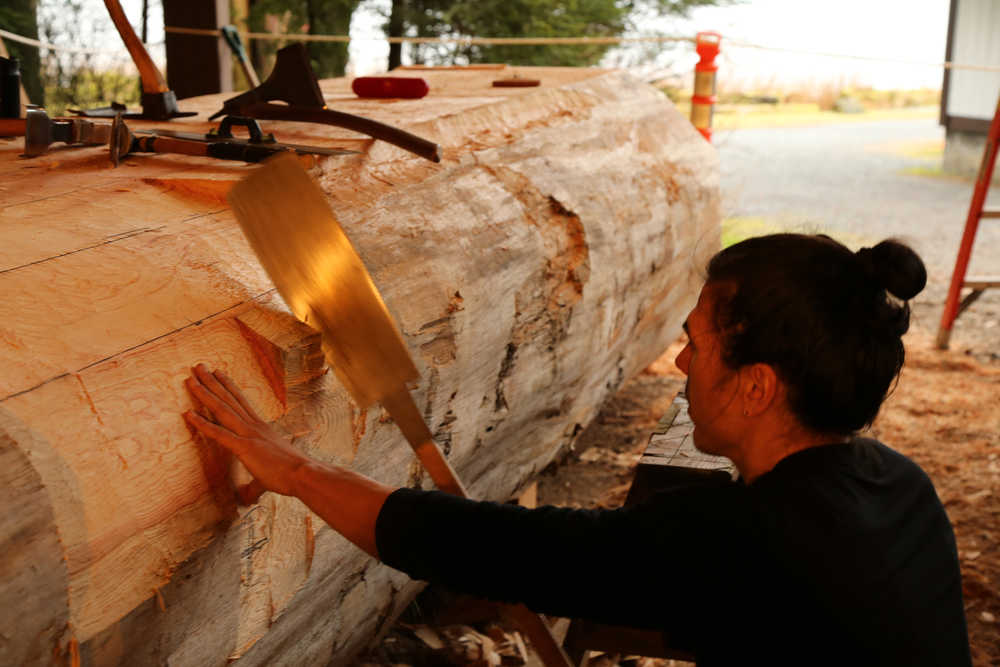
Haida carver TJ Young, who lives in Anchorage, has been in Sitka working on the canoe almost every day since the project started. (National Park Service | Erin Fulton)
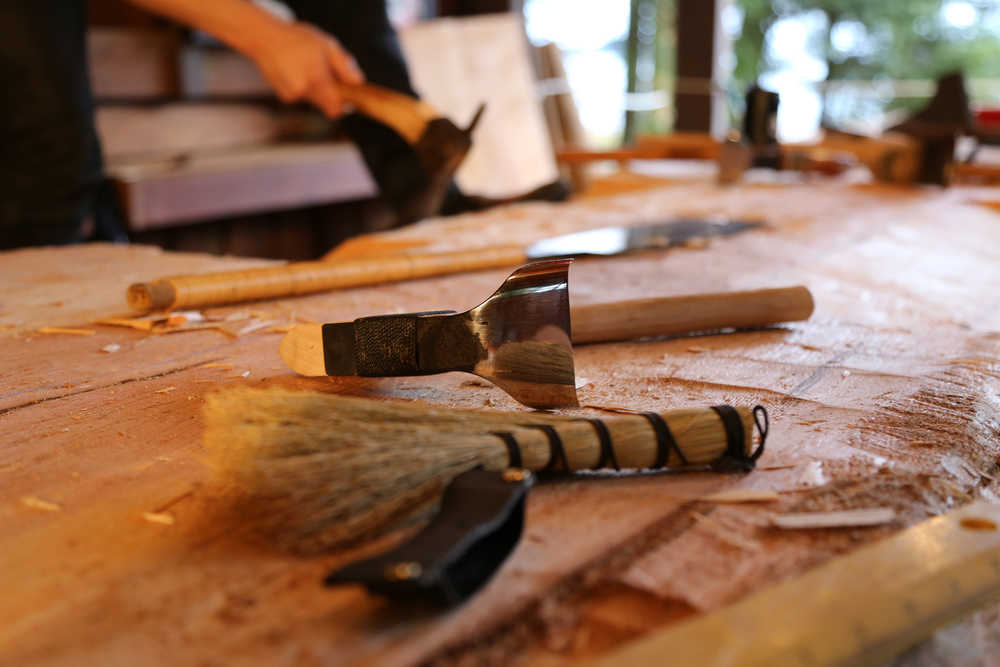
From front to back, an adze blade guard, a straw broom, and an adze rest on the 28-foot cedar log that will become a canoe as carvers work. (National Park Service | Erin Fulton)
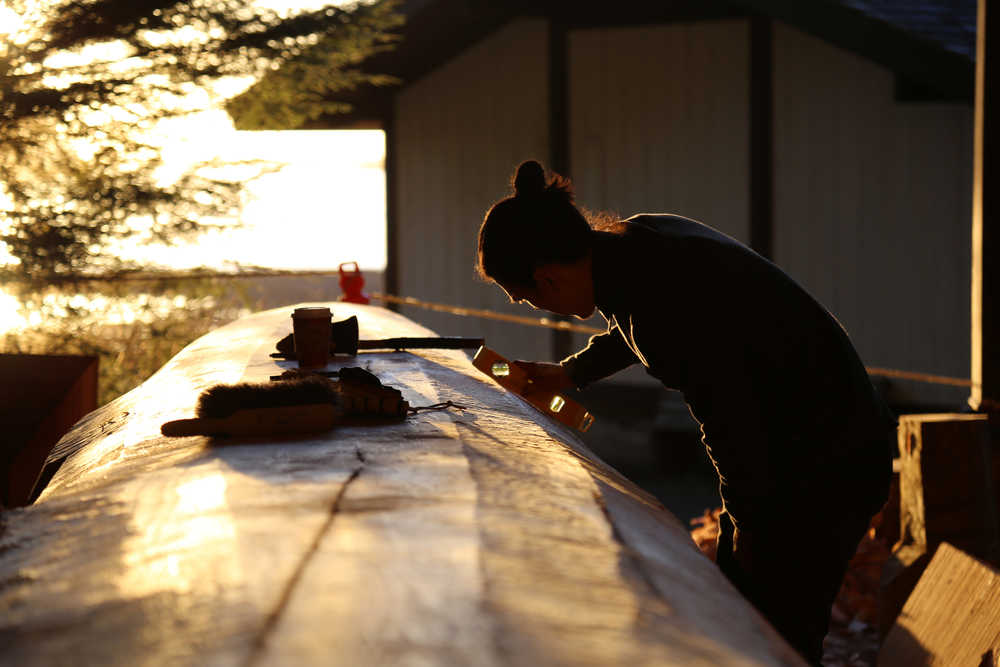
Haida carver TJ Young has been working on the canoe every day. All the carvers welcome visitors – and coffee. (National Park Service | Erin Fulton)
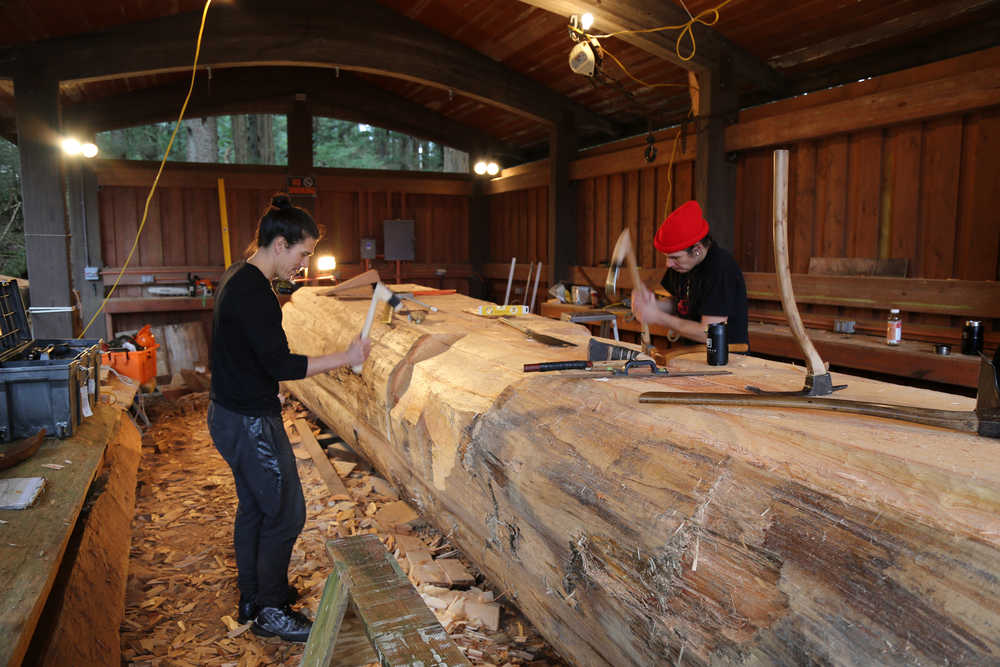
TJ Young, left, and Nicholas Galanin work on the beginning of the canoe. (National Park Service | Erin Fulton)
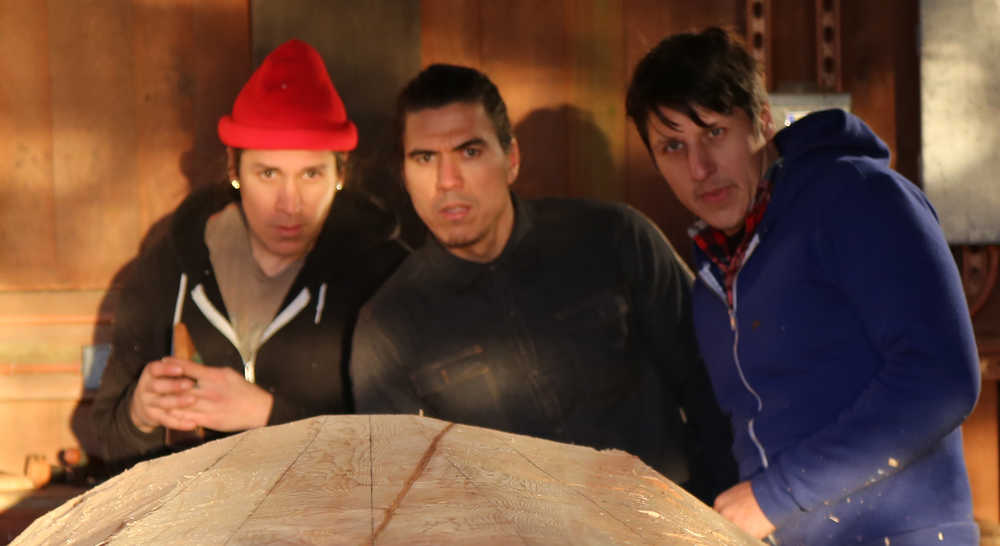
Three of the carvers working on the canoe are, from left, Nicholas Galanin, TJ Young and Jerrod Galanin. (National Park Service | Erin Fulton)
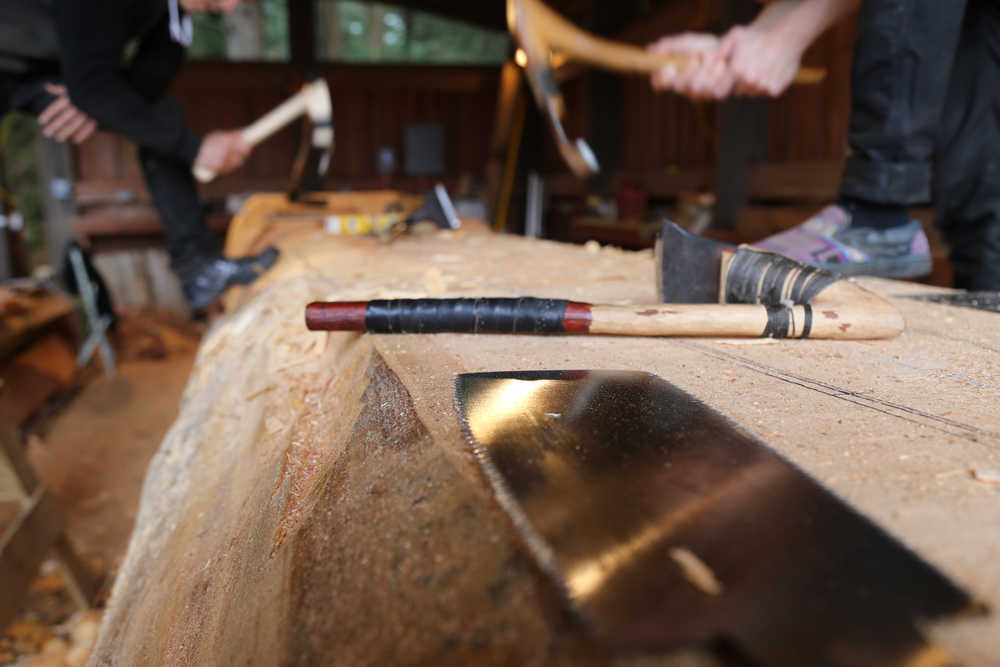
The carvers and their tools. (National Park Service | Erin Fulton)
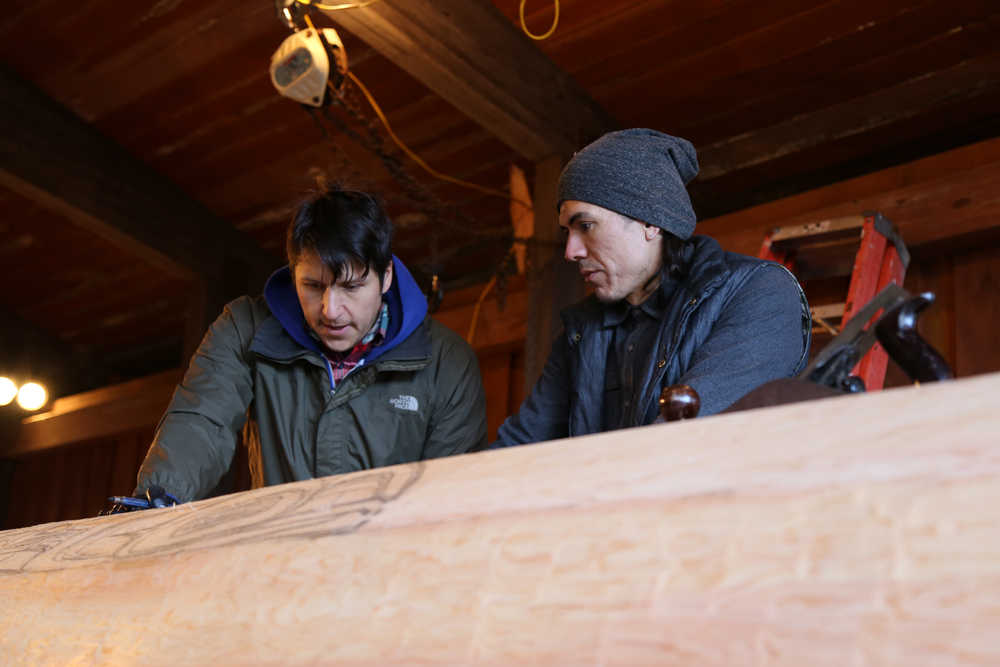
From left, Jerrod Galanin and TJ Young study the 28-foot red cedar log that will become a canoe. Jerrod and Nicholas Galanin’s uncle and great grandfather were some of the last people to carve canoes in Sitka. (National Park Service | Erin Fulton)
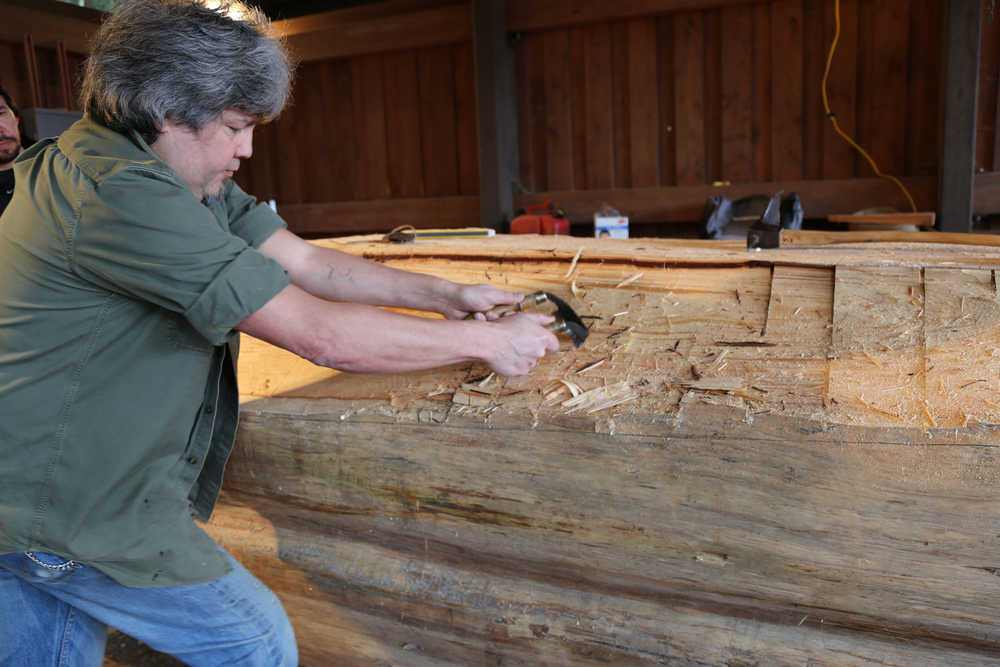
Sitka carver Tommy Joseph works on the beginnings of a canoe at Sitka National Historical Park, a project led by master carver Steve Brown. (National Park Service | Erin Fulton)
