The days get longer and longer, and folks in Juneau begin to wish that spring would hurry up and get here. The spring equinox occurred this week, so now spring is officially here.
The real world was ever-so-slightly ahead of officialdom. In the days of March before the equinox, there were clear signs that spring might really happen, even though snow still covered the ground and hung in clumps on tree branches, and creeks were mostly ice-covered. Redpolls still thronged to our seed feeders, and the magpies were still in town too, not yet ready to head over the mountains to their nesting places.
But the plants knew that the times were changing. Cottonwood buds swelled with the developing leaves inside them. The catkins of feltleaf willow, always the earliest willow to flower, began to emerge from their bud covers but were not yet sexually mature. The still-immature male catkins of red alders along the roads began to blush with a rusty-red hue. Blueberry twigs took on a brighter red and their buds began to peep open. Young willow shoots shone with a yellow hue.
Near several streams, adult stoneflies began to emerge from the creeks, crawling over the snow. Some observers have suggested that female stoneflies stay closer to the streams than males do, because they lay their eggs in the water, where the larvae develop. That leads me to wonder why the males don’t hang out where the girls are, since their main goal is to find mates.
The early birds were singing: Juncos trilled from the tops of trees and shrubs. I heard a few song sparrows and had reports of varied thrushes and a wren in song — still rather sporadically. A few robins foraged for skimpy foods. At least some sapsuckers are back, drumming their rhythms on metal roofs and drainpipes. There is a report of black oystercatchers, early returnees to our rocky shores from points south. Groups of gulls were checking out their nesting areas near Mendenhall Lake one day, but apparently they decided that the visit was premature and it would be better to wait a while. Then, just before the equinox, they tried again; I heard their calls as they flew up the valley and over the lake toward the glacier.
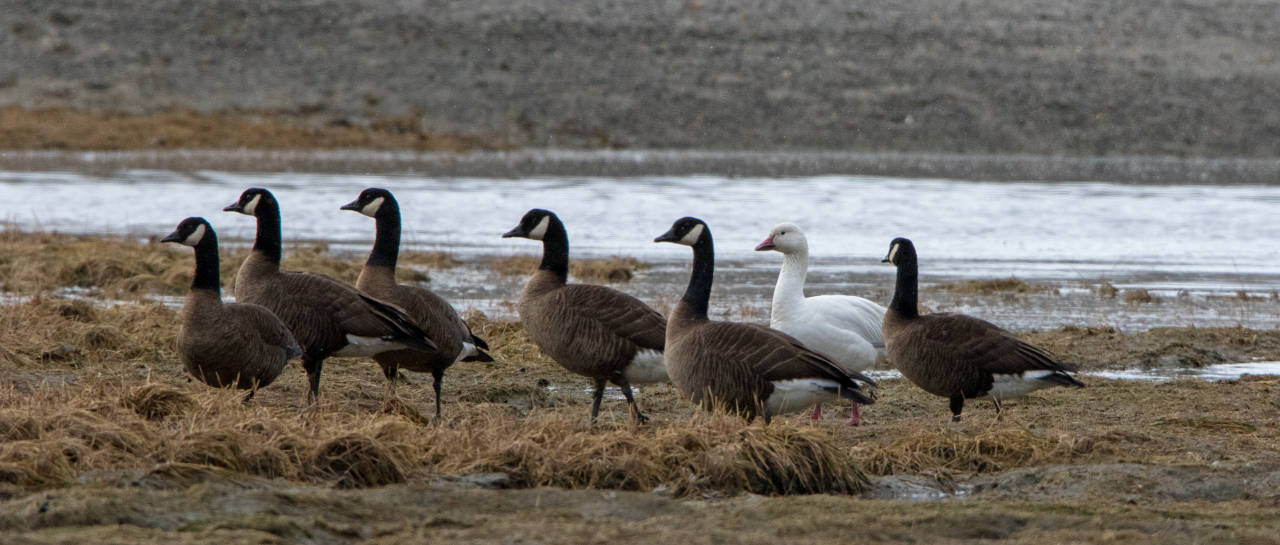
Pairs of ravens canoodled on lamp posts, and a raven on Sandy Beach was diligently filling its bill with clumps of dog fur, a sign that a nest was being lined with those cozy materials. At least some of the Canada geese near the Boy Scout camp were consorting in pairs. A few days later, in the same broad meadow, hundreds of Canadas grazed, joined by a lone snow goose. Steller’s jays expanded their vocabulary: their spring repertoire includes a variety of more musical sounds than the familiar year-round squawk.
One of the beaches on Douglas Island is a place I like to check, about this time of year, because I often find “mermaids’ purses” washed up at the high tide line. These are the egg cases of long-nose skates (relatives of rays and, more distantly, sharks). There is one egg, and thus one embryo, in each egg case of this species. Eggs are fertilized inside the female skates and the cases of protein fibers are constructed around the eggs. The cases are yellowish-brown before they dry out and turn black on the shore. Most of those that I found had been hacked open, perhaps by a raven or gull, but some appeared to be intact. Maybe the embryo had already emerged through the seam in the side of the case, ready to go as a fully formed young skate. Or maybe a predatory snail had drilled a very small hole (less than 5 millimeters or so) in the case and slurped up the young embryo. Or there is also a possibility that no embryo had been there — that the case was produced with no egg.
When someone says “spring is in the air,” it really is! As Parks and Rec hikers waded through flooded meadows to the beach just beyond the Cowee Meadow cabin, little zephyrs brought the welcome smell of spring to our noses. I don’t know what makes that aroma so distinct, but there is nothing quite like it.
• Mary F. Willson is a retired professor of ecology. “On The Trails” appears every Friday. Her essays can be found online at onthetrailsjuneau.wordpress.com.
