
SHI releases new study on definition of ‘Alaska Native’

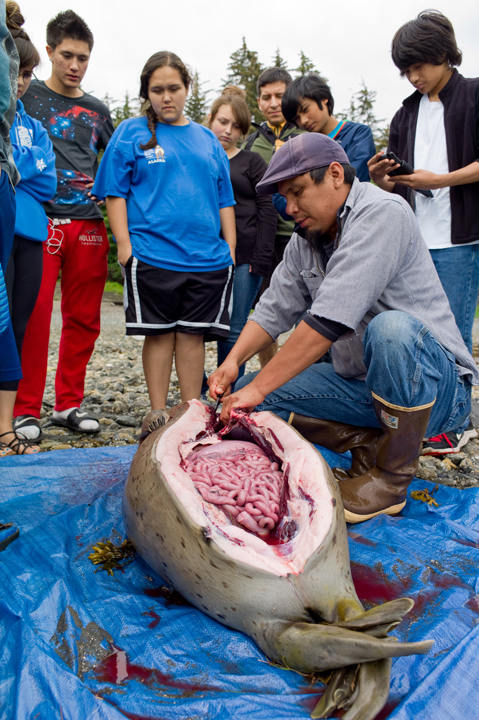
In this file photo from July 2014, Lyle James teaches students how to butcher a harbor seal as part of the “Haa Yoo X’atangi, Haa Kusteeyix sitee: Our Language is Our Culture” camp at the Auke Recreation Area beach.

In this file photo from July 2014, Lyle James teaches students how to butcher a harbor seal as part of the “Haa Yoo X’atangi, Haa Kusteeyix sitee: Our Language is Our Culture” camp at the Auke Recreation Area beach.

JUNEAU — The Sealaska Heritage Institute has released a statewide study on the current definition of “Alaska Native” and how the rule could affect future generations of Natives who want to hunt marine mammals.

The definition under the Marine Mammal Protection Act (MMPA) allows only Natives with 1/4 blood quantum or more to hunt or use marine mammals for food or clothing and arts and crafts.

The study, conducted by Maritime Anthropologist Dr. Steve Langdon through Sealaska Heritage, does not make any recommendations but rather lays out several approaches the Native community may want to consider to protect their descendants’ hunting rights, said SHI President Dr. Rosita Worl, who presented the study, “Determination of Alaska Native Status under the Marine Mammal Protection Act,” to the Alaska Federation of Natives Board of Directors. AFN has not taken a position on changing the eligibility or maintaining the status quo.

The study also brings to light data that might alarm some sectors of the Native community, because findings indicate among other things that the proportion of the Alaska Native population becoming ineligible to hunt marine mammals under current agency enforcement policies is rising at an accelerating rate, Worl said.

“The result may be that in some communities especially around the Gulf of Alaska there may be few individuals eligible to hunt or utilize marine mammals in the not too distant future,” said Worl, who emphasized that any decision to maintain the status quo or to advance an alternative eligibility requirement will remain with the Native community.

In her presentation to the AFN board, Worl laid out the study and the possible approaches the Native community might consider if they elect to change the status quo.

The study was funded by Afognak Native Corporation, Native Village of Afognak, Chugach Alaska Corporation, Koniag Incorporated, NANA, North Slope Borough, Sealaska and Sealaska Heritage Institute.

More in Neighbors

Weekly events guide: Juneau community calendar for Feb. 9 – 15
Juneau Community Calendar

Weekly events guide: Feb. 9 – 15

Jeff Lund/contributed
The author would rather fish for steelhead, but he’ll watch the Super Bowl.
I Went to the Woods: Super Bowl spectacle

At some point on Sunday, dopey characters, hopelessly addicted to Doritos, will… Continue reading

Peggy McKee Barnhill (Courtesy photo)
Gimme a Smile: How much snow can one backyard hold?

Snow, snow, everywhere, and no place to put it!

The Spruce Root team gathers for a retreat in Sitka. Spruce Root, is an Indigenous institution that provides all Southeast Alaskans with access to business development resources. (Photo by Lione Clare)
Woven Peoples and Places: Wealth lives in our communities

Sustainable Southeast Partnership reflects on a values-aligned approach to financial wellness.

Actors in These Birds, a play inspired by death, flowers and Farkle, hold ‘flowers’ during a performance at the UAS Egan Library on Saturday, Jan. 31. (photo courtesy Claire Richardson)
Living and Growing: Why stories of living and dying in Juneau matter

What if we gave our town a safe space to talk about living and dying with family and friends?

calendar
Weekly events guide: Juneau community calendar for Feb. 2 – Feb. 8

Visit Juneau Arts and Humanities Council at JAHC.org for more details on this week’s happenings.

calendar
Weekly events guide: Juneau community calendar for Jan. 26 – Feb. 1

Visit Juneau Arts and Humanities Council at JAHC.org for more details on this week’s happenings.

Courtesy photo
Adam Bauer of the Local Spiritual Assembly of Bahá’ís of Juneau.
Living and Growing: Surfing into the future

Many religious traditions draw strength from the past.

calendar (web only)
Weekly events guide: Juneau community calendar for Jan. 19-25

Visit Juneau Arts and Humanities Council at JAHC.org for more details on this week’s happenings.

(web only)
Weekly events guide: Juneau community calendar for Jan. 12-18

Visit Juneau Arts and Humanities Council at JAHC.org for more details on this week’s happenings.

Four members of the Riley Creek wolf pack, including the matriarch, “Riley,” dig a moose carcass frozen from creek ice in May 2016. National Park Service trail camera photo
Alaska Science Forum: The Riley Creek pack’s sole survivor

Born in May, 2009, Riley first saw sunlight after crawling from a hole dug in the roots of an old spruce above the Teklanika River.

Sun shines through the canopy in the Tongass National Forest. (Photo by Brian Logan/U.S. Forest Service)
Opinion: Let’s start the New Year with an Alaskan-style wellness movement

Instead of simplified happiness and self-esteem, our Alaskan movement will seize the joy of duty.