
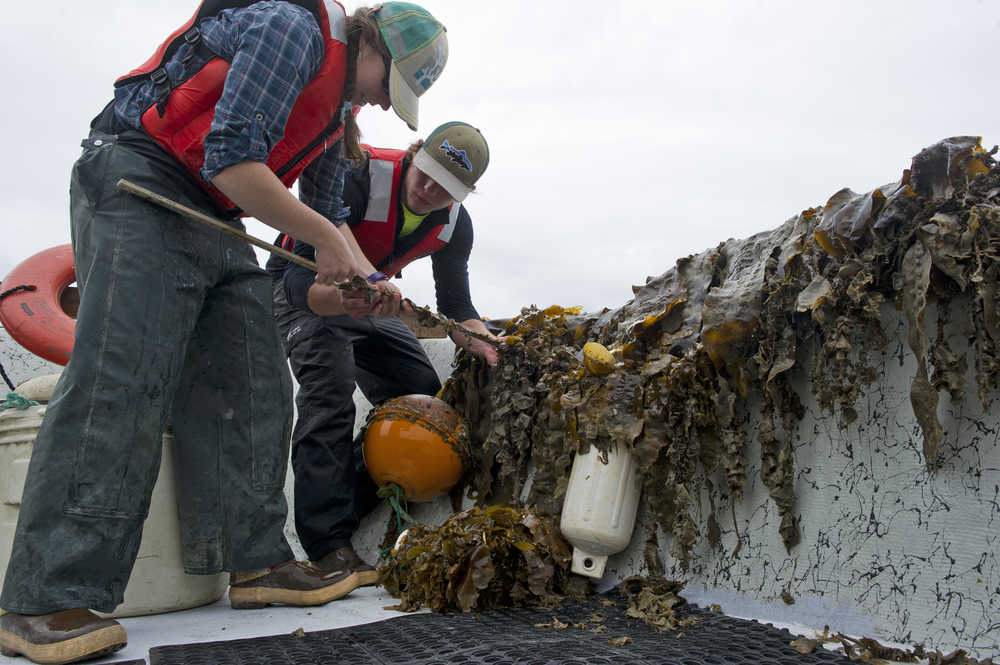
A year ago, Trevor Sande wasn’t thinking much about seaweed.
Early this November, however, he and the employees at Hump Island Oyster Company in Ketchikan, which Sande founded and owns, will plant five acres of bull kelp and ribbon kelp, all originating from local seaweed.
Seaweed isn’t yet a big part of commercial mariculture in Alaska — but researchers at the University of Alaska Southeast and seaweed product company Blue Evolution are working to change that.
UAS professor of chemistry and biochemistry Mike Stekoll has been researching the viability of different kinds of seaweed grown commercially in Alaskan waters, recently funded by Premium Oceanic (Blue Evolution’s parent company) and grants.
Stekoll is testing out species including sugar kelp, bull kelp, black seaweed, alaria (a kind of kelp similar to wakame, the Japanese name for seaweed most commonly found in seaweed salad), dulse (palmeria moliis), which has a high protein content compared to other seaweeds, and nori, which most people know as the kind of seaweed used to wrap sushi or to snack on.
Sugar kelp and alaria especially are some “we think… are going to be the crops that are relatively easy to grow, have a big yield, and have an existing global market,” said Beau Perry, founder and owner of Premium Oceanic. Blue Evolution, its trademark, makes “high-end food products” — pasta with powdered seaweed worked into it and pestos, for example. In Mexico, where it already has an operation, it’s growing sea lettuce.
Stekoll and a team including lead technician Tamsen Peeples and technician Eric Fagerstrom are testing seaweed outside the lab, as well. Off the shore of Coghlan Island, buoys mark not crab pots, but longlines of string seeded with sugar kelp and alaria, both of which grow naturally in Southeast. They’re measuring nitrogen, phosphorus, turbidity, salinity, light and other variables, and evaluating the seaweed’s growth, fertility and health at different stages, including stages well beyond when most growers would harvest, and seaweed planted beyond when growers would normally plant.
This year, Juneau — and Stekoll’s lab — will supply seed to the three farms currently growing it, Perry said; they recently received a seaweed hatchery permit from the Alaska Department of Fish and Game. It will be in the first floor of UAS’ Anderson Building and will put out string seeded with different kinds of seaweed.
Next year, Perry said the hatchery will likely expand.
Farming
Perry presented last year — and will present again this year — at the Alaska Shellfish Growers Association, which is where Sande heard about the opportunity. Oyster farmers, he said, are “prime candidates” for the crop.
Perry, who has an MBA in sustainable business management, said one of the benefits of seaweed is that it’s “restorative, in many respects, of the ecosystem. There’s very little downside.”
Seaweed also serves as a buffer for ocean acidification, which can help protect oysters.
Besides Sande’s, the other two farms in Alaska that will grow seafood this year are 1-acre farms in Kodiak that will start from scratch, Perry said.
“We’re pretty bullish about it,” he said. “It’s just something that aligns with trends where people want to … know the grower, know the source of their food, and see the benefits shared all the way to the hands that cultivate and harvest these crops.”
Seaweed in Southeast
It’s been a big year for Sande’s Ketchikan oyster farm, started five years ago. In addition to their upcoming planting of seaweed, they just began selling their oysters a few weeks ago. (Sande also has a day job as the president and principal engineer of R&M Engineering in Ketchikan.)
Next year, Sande hopes to plant sugar kelp, as well.
He’ll grow the seaweed on longlines, with one end of a line attached to the beach, and the other to an anchor, he said. They’ll plant in early November and harvest in March or April, depending on how the season has gone.
“It’s a winter cycle, so it’s perfect for oyster farming,” he said. “The two go together really well in theory.”
Perry said he hopes to lead efforts to make Alaska “one of the major seaweed-producing regions in the world within the next decade.”
“We’re really excited to work in Alaska,” Perry said. “It’s a tough place to do business, but it has really excellent people and is, I think, a place that can really use a new seaweed industry … it may not replace the oil industry, but it can be part of a new economy for the state — one that creates jobs and is built upon a series of products that the state can really take pride in.”
Blue Evolution’s website is blueevolution.com
• Contact Capital City Weekly staff writer Mary Catharine Martin at maryc.martin@capweek.com.
Read more Capital City Weekly:
Canoe likely to be the first 3D-imaged for teaching, models
Moose butchering: Local foods project turns to game
LCCC prison art turns walls into mirrors
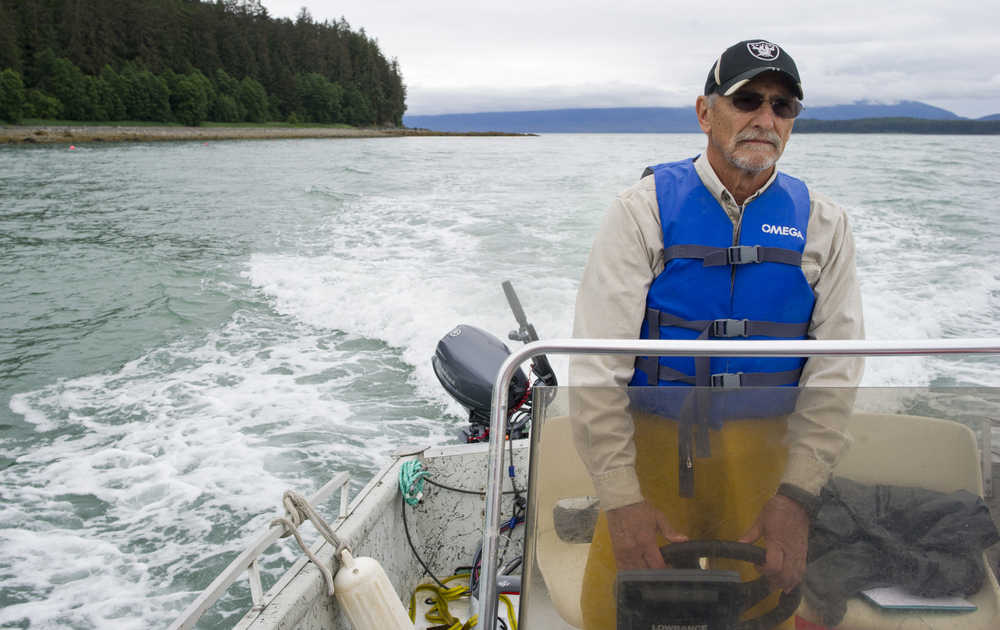
Dr. Michael S. Stekoll, professor of chemistry and biochemistry at the University of Alaska, pilots a skiff away from an area near Coghlan Island in July where testing for seaweed is being done.
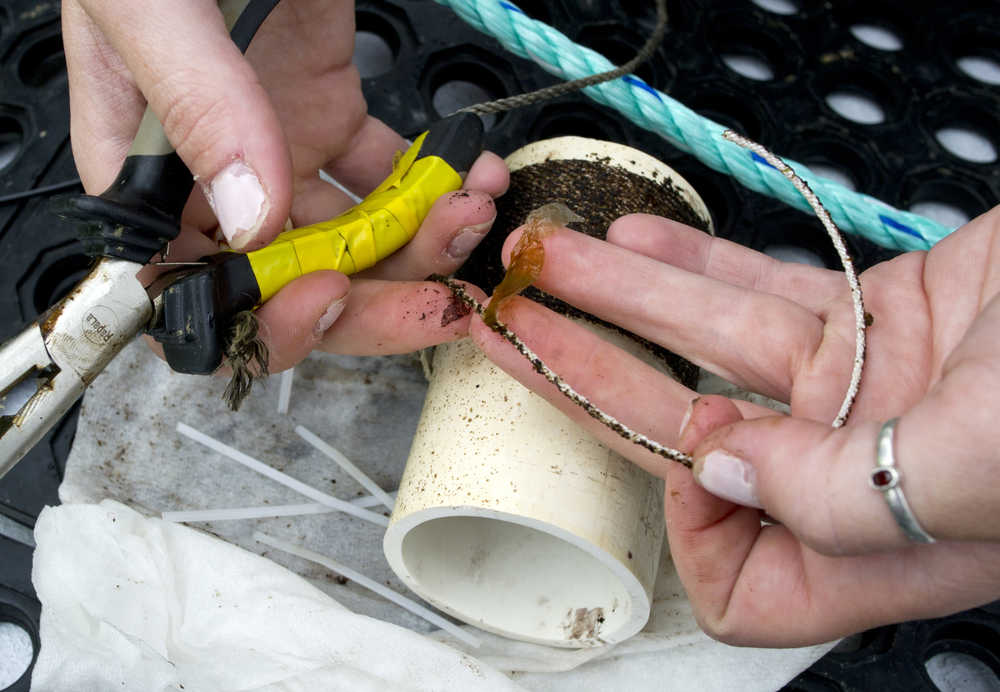
Seaweed spores impanted on cord are readied to be lowered in test beds near Coghlan Island for a joint project between the Unversity of Alaska and Premium Oceanic.
