

A trip at low tide to one or our rocky intertidal sites always yields an array of pleasures and some treasures. Maybe I’ll see my favorite bright red hermit crab! Or find an Aristotle’s lantern —the feeding apparatus of sea urchins, which may be all that’s left of the innards of a hapless urchin demolished by a crow. Or maybe I’ll catch a whelk in the act of laying eggs. Always fun.
Lurking under rocks and rockweed, I’ll find small, slender fishes. Sometimes called eels, or blennies, they are neither: in our area, they are usually gunnels or pricklebacks, and I will focus here on some that reside in the upper portion of the intertidal zone. They spend their entire lives in the intertidal zone, which means that they are not submerged in sea water for a significant portion of each day. Of course, the higher up in the intertidal zone they are, the longer the non-submerged period, which happens twice a day. Most fish can’t handle that; we even have an expression, “like a fish out of water,” to describe someone completely out of his or her element.
Gunnels and pricklebacks, however, deal with low tides just fine. They (and many other species of fishes, of many different kinds) are able to breathe air. Air-breathing fishes around the world accomplish this feat in lots of different ways: for example, some use their swim bladders, or various parts of the digestive tract, or special chambers above the gills. Gunnels and pricklebacks can breathe air, using both gills and skin, as they do in water. Their respiration is reported to be just as effective in air as it is in water, although prolonged stress might alter that.
To begin this discussion, let me present some basics about respiration (in either air or water). Respiration is all about 1) getting oxygen into the body and then to the cells, where mini-organs called mitochondria do the work of oxidizing carbohydrates and creating energy to run the whole body, and 2) getting rid of carbon dioxide, which is one of the byproducts of oxidizing those carbos, so that the interior of the cells and of the body don’t become too acidic (which interferes with lots of processes). Both gills and skin perform these functions, but the relative roles of those organs differ among species.
Gills of most fishes are long, thin, and delicate, so as to expose lots of surface area for uptake of oxygen and elimination of carbon dioxide. But such gills tend to collapse when out of water. Intertidal fishes make what is called a ‘trade-off: they have gills that are shorter and not quite so delicate, thus reducing their tendency to collapse, but they sacrifice some of the surface area for diffusion of respiratory gases. Shorter, stouter gills also reduce the risk of desiccation in air.
Both gills and skin need to be kept moist in order for oxygen to diffuse in and carbon dioxide to diffuse out. So when the tide is out, these intertidal residents may dip in and out of tiny pools or roll in wet places, for example.
A common prickleback in our upper intertidal zone is known as the high cockscomb prickleback — named for the prominent ridge on top of its head. That ridge tends to lie flat, however, when this dark fish is not submerged, making confident identification difficult for non-experts, in most field conditions. In this species, females tend to be larger than males (at equal ages), and males compete for mating privileges with females. Large females are especially worth competing for, because they lay more eggs than small females. Eggs are laid under rocks, where the female takes care of them for about a month: coiling around the ball of stuck-together eggs, fanning them to increase flow of oxygenated water, and guarding.
We also see crescent gunnels in the upper intertidal zone. These are sometimes readily identified by the light-colored marks along the sides, but I’m told that some individuals are dark, so discriminating them from other dark species may not be easy in the field. Crescent gunnels have apparently been studied less than high cockscomb pricklebacks, but both parents (but sometimes one or none) often tend the eggs, which are laid under rocks. Most of the other gunnels and pricklebacks in our region are either relatively rare or occupy lower parts of the intertidal zone, and in some of these species, parental care is done by the males.
Another small fish is common in the upper parts of the intertidal zone: the tidepool sculpin. As the name tells us, it typically lives in tidepools left by the receding tide. It’s an air-breather too, using the gills, mouth lining, and skin. Sometimes conditions in its home tidepool become low in oxygen or too acidic; this could happen especially at night when all organisms continue to respire and produce carbon dioxide but there is no photosynthesis to use that carbon dioxide. Or sunlight might make the pool too warm. Then these little sculpins often choose to leave their pools, either partially — just exposing the head to air — or fully, resting on nearby weeds or rocks or, occasionally, crawling to another tidepool. They are said to be quite good at homing … returning to their home pond if they are displaced.
This fish is unusual in that males and females copulate and the males’ sperm are deposited inside the female but the eggs are actually fertilized after they are laid. This is obviously a contrast with most other fishes, in which males and females spawn by releasing sperm and eggs into the water. There is no parental care.
These intertidal fishes face many risks in addition to desiccation and respiratory difficulties. Even though they have escaped the many predators in the open sea, there are opportunistic land-based predators that can find them. For example, ravens and crows fossick about in the rockweed and poke under rocks, sometimes coming up with a prize; mink delve into tidepools or turn over rocks. And we who love to explore the rocky intertidal inevitably do more damage than we would like.
Thanks to Dr. K. L. Martin, Pepperdine University, for helpful references and consultation.
• Mary F. Willson is a retired professor of ecology.
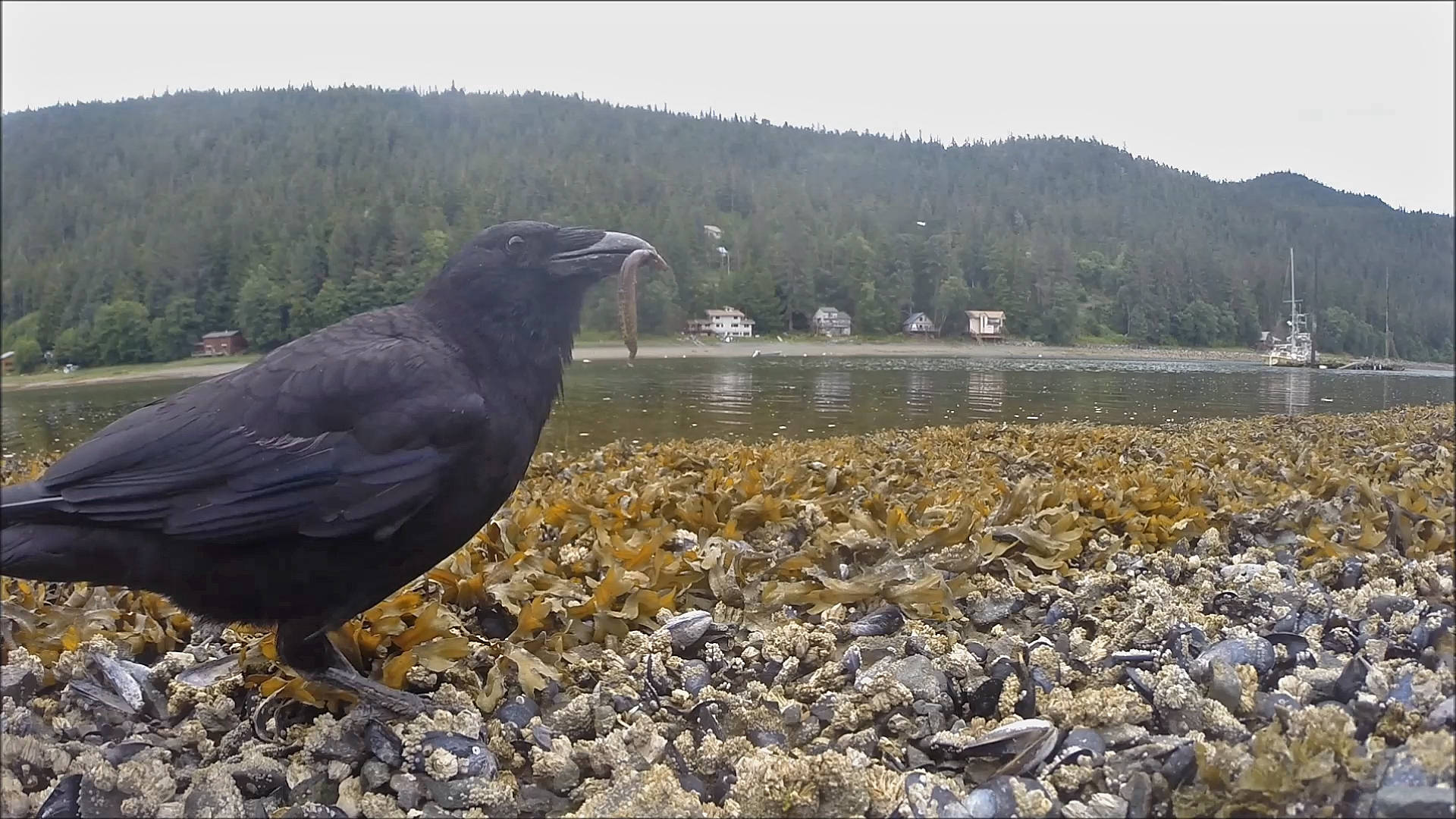
A large black bird holds a high cockscomb prickleback that it snatched from under the rockweed. (Courtesy Photo / Bob Armstrong)
