
Some stories never get old. In fact, in their retelling, they can timelessly spark creativity, fun, and learning, especially when shared as a group.
Riverside Elementary School did just that this month, kicking off its annual One School One Book event. The schoolwide program, now in its second year, provides a copy of a selected book to every student, teacher and staff member, and builds various projects and activities around the text.
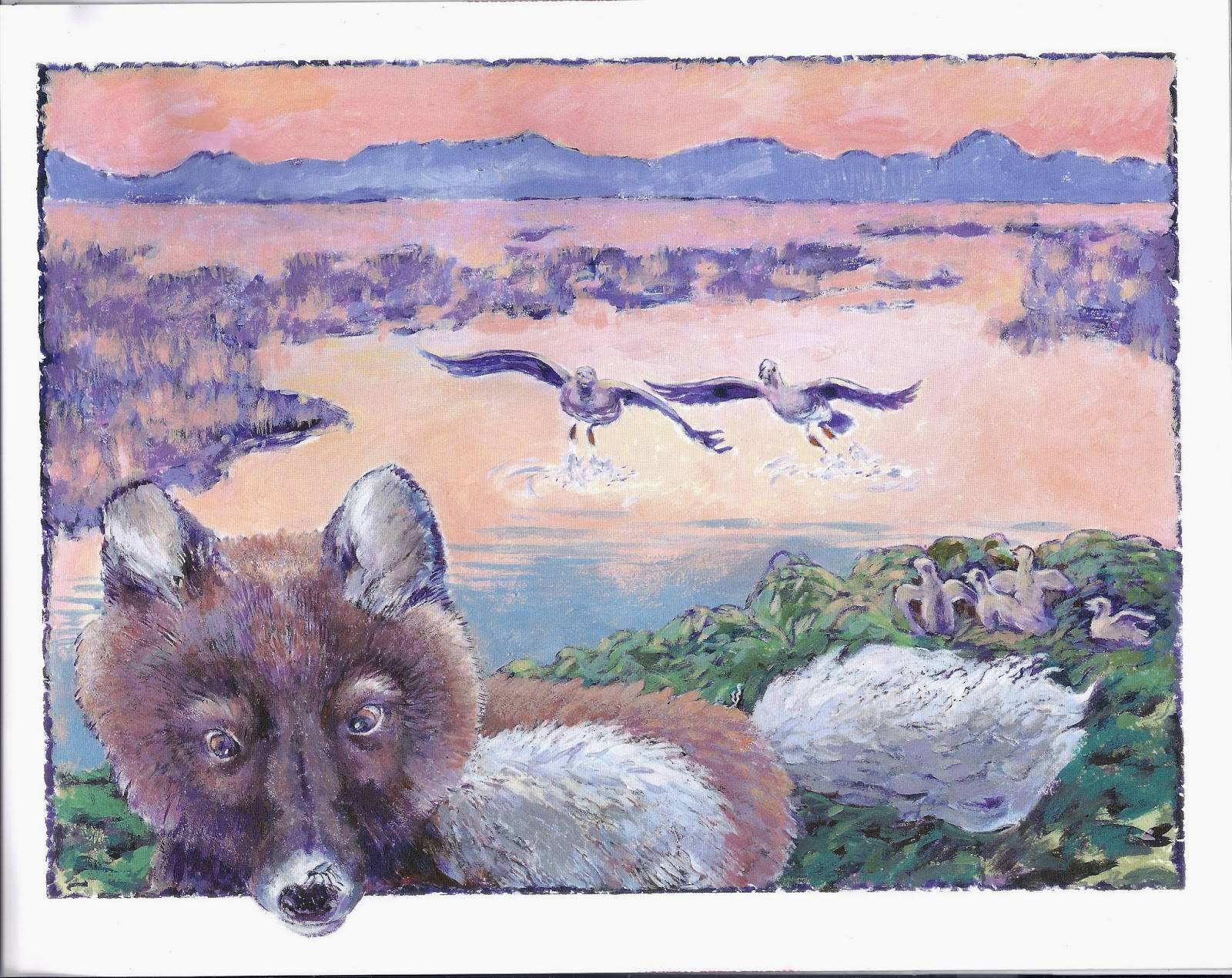
This year’s selection for the program was “Arctic Aesop’s Fables” by Juneau author Susi Gregg Fowler and illustrated by her artist husband Jim Fowler.
During March, Riverbend teachers worked with the students on a variety of learning activities across all content areas. Classes worked on everything from reader’s theaters to stop motion videos, as well as a visit and talks with the Fowlers and students. The school also worked in the book to its Science Night event.
“As the book and the fables have so much to do with animals, it was a really nice tie in with our science night — lots of hands on animal activities,” said Jenn Lanz, Riverbend Parent Teacher Organization (PTO) president. The PTO spearheaded the One School One Book Program.
Each classroom also “adopted” one of the fables, and created artistic bulletin board displays throughout the school.
“Teachers have walked their classes around the school to see all the fables ‘come to life,’” Lanz said.
One particular display the students put together that stood out to “Arctic Aesop’s Fables” author Susi Gregg Fowler was one based on “The Bat, the Bird, and the Beasts,” a fable about a fair-weather bat who continuously switches sides in the battle between birds and land animals. The moral at the end of Fowler’s version is “The pretense of friendship is no friendship at all.” The students’ interpretation took a more positive angle on the tale, rewording it as “Real friends win and lose together.”
“I wish I’d had them on my team,” Fowler said.” It’s … really the perfect moral for it.”
Another favorite of the author’s was the Riverbend students’ depiction of “The Butterfly and the Caribou,” which displayed a group of butterflies surrounding the indifferent ruminant’s antlers (the moral of the story being “We are not always as important as we may think”).
“I thought it was so beautiful; it kind of took my breath away,” said Fowler.
“Arctic Aesop’s Fables” was a cooperative project by the Fowlers. Both Fowlers have worked on various publications and authored books both together and separately. “Arctic Aesop” marks their seventh joint collaboration. In it, 12 stories credited to Aesop (the Ancient Greek fabulist whose authorship — and existence — is debatable), often depicting anthropomorphic animals framed around a proverb or lesson, were reset in the arctic and subarctic, and paired with an illustration evocative of the tale being told.
When she was asked to write a piece about what it was like to work with her husband on their projects, Fowler said that the work was as complex as an intimate relationship.
“Basically my statement was it was kind of like marriage, you know, on the good days, there’s nothing like it, on the days that aren’t so good you wonder why anyone would want this job,” she said.
Making the fables accessible to a contemporary youth audience was an important goal for Fowler. While putting the book together, she pored through hundreds of Aesop’s fables, making the process for selecting a handful onerous. Some guiding criteria helped; she knew she didn’t want to pick any stories with non-human animals in it, nor any of the more disturbing ones, often involving particularly draconian morals and violent outcomes.
“I did want it to be a book either kids would read to themselves or [have] read to them,” Fowler said.
Another goal was to make it fit well and accurately represent the setting in arctic and subarctic regions. Jim Fowler has a lot of experience both in painting wildlife — including his work in the popular “Alaska Wildlife Notebook Series” for the Alaska Department of Fish and Game — as well as vast familiarity with the settings, having created paintings of plein air scenes in the arctic and subarctic for many years. Susi Gregg Fowler also did research to ensure the animal groups appearing together would actually be in the same area at the same time.
“I wanted it to be as realistic as possible given that, actually, animals aren’t usually talking to each other, as far as we know,” she said.
Fowler said that out of the stories in “Arctic Aesop’s Fables,” “The Hare and the Porcupine” is her favorite, based on perhaps Aesop’s best known fable, “The Hare and the Tortoise,” which employs the truism “Slow and steady wins the race.” Fowler also has a personal relationship with porcupines and their interactions with other species in her life.
“I have healthy respect for them because I have a dog,” she said.
Overall, Fowler was happy that the students and teachers were able to come up with so many different ways to engage and expand on the book.
“We were delighted … with what the school did with it,” Fowler said. “They were so creative.”
Last year’s selection for the school’s One School One Book was “Mary’s Wild Winter Feast” by local author Hannah Lindoff. Plans are already in the works to hold another program at Riverbend next year.
Other Big Reads:
Riverbend Elementary School’s One School One Book joins other current widespread local common reading programs. The University of Alaska Southeast (UAS) has held an annual One Campus, One Book since 2010, which has various events and curricula based around a communally read text. In 2017, UAS teamed up with the Juneau Public Libraries, which received a grant from the National Endowment for the Arts’ Big Read program, a nationwide initiative to widen “our understanding of our world, our communities, and ourselves through the joy of sharing a good book”. The selected title for the Big Read is “Station Eleven,” a post-apocalyptic novel by Emily St. John Mandel. For more information these programs, go online at http://www.uas.alaska.edu/ocob/ or https://bigreadjuneau.org/.
• Richard Radford is a freelance writer living in Juneau.
