
‘A LANDMARK ADDITION’ TO ALASKAN WRITING
BY CHELSEA TREMBLAY
For the Capital City Weekly
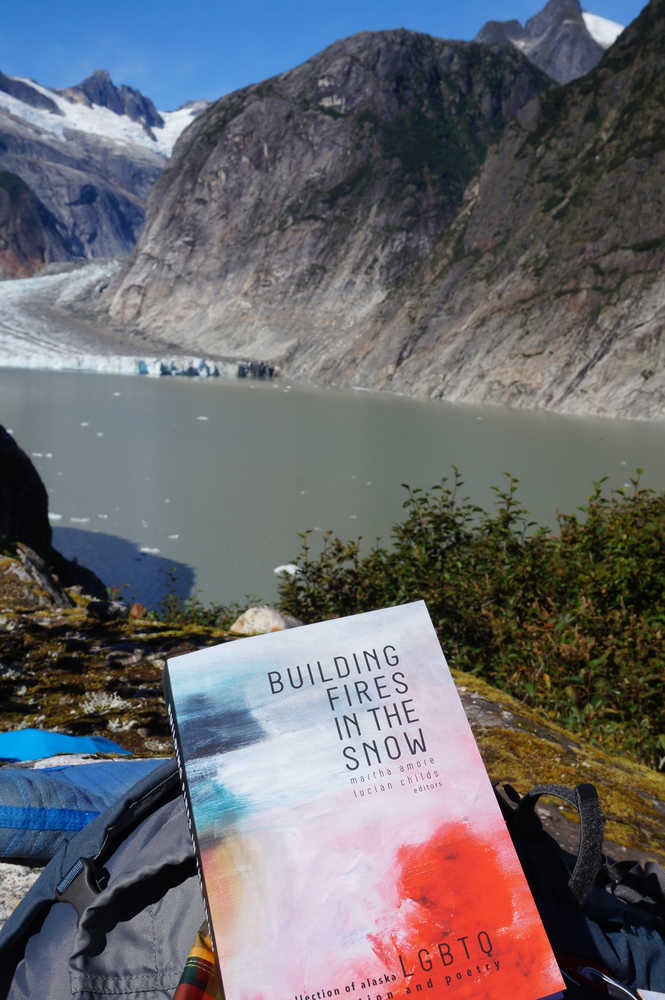
I was sitting on a mossy overlook watching Shakes Glacier up the Stikine River. This year Petersburg’s week-long Rainforest Festival included an artist excursion, during which I and four others found a secluded corner of a ridge to capture the ice in our own medium. Two artists, Pia Reilly and Joe Viechnicki, brought canvases and oil paint. I brought food, paper and pens, more coffee than water, and “Building Fires in the Snow,” edited by Martha Amore and Lucian Childs. The anthology is a collection of Alaska LGBTQ (lesbian, gay, bisexual, transgender and queer) short stories and poetry, and as a bookseller often tasked with selling the Alaskan experience, I am always looking for a complicatedly beautiful exploration of my home state.
The worlds depicted in Building Fires are not unfamiliar. The struggle that comes with building a life in the wilderness, common in much of Alaskan literature, is particularly fraught among these stories. Exposure, deadly in the wilderness, grows sharper still when people enter the picture, as the protagonist’s fate often depends on the whim of a stranger. Isolationism is a common answer, but not the only one. The obvious alternative is made lucidly beautiful by Elizabeth Bradfield’s poem “Remodeling,” in which the kindness and generosity central to building Alaskan communities shines. In Teresa Sundmark’s story “Worse Disasters,” we see how little who you love matters when contrasted with the occasional brutality of life in the north.
Above all, the anthology speaks to love. Its transcendent power and devastating ability shines through in the poetry of Amber Flora Thomas, particularly “Era of a Happy Heart,” and work from both editors are pillars of the collection. Amore’s exploration of the way we love and build families in Alaska and Childs’ depiction of the struggle to fit into a wild place encapsulate themes also present in the other works. Details can vary, but elements of the Alaskan story are the same. Our love forms in moments, maybe around the campfire, eventually cultivating a life of mutual dependence and adventure. Living on the edge means being fiercely independent while leaving room for help along the way. Community shines through as a tenderly powerful thing, not voluntary, but a method of survival through long dark winters. Love and partnership is no fairy tale, but mean comfort and strife in equal measure.
Contributions from Rosemary McGuire, Alyse Knorr and Dawnell Smith stand out, as does the poetry of Indra Arriaga, the only bilingual contribution. Stories of Anchorage during the oil boom spotlight a time from the past, and Gabrielle Barnett poignantly reckons with the aftermath. “Going Too Far,” from Mei Mei Evans, the concluding novella, highlights youthful discovery in a time of possibility. The pull between returning to the world Outside and building a life in Alaska as lyrically described by Sandy Gillespie is a constant one, which only serves to highlight one of the great limitations of the collection. As the editors note, no Alaska Native voices are represented in the book. It’s disappointing for such a landmark collection, and I’m not sure why this is the case. I understand why, in a regional literary world filled with nonfiction, the editors decided focusing on short stories and poetry was a priority. I lament the absence of Alaska Native voices even as I celebrate the words “Building Fires” contains.
The questions I brought to the glacier, and to “Building Fires,” were ones I carried with me the week before. I was kayaking with nine others down the Stikine River from Telegraph Creek, B.C. to Mitkof Island. As the current pulled us down the river my mind drifted, returning to my life in Southeast and the choices ahead as I build my version of a family. The quality of our lives in Alaska often depend on the people we surround ourselves with against the long dark. How delicate that dance is, then, when who we love and how we live can be weapons used against us. I had earlier asked the Great Glacier and the rest of the Coastal Range ice field how to carve my way. Now I was at Shakes Glacier, closer to home, asking the same question, just to find the same silence.
This anthology is a landmark addition to the Alaskan written word. The search for place, love, and adventure lie at the heart of the Alaskan experience. The lives and loves explored in these pages are the ultimate human experience, yet can keep LGBTQ Alaskans from finding employment, housing, and other elements of what we call a civilized life. Anti-discrimination ordinances in Juneau and Anchorage are incremental progress, but many, especially those living in smaller communities, are still vulnerable. The conversation has only just begun in Alaska, but “Building Fires in the Snow” has earned its place at the forefront.
• Chelsea Tremblay lives, writes and sells books in Petersburg. Visit her at ofpeopleandplaces.net.
