
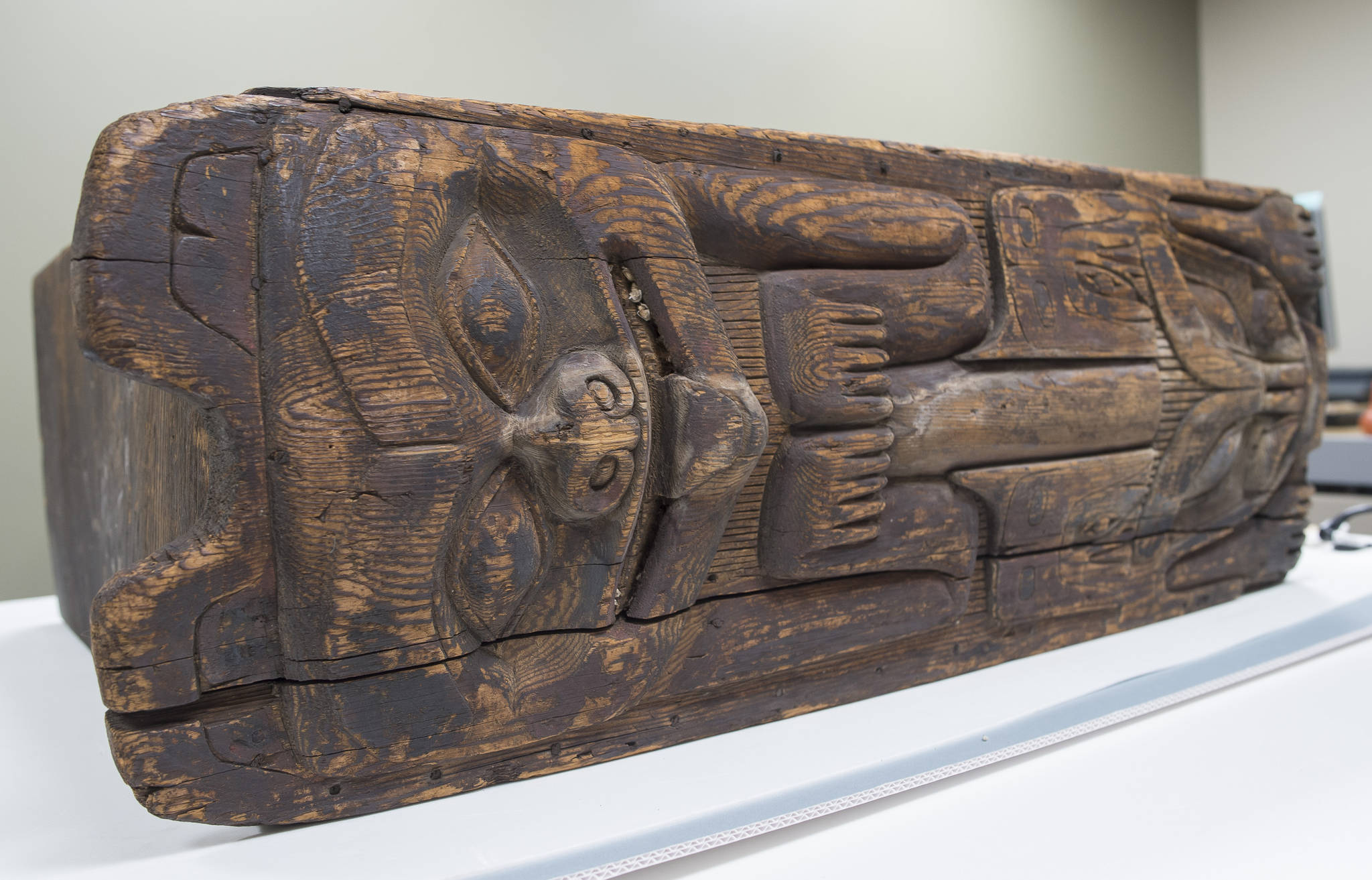
A wooden box drum that is currently undergoing restoration at Sealaska Heritage Institute on Wednesday, Oct. 18, 2017. (Michael Penn | Capital City Weekly)

A wooden box drum that is currently undergoing restoration at Sealaska Heritage Institute on Wednesday, Oct. 18, 2017. (Michael Penn | Capital City Weekly)

Re-discovering a shaman’s drum

In the basement of the Sealaska Heritage Institute is very old box drum belonging to the Mount Fairweather (Snail) house of the T’akdeintaan clan in Hoonah. In mid-October, it got some long-needed care, and the Capital City Weekly visited with those working on it to hear a bit more about its fascinating history.

The drum, which was repatriated in 2011 from the University of Pennsylvania Museum of Archaeology and Anthropology, is unique in several ways. First, it’s very old; it’s most likely the same drum depicted in geographer Aurel Krause’s 1882 book, called “The Tlingit Indians” in English, and could have been carved decades before that.

The top figure carved on the front of the drum is a bear, which could represent the T’akdeintaan’s opposite moiety, the Chookaneidi, a clan member has suggested. Alternatively, it could represent the shaman’s spirit. Its mouth is inset with fragmented teeth, like the mouths in some masks.

The bottom figure, however, is a bit of a mystery; its eyes are slanted in a way unlike that of much other formline design. Some think it may be a wolf.

It’s the faded formline on the side of the drum, however, that is especially unique.

“It’s formline nobody’s seen,” said SHI archivist Jennifer Treadway. “Right now it doesn’t look very recognizable, and it doesn’t look like contemporary formline.”

Some of the clan members who have seen it believe it’s x-ray formline — formline showing the insides of an animal, like its skeleton or ribs — which is consistent with it belonging to a shaman, as Louis Shotridge, a Tlingit ethnographer and art collector who acquired the drum for the Penn Museum in 1924, recorded.

“It commemorates the time that a T’akdeintaan shaman ‘proved his spiritual power as a shaman.’ It was carved to represent his helping spirit, which Shotridge called Adawulcan [Adawulsháan], ‘Old Man of War,’” according to information provided by SHI.

Photographer Brian Wallace will soon do infrared scanning of the drum’s sides in an attempt to more clearly see those unique, original images.

The drum is in remarkably good condition for its age, said Skagway art conservator Nicole Peters, owner of Peters Art Conservation Services. That’s a testament, she said, to the skill of its carver.

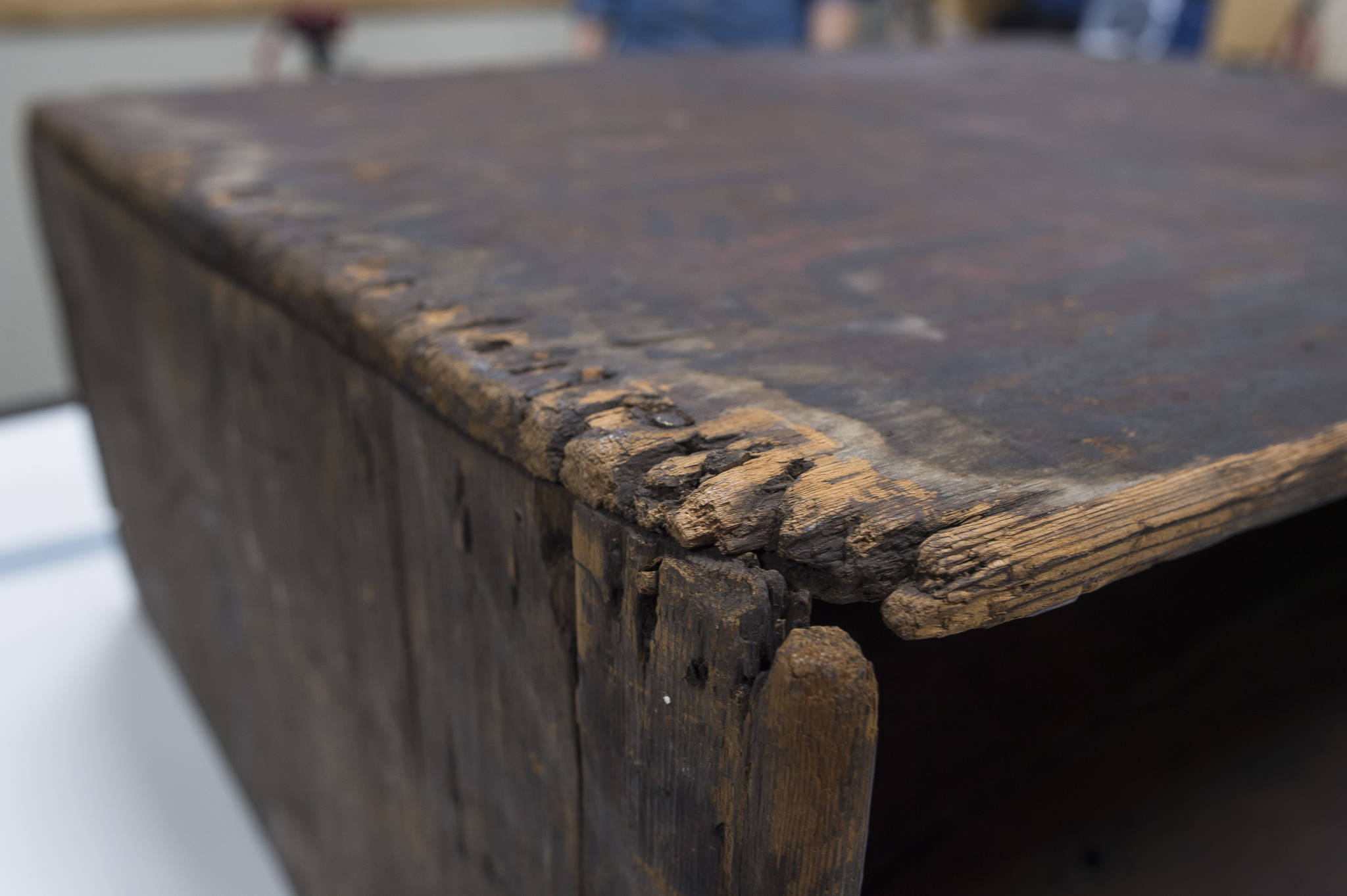
Peters on Oct. 16-18 assessed and cleaned the drum. She’s only been able to clean one side, however; they’ll need to stabilize the damaged corner before they turn it.

Box drums were either played upright or tilted back, and the damage, which is to one of the corners it would have rested on when tilted, is consistent with that, she said. The rest of what she or others will do depends, she said, on what the clan decides they’d like to do with the drum.

It may be displayed in the Walter Soboleff Building, said Smythe.

“It was an honor for me to be invited to work on such a special piece,” Peters said. “It’s really been a pleasure the last few days getting to know it inch by inch.”

“We know it’s old,” Smythe said. “It’s just amazing that it’s still in good condition. It shows the quality of the workmanship.”


• Mary Catharine Martin is the managing editor of the Capital City Weekly.
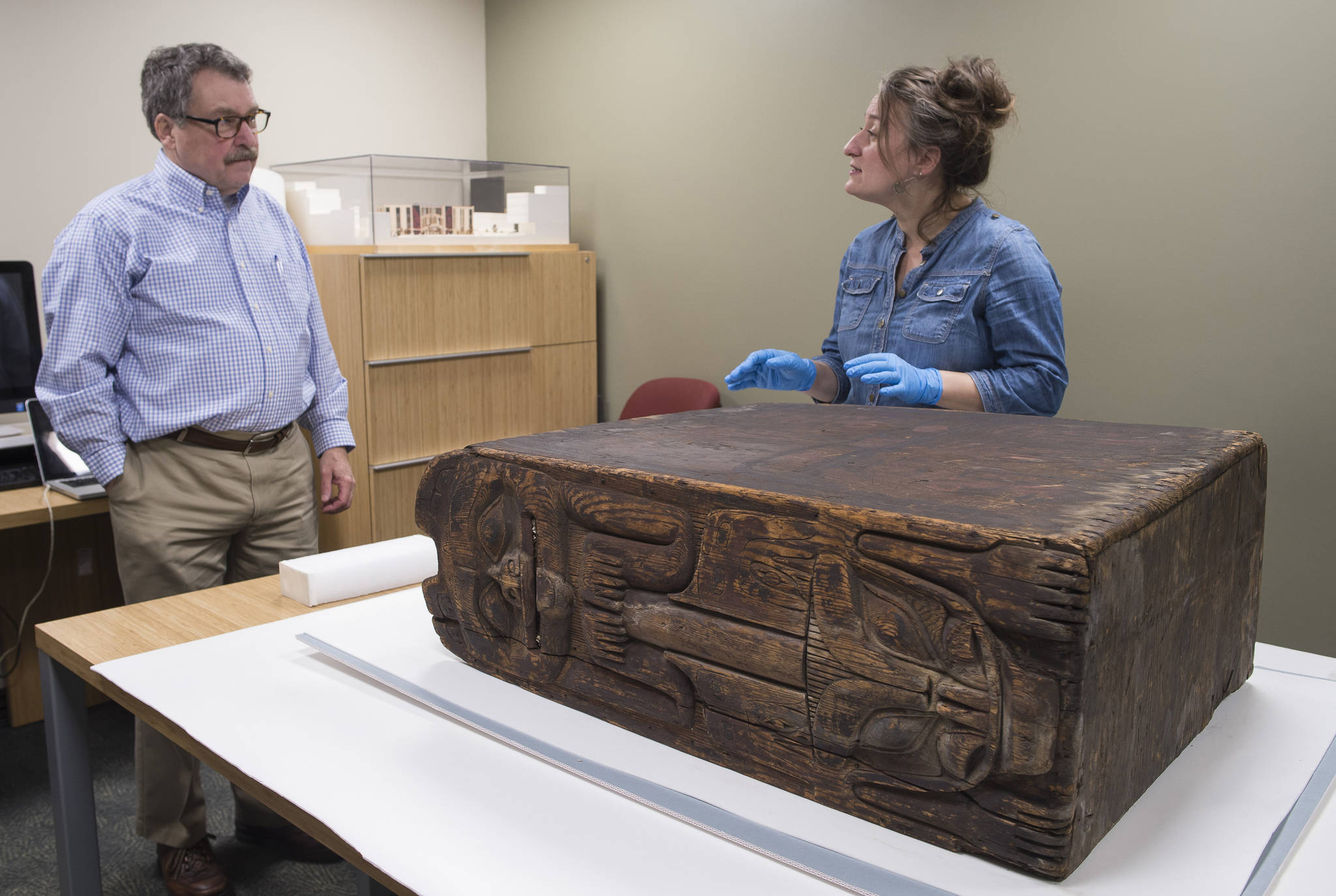


Chuck Smythe, Ph.D. History and Culture Director for Sealaska Heritage Institute, and Nicole Peters, an arts conservator from Skagway, talk about a wooden box drum that is currently undergoing restoration at SHI on Wednesday, Oct. 18, 2017. (Michael Penn | Capital City Weekly)
Chuck Smythe, Ph.D. History and Culture Director for Sealaska Heritage Institute, and Nicole Peters, an arts conservator from Skagway, talk about a wooden box drum that is currently undergoing restoration at SHI on Wednesday, Oct. 18, 2017. (Michael Penn | Capital City Weekly)

Damage to a wooden box drum that is currently undergoing restoration at Sealaska Heritage Institute on Wednesday, Oct. 18, 2017. The drum, which is from the T’akdeintaan clan of Hoonah, was repatriated in 2011 and is believed to have belonged to a shaman. (Michael Penn | Capital City Weekly)

Damage to a wooden box drum that is currently undergoing restoration at Sealaska Heritage Institute on Wednesday, Oct. 18, 2017. The drum, which is from the T’akdeintaan clan of Hoonah, was repatriated in 2011 and is believed to have belonged to a shaman. (Michael Penn | Capital City Weekly)

More in Neighbors

Fred LaPlante serves the Juneau community as the pastor of the Juneau Church of the Nazarene. He is passionate about encouraging others to see life more clearly through faith in God’s Word.
Living and Growing: Love listens first

‘Loving people well requires more than speaking clearly; it requires listening carefully.’

Weekly events guide: Juneau community calendar for Feb. 9 – 15
Juneau Community Calendar

Weekly events guide: Feb. 9 – 15

Jeff Lund/contributed
The author would rather fish for steelhead, but he’ll watch the Super Bowl.
I Went to the Woods: Super Bowl spectacle

At some point on Sunday, dopey characters, hopelessly addicted to Doritos, will… Continue reading

Peggy McKee Barnhill (Courtesy photo)
Gimme a Smile: How much snow can one backyard hold?

Snow, snow, everywhere, and no place to put it!

The Spruce Root team gathers for a retreat in Sitka. Spruce Root, is an Indigenous institution that provides all Southeast Alaskans with access to business development resources. (Photo by Lione Clare)
Woven Peoples and Places: Wealth lives in our communities

Sustainable Southeast Partnership reflects on a values-aligned approach to financial wellness.

calendar
Weekly events guide: Juneau community calendar for Feb. 2 – Feb. 8

Visit Juneau Arts and Humanities Council at JAHC.org for more details on this week’s happenings.

Actors in These Birds, a play inspired by death, flowers and Farkle, hold ‘flowers’ during a performance at the UAS Egan Library on Saturday, Jan. 31. (photo courtesy Claire Richardson)
Living and Growing: Why stories of living and dying in Juneau matter

What if we gave our town a safe space to talk about living and dying with family and friends?

calendar
Weekly events guide: Juneau community calendar for Jan. 26 – Feb. 1

Visit Juneau Arts and Humanities Council at JAHC.org for more details on this week’s happenings.

Courtesy photo
Adam Bauer of the Local Spiritual Assembly of Bahá’ís of Juneau.
Living and Growing: Surfing into the future

Many religious traditions draw strength from the past.

calendar (web only)
Weekly events guide: Juneau community calendar for Jan. 19-25

Visit Juneau Arts and Humanities Council at JAHC.org for more details on this week’s happenings.

(web only)
Weekly events guide: Juneau community calendar for Jan. 12-18

Visit Juneau Arts and Humanities Council at JAHC.org for more details on this week’s happenings.

Four members of the Riley Creek wolf pack, including the matriarch, “Riley,” dig a moose carcass frozen from creek ice in May 2016. National Park Service trail camera photo
Alaska Science Forum: The Riley Creek pack’s sole survivor

Born in May, 2009, Riley first saw sunlight after crawling from a hole dug in the roots of an old spruce above the Teklanika River.