
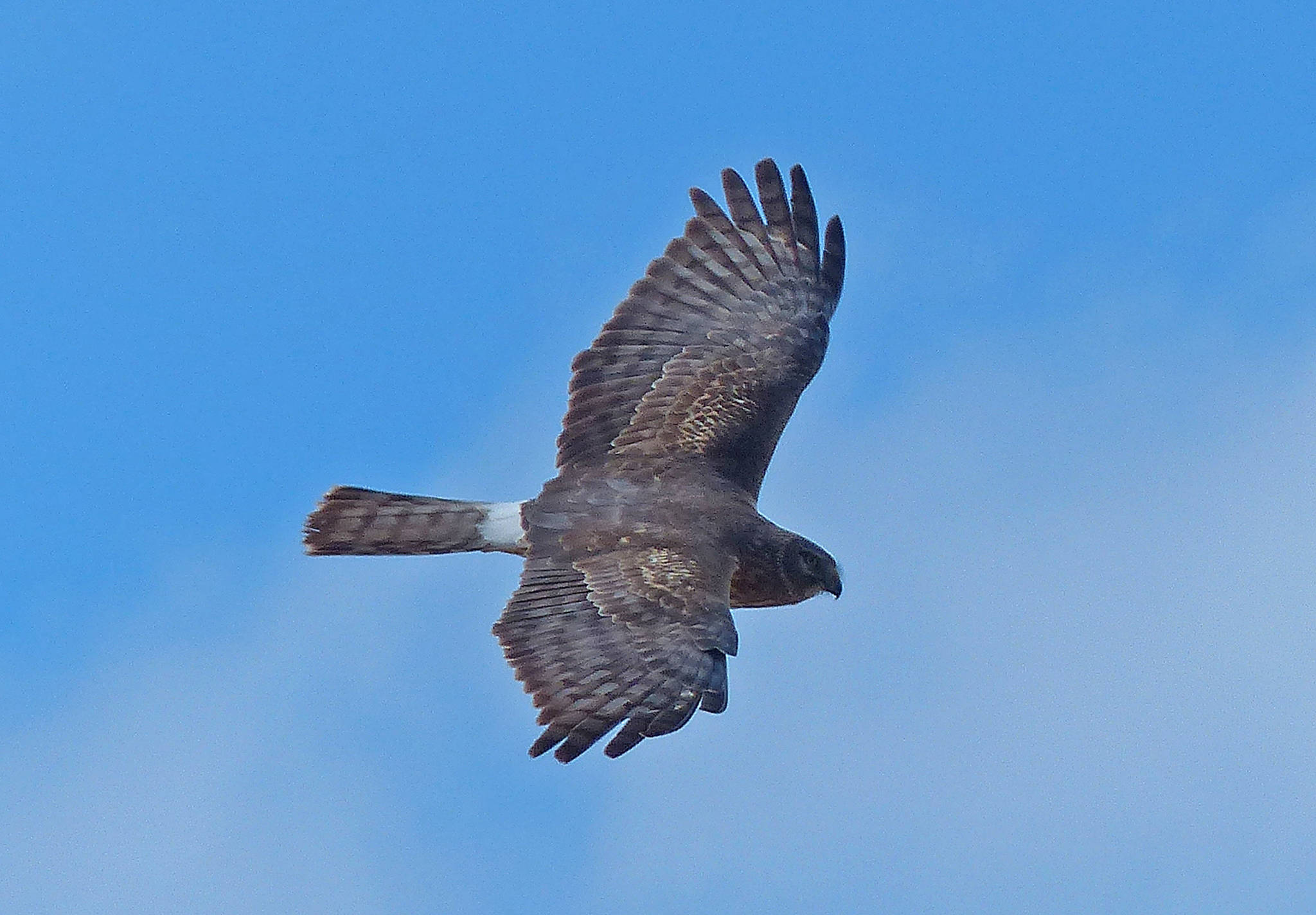
One day in mid-September, I was perched on a rocky outcrop high on the side of Gold Ridge. Despite the hopeful forecast of clearing skies, the ridge was shrouded in low-hanging clouds and, below the ridge crest, thick patches of cloud drifted slowly by. Between the patches just above my head, I saw a fast-moving silhouette — long wings, long tail — that quickly disappeared into the next cloud patch. As I turned to look in a different direction, two small shapes emerged from a cloud and vanished rapidly into another.
Beautiful and somewhat magical!
Gold Ridge is a good place to witness the annual southward migration of raptors in the fall. September is usually the best month, although the migration season extends to August and October. On the day I was watching, the clouds made identification of each bird challenging — a quick glimpse of a silhouette isn’t much to go on. But I guessed that the first bird was a northern harrier and that the other two were sharp-shinned hawks.
Over the years, I’ve seen several kinds of raptors up here, winging south to their wintering grounds. They come in ones and twos, not in flocks. Harriers and sharpshins are regularly reported by various observers, along with merlins, a small falcon.
By the way: falcons are no longer classified with the hawks, although they are all known, informally, as raptors (from the Latin word for ‘to seize’— they commonly catch prey with their feet, unlike other birds). Molecular data have shown that falcons are distantly related to — parrots (!). Although both hawks and falcons are day-flying raptors (unlike most owls), they typically hunt in different ways. Falcons, with narrow, tapered wings, are pursuit predators, chasing after their prey (and, in the case of the peregrine, diving) at high speed, sometimes for quite some distance. Hawks have broader wings and typically hunt either by ambush and short chase or by searching and swooping down over prey in an open field.
Sharpshins are typically hunters in the forest, but on migration above timberline, they would happily chase a migrating songbird, if they saw one. Harriers are hawks of open country, generally nesting and foraging over meadows and wetlands. They too might snag an unwary songbird or mouse in the open alpine zone. Merlins nest in wooded areas (using old crow or hawk nests). Back in the 1920s, an early ornithologist found them chasing songbirds on Gold Ridge, and I once watched one pursue a sparrow deep into the subalpine thickets up there (and miss).
All three of these relatively common timberline migrants nest at least occasionally around here. But they also nest farther north and many of those birds that we see on the ridge probably started with migratory flight at some distance from Juneau. Some of them may not leave Southeast at all, but most are likely to winter in the southern U.S., Mexico, and Central America. However, there seem to be no specific data from marked individuals that would tell us exactly where our nesting raptors go for the winter.
In addition to those three species, which are most commonly reported, several other raptor species are seen occasionally on the ridge in fall. Osprey and peregrines come from the Interior. Red-tailed hawks, goshawks, kestrels, and golden eagles sometimes nest here but also arrive from farther north. We always see bald eagles, of course, and some of them go south for the winter, but I suspect that many of them delay departures until after September, when the salmon runs are finished.
The raptors migrating over Gold Ridge are not sufficiently numerous for people to stage an annual festival; such celebrations occur in several places across the continent, where the number of raptors is extraordinarily high at certain times. In Alaska, the Gunsight Mountain raptor concentration occurs in April, when the raptors come back to the Interior to nest. Gold Ridge is ‘small potatoes’ compared to such sites. Nevertheless, it can be great fun to watch for the next hawk or falcon to come zooming around a corner or out of a cloud.
Thanks to Gus van Vliet for helpful consultation.
• Mary F. Willson is a retired professor of ecology.
