
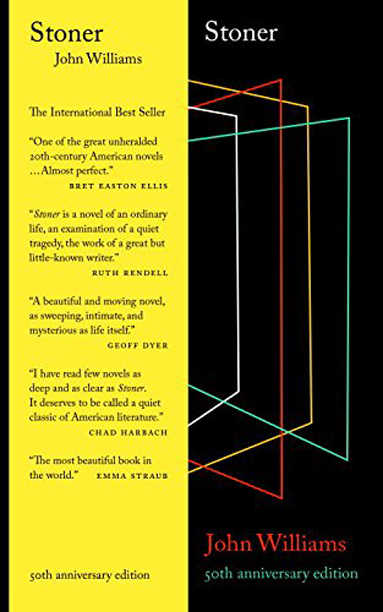
I bought this book because it was pretty and I was pleasantly surprised to find it was also wonderful.
The 50th anniversary edition is in a nice minimalist brown with colored trapezoids and — is this a publishing trend? I’ve gotten at least three books lately with these little wrap-around strips — a little slip of bright yellow paper hugging the cover so they don’t have to muck up the design with all those messy blurbs and promotions. I can get behind this trend: it doubles as a bookmark.
I originally hesitated because I thought it might be about a pothead, but no, it’s about an English professor named Stoner, William Stoner.
The life story of a man who — on the surface — doesn’t seem to do much (he goes to college, discovers literature, and stays at the same college teaching for the rest of his life) but the small, otherwise insignificant scenes are charged with such unbearable tension and meaning that I didn’t want it to end.
I found his neurotic wife fascinating, his battles with his inter-departmental nemesis all the more terrifying for the smallness of the stakes, and his brief love affair uplifting.
Two things in particular struck me. The first is the book’s take on the relationship between scholarship and warfare. World War I breaks out while Stoner is a graduate and war-fever sweeps the campus, students and professors joining up right and left. When Stoner goes to tell his advisor he’s decided to join too, this is what the advisor has to say:
“A war doesn’t merely kill off a few thousand or a few hundred thousand men. It kills off something in a people that can never be brought back. And if a people goes through enough wars, pretty soon all that’s left is the brute, the creature that we – you and I and others like us – have brought up from the slime. The scholar should not be asked to destroy what he has aimed his life to build.”
I’m not sure if I agree, but I found it interesting to think about. The argument of whether the study of the humanities makes us better people and citizens has seemed to die down in recent years and we no longer ask what is it exactly that higher learning contributes to our nation. It’s certainly not job-preparedness (as this Bachelor of Liberal Arts can vouch). Could it be the opposite of whatever in us thirsts for war?
The second thing hit closer to home as a book reviewer: Stoner’s inability, as an English professor, to communicate his love of literature to his students. “The love of literature, of language, of the mystery of the mind and heart showing themselves in the minute, strange, and unexpected combinations of letters and words, in the blackest and coldest print. … Those things that he held most deeply were most profoundly betrayed when he spoke of them to his classes; what was most alive withered in his words; and what moved him most became cold in its utterance.”
My own words too frequently fall short in describing the experience of these other words, the author’s words, and I feel I do you, the reader, a disservice and yet I keep trying. For I, like Stoner, am a hopeless literary evangelist.
And so, to aid my efforts, let me add the words of two other reviewers to my purpose: “Stoner” has been called by no less a person that Bret Easton Ellis “almost perfect.” The New York Times Book Review went even further, writing “John Williams’s Stoner is something rarer than a great novel — it is a perfect novel, so well told and beautifully written, so deeply moving, that it takes your breath away.”
The question of what might make a novel perfect is one we’re not going to go into here (How would I even judge that?) but there you have it, from two cultural authorities. If perfect’s what you want, John Williams’ “Stoner” is a good place to go looking for it.
