
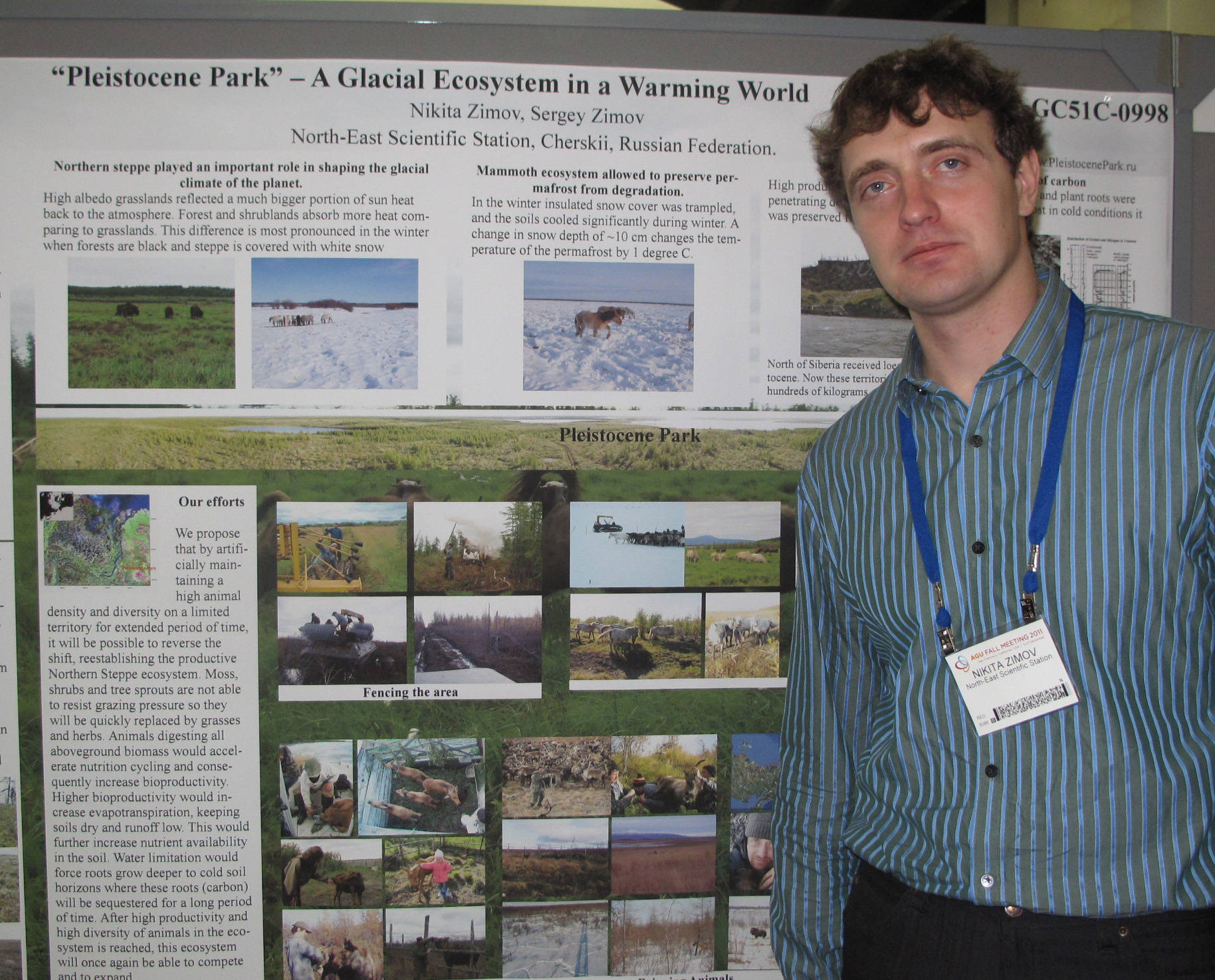
More than 700 donors believe in an attempt to recreate the ice age in Siberia. The operators of Pleistocene Park have raised more than $100,000 in a crowdfunding effort to bring bison and yaks to eastern Russia. The creators think the animals will help convert tundra to ancient grasslands that will slow global warming.
An Alaska researcher has visited Pleistocene Park five times. He has an affection for the directors and an admiration for their lofty mission: “Turning the Arctic into a northern Serengeti and stopping permafrost degradation on a big scale.”
Colin Edgar is a research technician at UAF who works on devices that measure greenhouse gases wafting from the tundra. He installs, fixes and gathers data from carbon dioxide and methane meters near Toolik Field Station and Bonanza Creek Experimental Forest in Alaska. Until funding fell off, he also traveled on occasion to Pleistocene Park.
Edgar’s trips from Fairbanks to the North-East Scientific Station in Cherskiy, Russia, took four days. The station, a center for scientists visiting far eastern Siberia, is the jumping-off point for Pleistocene Park.
Pleistocene Park is a 50-square-mile fenced-in swath of tundra and larch trees in lowlands off the Kolyma River. There, Nikita Zimov leads a project to restore the northern ecosystem that existed at the time of the mammoths. His father, Sergey Zimov, envisioned and initiated Pleistocene Park.
The Zimovs are bringing in large, cold-adapted creatures descended from those that roamed the landscape during the last ice age, which ended about 11,500 years ago. In adventurous missions to other parts of Russia, they have retrieved reindeer, musk oxen, horses, bison and elk.
As these animals graze the tundra in winter, they pack down snow and lessen its insulating qualities. In this way, the Zimovs want to preserve the permafrost by increasing its exposure to cold winter air. They also hope their large herbivores will trample trees, shrubs and moss, restoring the mammoth steppe ecosystem.
The mammoth steppe once extended across the top of the globe, covering much of Alaska and the Bering Land Bridge. When mammoths disappeared, the modern boreal forest and its relative paucity of animals emerged.
From ice-age bones they have found in eroding river bluffs, the Zimovs estimate 30 large grass-eaters roamed a typical square kilometer of the mammoth steppe during the Ice Age. This is the density they are trying to reproduce at Pleistocene Park.
The Zimovs’ dream is an eventual expansion of their experiment across the circumpolar north.
In Edgar’s visits to Pleistocene Park, he worked on the tundra-gas measuring equipment that showed what observations in northern Alaska are showing: the tundra is now acting as a slight source of carbon dioxide to the atmosphere.
“It remains a very relevant scientific question,” Edgar said of having the station in Russia. “What’s happening in Siberia (where the permafrost is one mile thick in places)? We know so much less about the ecology there.”
Edgar enjoyed working with Nikita Zimov and others at the outpost, which resembles a much smaller, more rustic Toolik Field Station. The North-East Scientific Station offers scientists rooms, meals, a Russian-style sauna and free vodka and beer.
Pleistocene Park is 25 miles down the Kolyma River from the station. Zimov ferried Edgar and others in a riverboat. Edgar maintained the gas-measuring equipment, mounted on a tall metal tower. He also assisted with other projects in the park.
Edgar once helped capture reindeer from northern Siberia and transport them back to Pleistocene Park by riverboat.
He remembered when the boat could not proceed that morning because of dense fog. The Zimovs pulled to a riverbank. There, they smoked cigarettes and played cards, waiting for the fog to lift.
After an hour, conditions did not improve but they started upriver anyway. Edgar and another helper stood on the front of the boat to squint for obstacles. He called the progress “terrifying.”
On the way, the boat engine overheated. An alarm beeped, and the Zimovs pulled back the engine cowling to add cooling river water.
This continued for the rest of the trip. On the return, with the boat full of a dozen reindeer, they could not reach the engine when it overheated. They cut the engine and let the boat drift.
They made it to Pleistocene Park. There, they released the reindeer. By then it was nightime, but the Zimovs continued the 25 river miles back to the science station. Edgar remembers a “super terrifying” ride through the darkness.
For the Zimovs, it was mission accomplished.
“It was this 16-hour day of extreme adventure,” Edgar said. “But that’s like every day for them.
“They have a lot of tenacity to keep at this even though there’s a lot of people who doubt them,” Edgar said.
He thinks the Kickstarter money will help the Zimovs make more trips and continue “rewilding” Pleistocene Park.
“That’s really going to go a long way,” he said. “They do so much with so little.”
• Since the late 1970s, the University of Alaska Fairbanks’ Geophysical Institute has provided this column free in cooperation with the UAF research community. Ned Rozell is a science writer for the Geophysical Institute.
