
We awoke just after midnight to a pounding on our door. My slightly inebriated fisherman neighbor, who is moored on another finger, anxiously informed us there was a tsunami warning and we needed to get to higher ground. My partner and I live on our boat in Sitka’s harbor. My neighbor said he was going to grab his gun, his chainsaw, his sleeping bag, his dog, and head for the woods. I closed the door, turned to my partner and said, “We gotta go right now.”
I don’t know how much time we took to get ready, but it felt much too long. I was exceptionally unprepared. We’d been so busy fixing up our liveaboard boat this past year that we’d neglected to have an emergency bag ready. It was taking too long to put on all our cold weather gear, and it was going to be a long walk down the dock. Typically, on a good summer day, let alone in freezing weather on a float covered in ice, it takes 8 to 10 minutes to walk all the way from our boat to the parking lot. I finally said, “I don’t need anything else. Just you and the dogs. If a tsunami comes, we need time to get to higher ground, especially when we don’t know how much time we have.”
We were a quarter of the way down the dock when the tsunami sirens began ricocheting off the mountains. Followed by: “Warning! Warning! A possible tsunami is threatening the Sitka area! Do not wait! Evacuate to high ground immediately! Repeat, evacuate to high ground immediately!” I didn’t want to show my partner how afraid I was, but my heart was beating fast. How did my neighbor know about the tsunami before the city’s warning system?
As we ran down the dock with our two dogs I hoped there would be no tsunami. I hoped we were getting out of bed for nothing, and tomorrow we’d be tired from sitting on a hill waiting for a tsunami that never came. The dock moved a little as we ran, enough to make my heart jump into my throat.
As we continued running down the dock I thought of the village of Chenega. I thought of people whose families were taken from them as they ran from the tsunami caused by the Good Friday Earthquake in 1964. On average, Alaska experiences a magnitude 7 earthquake every year, a magnitude 8 earthquake every 14 years, 50-100 earthquakes a day, 400-700 a week, 1,000-3,000 a month, and 24,000-35,000 a year. I come from a history of earthquakes and tsunamis. I know their power. Alaska has a spirit that is not only loved, but also respected and feared. My cousin, Jerry Hibner, died on the dock in Valdez when the 1964 tsunami hit. For a split second I envisioned losing my partner this way.
When we finally arrived at our car I asked my partner, “Where do you want to go? The high school is the closest tsunami evacuation center. If a big tsunami comes, it will still hit it.” I briefly explained the safest bet was Harbor Mountain Road, but if the tsunami was close, we wouldn’t make it. There was always the possibility we could get there and discover a locked gate and we’d be unable to travel up the hill. Should we risk it? We quickly decided on Harbor Mountain, as far away from sea level as possible.
We turned out of the harbor parking lot, and before the stop light, my phone rang. It was our friend. “What do I do? We don’t have a car,” they said.
“We’ll be there in a minute. Be ready,” I responded. My partner and I rushed into her house and helped grab her emergency bags. We explained we didn’t have an emergency bag, that we only had dog food, a blanket, chips, and vodka. Our friend takes care of a handicapped young man. They are prepared for everything. He was frazzled from being woken up suddenly, but he knew we had to hurry, so he was helping.
We piled into our car, but we had taken too long. If a tsunami was heading our way, we definitely wouldn’t be able to make it to Harbor Mountain. We drove to Sitka High School, a closer evacuation area. In the high school parking lot, we passed the time in our car trying to get Facebook updates about the tsunami. We tried Sitka Chatters, our local Facebook community page; we tried the Kodiak Police Department page; and we even tried friends and family. Cell service was at a standstill. We turned on the radio. Eventually the BBC said the tsunami warning was now canceled for Alaska and the west coast of the United States, so we headed back to our friend’s; but as we pulled into the driveway, and got out of the car, the sirens started again, followed by the warning to move to high ground.
By now everyone was tired. We wanted to ignore the second siren. I reasoned, “Most likely the tsunami’s not coming. But if it is, we can’t come back from making the decision not to head to high ground.” So we got back in the car and this time we drove to the top of Edgecumbe Drive, a high-elevation street.
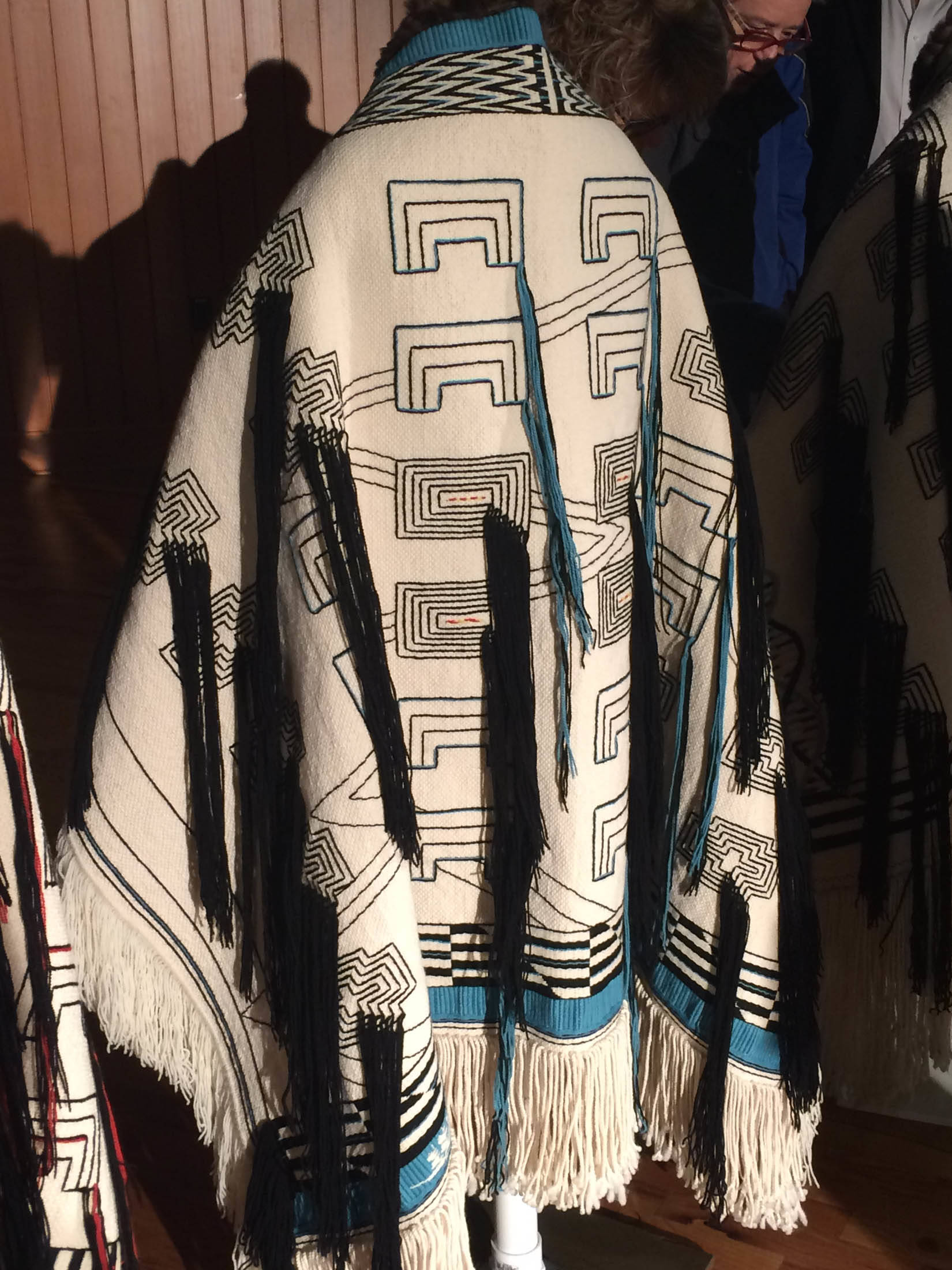
As we sat at the top of Edgecumbe Drive waiting for the tsunami that might or might not arrive, I thought about how tsunamis and earthquakes are a part of the story of who I am. I am Tlingit. I am Raven from the T’akdeintaan clan. We are connected to Lituya Bay and to tsunamis and earthquakes. My cousin Teri Rofkar wove both a 1964 Earthquake raven’s tail robe and a Lituya Bay raven’s tail robe. The Lituya Bay Robe has the seismograph woven to scale in it, and represents the mountainous area carved out by the tsunami. In 1958, the Lituya Bay tsunami was caused by an earthquake measuring 7.8 on the Richter Scale, XI on the MM scale (XII is total devastation). The quake threw 90 million tons of earth into the ocean, causing the largest tsunami ever recorded: 1,720 feet. My uncle and cousin were among the few miraculous survivors. As we waited I envisioned my uncle and cousin, on their fishing boat, riding out the giant wave. I shuddered. I drove through a 7.9 earthquake near Tok in 2002. I have seen concrete ripple like waves. I kept these thoughts to myself in the car.
It was a long night. We didn’t get back to the boat until after 4 a.m. As I lay there going to sleep, I thought about what I needed to put in my emergency bag. I was not going to be unprepared the next time. In Alaska we know there will always be a next time. I am grateful for tsunami sirens. I am grateful for friends. I am grateful for being tired at having spent hours on a hill waiting for a tsunami that never came.
• Vivian Mork Yéilk’ shares the Planet Alaska column with her mother, Vivian Faith Prescott.
