
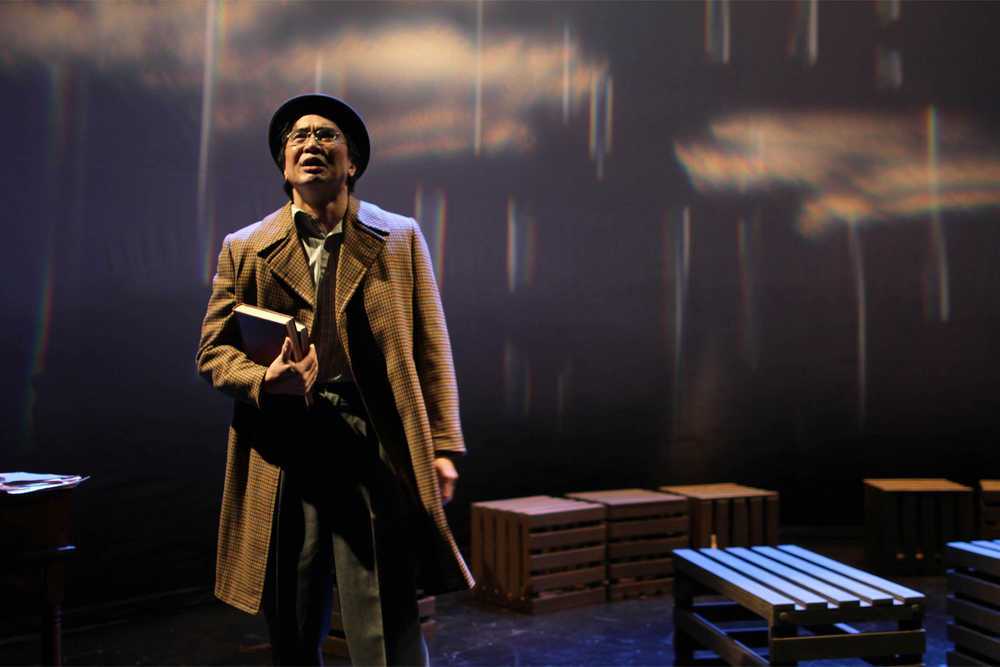
Last year, when Perseverance Theatre selected “Hold These Truths” for the 2016-17 season, it could hardly have been more prescient.
Instructive, entertaining and thought provoking in any context, “Hold These Truths” takes on a whole new significance opening ten days after Election Day. Echoes of stories in the current news cycle are unmistakable, specifically proposals for ethnic registries and mass deportations, as well as the sudden, unexpected ascendency of politicians who champion these policies.
Would I have found this play equally impactful had the swing states swung differently two weeks ago? I can’t say; but it certainly would’ve been less scary.
“Hold These Truths” is a simple but stunning solo play in one long act, written by actor and playwright Jeanne Sakata and directed by Leslie Ishii.
Despite the odd fictional embellishment, Sakata’s script is inspired by and based on the true story of civil rights hero Gordon Hirabayashi, one of only three Japanese-Americans to defy a presidential order authorizing the forcible removal and mass incarceration of all people of Japanese ancestry on the West Coast during World War II. By the way, he was a U.S. citizen. By birth.
For his refusal, Hirabayashi—then a college student and conscientious objector to the war—was jailed, tried and sentenced. But, in his own words, he “could not give up on the Constitution.” So he appealed. And in 1943 his case reached the Supreme Court, which unanimously upheld the conviction. That same year, Hirabayashi also refused to complete a loyalty questionnaire, again, challenging its constitutionality. This earned him additional jail time. Then, some 40 years later, legal historian Peter Irons uncovered military documents, letters and memos proving the internment of Japanese Americans was an unnecessary security measure owing largely to racism and hysteria (sound familiar?). In 1987, Hirabayashi’s conviction was overturned; in 2012, President Barack Obama posthumously awarded him the Presidential Medal of Freedom.
Fresh from a Broadway debut in “Allegiance,” actor Greg Watanabe nimbly portrays Hirabayashi’s principled stand against both the government and the country’s prevailing sentiment of fear—“I seek to live such that the ought-to-be is.” During the play’s 98 fast-paced minutes (no intermission) Watanabe also assumes the role of other characters from the story, including his parents and friends, lawyers, judges, police officers, army brass and even several Supreme Court justices.
The stage itself provides few places to hide, with a purposefully sparse scenic design by Akiko Nishijima Rotch, derived in part from traditional Japanese Kabuki theater.
This minimalism forces the actor—and audience—to fill in the blanks. Under Ishii’s crisp direction and using little more than a few wooden crates and a battered suitcase, Watanabe evokes the entire life of this bookish, unassuming hero, from Hirabayashi’s early childhood on his parents’ Washington State farm all the way through his successful career as a sociologist.
In one memorable scene, Hirabayashi offers to serve a longer sentence and pay his own way to Arizona simply so he can serve his jail time outside in a prison camp. When he shows up, he’s told he’s free to go, but Hirabayashi knows differently—he’ll never be truly “free” until the government recognizes, admits and fixes a serious constitutional transgression.
In a broader sense, “Hold These Truths” explores the formation and impact of large cultural ideas in America. The play strives toward a deeper understanding of our triumphs through direct confrontation with our failures, as well as the courage of one person to stand up to—and triumph over—anything, even if that “anything” is his own government, and victory takes more than four decades to achieve.
What makes a patriot? What constitutes heroism? How can you reconcile a country’s betrayal with your own passionate belief in that country?
But perhaps the most important question stems from the play’s title, itself, which comes from the second line of the United States Declaration of Independence:
“We hold these truths to be self-evident, that all men are created equal, that they are endowed by their Creator certain unalienable Rights, that among these are Life, Liberty and the pursuit of Happiness.”
What happens when these truths are no longer self-evident? What happens when those entrusted to uphold the country’s ideals use their positions to deprive some “men” of these “Creator”-given rights? Doesn’t that undermine the entire American moral standard? And for what, exactly?
Because while Hirabayashi’s story is uplifting, it bears remembering that only three people refused to comply with Executive Order 9066 out of 120,000 Japanese Americans interned. And the order itself, which allows the President and top officials to impose “military zones” without Congressional approval, has yet to be overturned.
That, my friends, is scary.
Geoff Kirsch is a Juneau-based writer, now offering one-on-one writing coaching and editing in fiction, non-fiction, humor and memoir. This holiday season, give the gift of writing to the aspiring author in your life. Contact: geoff@geoffkirsch.com.
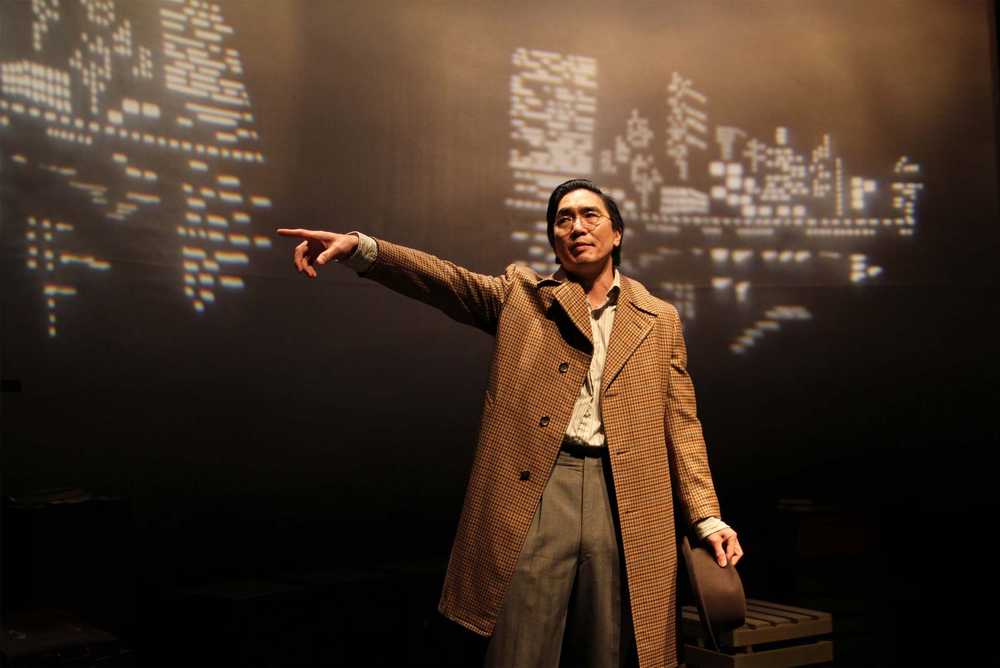
A young Gordon Hirabayashi is in New York City to attend a YMCA leadership conference, as portrayed by actor Greg Watanabe.
