
Editor’s note: This is part one of a two-part series.
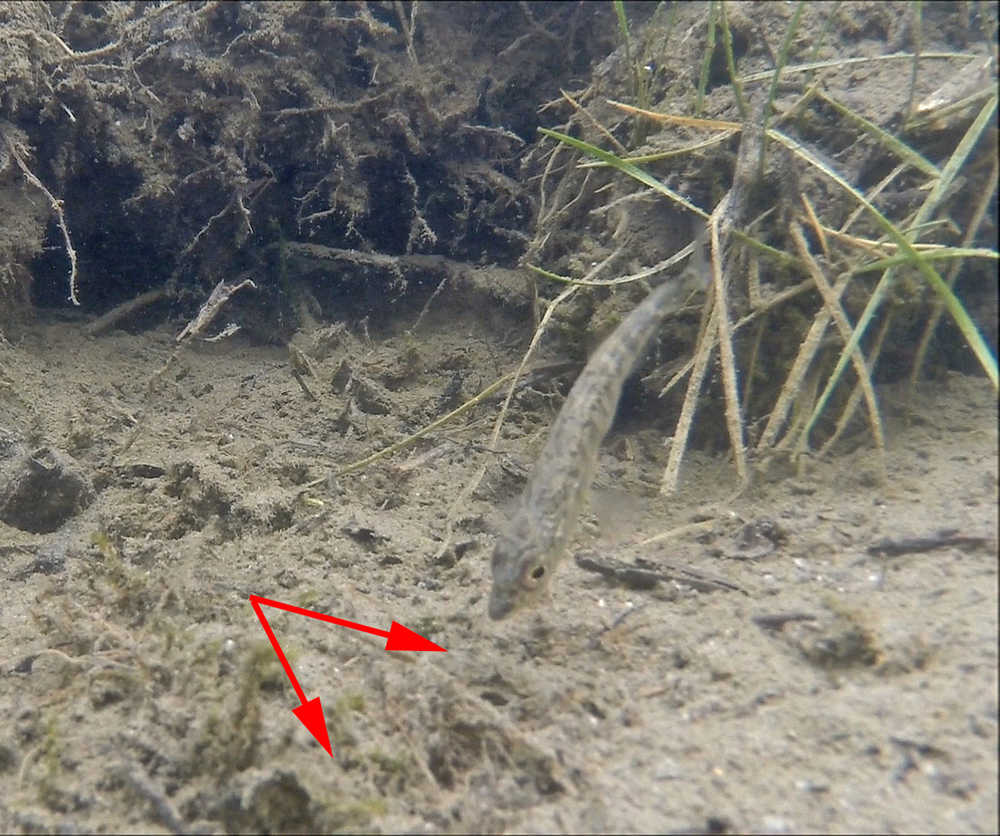
Some months ago I was captivated by a grunt sculpin at the NOAA lab, and I learned that males of this species commonly guard their mate’s eggs. When it is time for the eggs to hatch, the parent takes up the eggs in his mouth and spits them out into the water column, where the eggs membrane breaks and the hatchlings are freed. Then I saw a video of a male three-spined stickleback guarding his nest from all comers on naturalist Bob Armstrong’s website, naturebob.com; that video is attached to the online version of this article, and the accompanying photo is taken from it. And all that prompted me to think more about paternal care, particularly among vertebrates. In some species either parent or both parents may be involved with parental care, but here I am concerned chiefly with vertebrate species in which males are the sole caregivers (it happens among the invertebrates too, but that’s another story). Strictly paternal care is generally less common than strictly maternal care, except in fishes, among which fatherly care is more common.
The more I thought about it, and the more I read on the subject, the more it seemed necessary to divide this article into two parts, so as to cover some of the fascinating variation that is found concerning how males care for their young. In general, solo-male parental care among fishes is considered to be best developed in freshwater and small-bodied species; among both fishes and amphibians, it is most common in species with external fertilization of the eggs. Although the evolution of fatherly care has been much discussed and is still debated, here are some of the exotic parental things that male fishes and amphibians do.
The fishes offer the most fantastic array of different ways to take care of eggs and babies. The males of several very different, unrelated species customarily build nests; here are just a few examples. A male stickleback (the three-spined Gasterosteus, the nine-spined Spinachia) builds a nest and invites females to lay their eggs there. He then guards the nest against other males and potential predators, also fanning the eggs with his fins to provide a good flow of oxygen. Males of freshwater sunfish (Lepomis) scoop out shallow nests in the bottoms of lakes and ponds. They invite females to lay eggs and defend the eggs until they hatch. Again, one male may have eggs of several females in his nest (and females may mate with more than one male, too). Stream-dwelling johnny darters deposit eggs on the undersides of flat rocks. Males defend those clutches of eggs, and they also maintain sanitary conditions by removing any eggs that get infected by fungi. A male Siamese fighting fish (Betta splendens) makes a bubble nest, retrieving any eggs or hatchlings that fall out and repairing the nest as needed.
Males of sea horses (Hippocampus) take things one step further: females deposit their eggs in a pouch on the male’s belly, where fertilization occurs. The males incubate the eggs and brood the hatchlings in that pouch—a sort of movable nest. The male’s pouch provides not only a controlled environment, but also oxygen, hormones, calcium, lipids full of energy (in addition to the yolk of the egg) and waste management. Although apparently each brood of eggs is provided by one female, when one brood matures and leaves the pouch, the male can then mate with another female. In the related pipefishes and sea dragons, males carry the eggs either in a pouch, like the sea horses, or under his long tail.
The males of at least one species of Kurtus, a fish of slow-moving fresh and brackish waters, carry clumps of eggs on a vascularized hook on the forehead. Apparently it is still unknown if the blood supply serves to deliver nutrients to the eggs. Still other fishes brood eggs and hatchlings in the mouth of the male parents (some tilapias, a sea catfish Ariopsis, and a particular species of Betta). How offspring are distinguished from prey—an important distinction—is unclear.
Possibly less complicated is the behavior of a tropical fish sometimes called the splash tetra (Copeina arnoldi). Male and female leap together out of the water and spawn very quickly on an overhanging leaf before dropping back into the water. The male then spends a few days splashing the eggs to keep them wet and oxygenated until they hatch, and the hatchlings fall into the water.
Among the amphibians, both biparental and uniparental care occur; solo-male parental care is known from several species. For example, in the giant salamander known as the hellbender (Cryptobranchus), the male excavates a shallow scoop in the mud, where he fertilizes the eggs of each female that chooses to use his nest. He then tends the accumulated eggs (those that survive cannibalism), moving about the nest to circulate the water and keep up the oxygen supplies for the eggs. His incubation time lasts for several weeks, sometimes months.
Some male frogs build small mating pools in which females lay eggs. Males of other species carry eggs on their bodies. In one of the tropical poison-dart frogs (Phyllobates bicolor), the males tote their tadpoles on their backs, carrying them from puddle to puddle (related frogs apparently have biparental care). Male European midwife toads (Alytes obstetricans) carry a bunch of eggs on their rear ends.
Males of Darwin’s frog (Rhinoderma darwinii) in southern South America are dedicated parents. Each male guards a clutch of eggs for many days. When they are nearly ready to hatch, he takes them up with his tongue and stuffs them into his vocal sacs, which extend down his back and belly. There they hatch and grow, living off their yolk and secretions from the vocal sacs, until they metamorphose into froglets and hop out of their father’s mouth. That would be a sight to behold!
• Mary F. Willson is a retired professor of ecology.
