
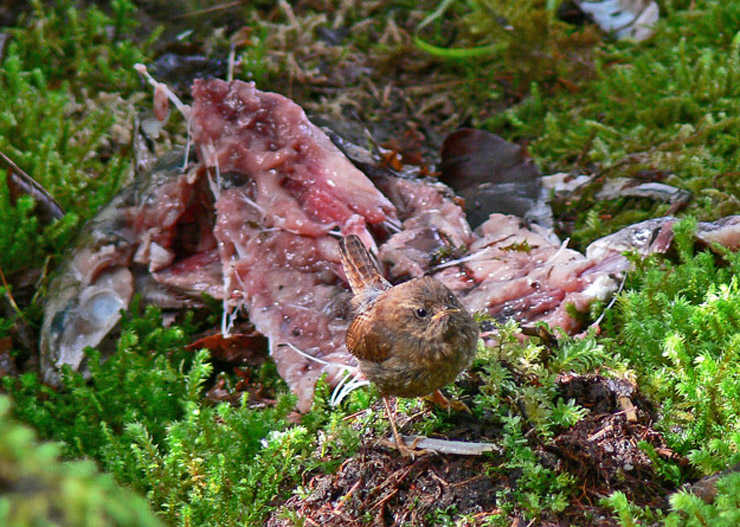
The little brown bird that we have long called the winter wren nests in forests across northern North America and Eurasia (plus a bit in North Africa). Because it is the only wren on the other side of the Atlantic, it is called The Wren there. However, taxonomists looked more closely at this widespread species and decided it was really three distinct species: the Eurasian one, another one spread through the northern forests of North America as far west as British Columbia, and one on the Pacific coast. So now the name of “winter wren” belongs to the widespread North American populations and “our” wren is called the Pacific wren. It is one of more than sixty species of wren, all living in the Americas except for the single species in Eurasia.
We notice wrens as they flit about in the forest understory or sing from atop a snag or rootwad. The long musical song is a favorite for many of us. Males sing to establish territories and attract females. Territory size ranges from about two to ten acres in our area and the literature reports that males may hold their territories all year round. Wrens are not typically migratory in our area, according to the literature, although those that nest at higher elevations may move downhill in winter. They conserve body heat in cold weather by roosting together, sometimes more than a dozen birds at once, in old nests and other cavities. Nevertheless, severe winters are hard on them and wren populations sometimes decline drastically as a result.
Wren diets consist almost entirely of insects and spiders, all year long. They and other songbirds sometimes pick fly maggots from salmon carcasses. Because wrens are so small, maintaining normal metabolism requires lots of food, relative to their body size. The literature reports that very occasionally, or in certain locations, wrens might eat berries, small fish, snails, and small crustaceans such as amphipods.
Males build several nests, often a mossy ball but sometimes in a cavity in a log, stump, or earthen bank. Visiting females inspect each nest before deciding to stay with a particular male and selecting a nest for her eggs. If a female decides to stay, she modifies the selected nest a bit just before she lays, adding to the lining and often building a little lip at the entrance. In the Juneau area and elsewhere, polygyny is quite common: around Juneau, forty-four percent of males mated with two females or rarely even three.
A female usually lays about five to seven eggs and incubates them by herself, taking a little time off to forage. Incubation lasts about sixteen days, and it takes another seventeen days or so for the chicks to leave the nest. Two broods per season may be possible, and if the first nest fails, females commonly re-nest. When the chicks hatch, the male will usually help feed them, but the amount of help he provides is reported to vary considerably. I could find no information on the relative amount of help that polygynous males of this species provide to their first and second mates, but in the related marsh wren, the male’s role varies with the productivity of the marsh, while in blackbirds, males commonly favor their first females.
In the 1990s, colleagues and I studied nesting wrens in the Juneau area. Juneau wrens had relatively high nesting success: more than seventy percent of the 143 nests we noted produced fledglings; that is higher than in most other studies. Cavity nesters such as wrens commonly have higher nesting success than open-cup nesters; as an extreme case, all 31 red-breasted sapsucker nests in Juneau were successful. For comparison with open-cup nesters: 31 percent of 30 robin nests were successful, 36 percent out of 36 hermit thrush nests were successful; 27 percent of 126 fox sparrow nests were successful; and 42 percent of 27 Wilson’s warbler nests were successful.
Most nest failures were caused by predation on eggs or chicks. Red squirrels and Steller’s jays are among the likely nest predators, both of which we recorded to eat eggs and chicks. Other possible predators include crows, ravens, mice and shrews, flying squirrels, weasels, and marten. Adults may be prey to sharp-shinned hawks, falcons, and marten, among others. Decades ago (mostly in the 1930s and 1940s) red squirrels or marten were introduced to several islands of Southeast Alaska, and their populations flourished; this very likely has had serious consequences for the populations of wrens and other songbirds, as well as grouse and ptarmigan.
The oldest wren on record was about six years old, but most don’t live anywhere near that long. Estimates of annual survivorship of adults (in English populations of The Wren) ranged between about thirty to about sixty percent. So if, for example, we take a middle value (i.e., 45 percent) and start with 100 adult birds, the next year there would be about 45 birds, and the year after that about 20 birds, and then only nine birds, and so on. Thus, few adults would get more than one or two breeding seasons. Of course, juvenile survivorship would be much lower, and each hatchling would have a low probability of surviving to breeding age.
Although wrens nest in a wide variety of forest types, they typically reach their highest densities in old-growth forests or mature forests with a good understory. Very young forests and second-growth forests generally do not provide a good understory for foraging and nesting, so those conditions are not favorable for wrens in most cases. Any kind of logging is generally detrimental to their populations, but large clearcuts and serious forest fragmentation are especially bad for wrens.
• Mary F. Willson is a retired professor of ecology.

A winter wren peers out of its tree hole nest.
