
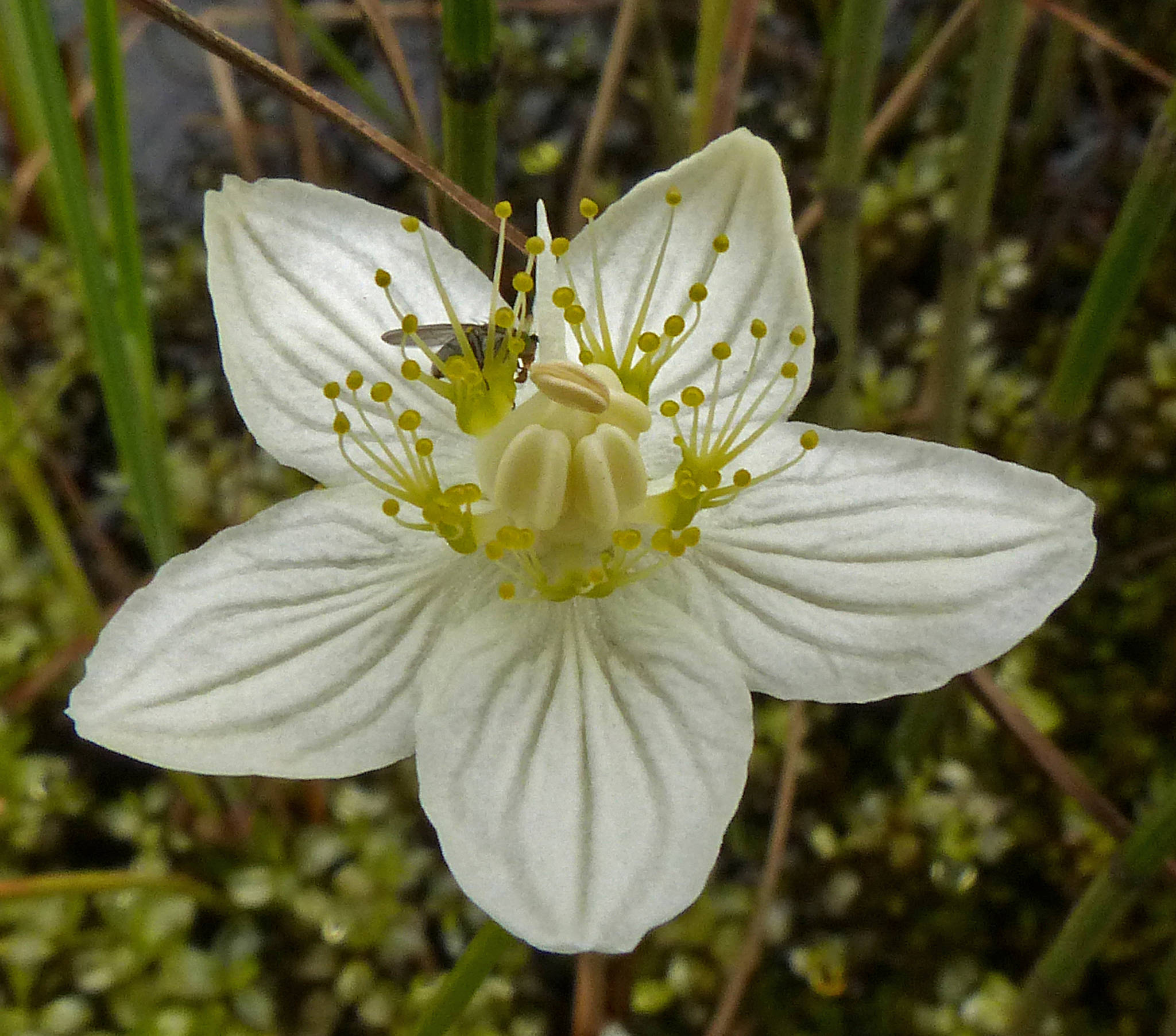
‘Twas the last day of July, and the big meadow at Eagle Beach State Rec Area was decorated with white flowers. Tall, flat-topped inflorescences of cow parsnip ringed the edge by the trees. Shorter and lacier inflorescences of hemlock-parsley came next and filled an area near the old dunes. On slightly lower, more central ground, the single flowers of northern grass-of-Parnassus spangled the field. And weedy little yarrow fit itself in wherever it could.
This grass-of-Parnassus (Parnassia palustris), also known as bog star, has a wide geographic range across North America and Eurasia. Inside the saucer-shaped flower are five stamens bearing pollen, five staminodes (sterile stamens) that bear droplets on their branched tips, and a single ovary with a stigma where pollen is deposited. The droplets do not contain nectar but may help attract small flies and bees that do the pollination. Nectar is produced at the bases of the stamens and staminodes, according to a scholarly report (resolving the contradictions and confusions found on general internet sources). Insect visitations, moving pollen within a flower or bringing it from another one, are reported to be necessary for pollination and seed set. Seeds are spread by wind and water.
The taxonomy of Parnassia is confusing too. Our field guides place the genus in the family Saxifragaceae. However, several internet sources place it either in its own family or in the family Celastraceae (along with burning bush, Oriental bittersweet, and others).
I was interested to learn how this plant got its English name. It’s not a grass, so that is a misnomer. But what does Parnassus have to do with this plant? The name appears in both the common and the scientific names.
Mount Parnassus is a fairly large mountain in Greece, not as big as Olympus and not as important in mythology. Nevertheless, in ancient Greek mythology, Parnassus was sacred to Dionysus, the god of grape harvest, wine, debauchery and madness. The mountain was also a sacred haunt of Apollo, who was a multifaceted god of light, music, town-building, and prophesy — and a hero, a protector of flocks and crops, a lecher, a bisexual, and an archer. Parnassus was also visited by the Muses — goddesses of song, poetry, history and dance, as well as other minor deities.
Then, about 2,000 years ago, a Greek physician and botanist named Dioscorides wrote a huge set of books on medicine, useful plants and related matters. He wrote in Greek; his books were translated into Latin and Arabic and, eventually, into other languages. They constituted the basis of the practice of western medicine for centuries. Supposedly, Dioscorides gave grass-of-Parnassus its name, having found it growing on the Mountain. I have no access to this doctor’s original opus, but it seems unlikely that he really confused this plant with the grasses; perhaps he merely said it was like a grass in some way. Then, somewhere along the line, some taxonomist just decided to apply the inappropriate name of grass when naming this species.
The generic names of two of the other white flowers in the meadow also hark back to Greek mythology. Heracleum lanatum (cow parsnip) refers to Heraclites (Hercules, in Latin) — known for his prodigious strength. As penance for his crime of murdering his wife and children in a fit of madness, he was given the fabled 12 Labors of Hercules (killing or capturing some monsters, cleaning the Augean stables that were full of manure, etc.). The very robust plants of cow parsnip might reflect his strength.
Achillea millefolium (yarrow) is related in name to Achilles — he of the vulnerable heel. Legends say that Achilles’ mother held her baby by a heel and dipped him in the river Styx to make him invulnerable, but the heel didn’t get wet, leaving it unprotected. After many adventures, including killing Hector in the Trojan war, Achilles was killed by an arrow in this heel. Yarrow indeed has good medicinal properties, but the tales telling that Achilles used this herb to heal wounds may be apocryphal.
Before I leave Greek mythology, here are two more quick examples; both are orchids with representatives in Southeast. The genus Cypripedium (moccasin flower or lady’s slipper) is named for the foot of Kypris (later known as Aphrodite in Greek, Venus in Latin; the ‘ped’ refers to foot in Latin). In variable forms, she was the goddess of love and lust, beauty, fertility, and marriage. Calypso bulbosa (fairy slipper) is a showy orchid. The “bulbosa” part of the plant’s name refers to a bulbous corm at the base of the plant. In Homer’s epic poem, Calypso was a goddess-nymph who successfully seduced Ulysses (Odysseus in Greek) for seven years. Perhaps she was really bulbous when bearing two children by him!
And how do all these mythical creatures get into taxonomy at all? Well, one reason is that, historically, all young scholars, including future taxonomists, were well schooled in Greek and Latin classics, so the names and stories were very familiar to them.
• Mary F. Willson is a retired professor of ecology. Her essays can be found online at www.onthetrailsjuneau.wordpress.com.
