
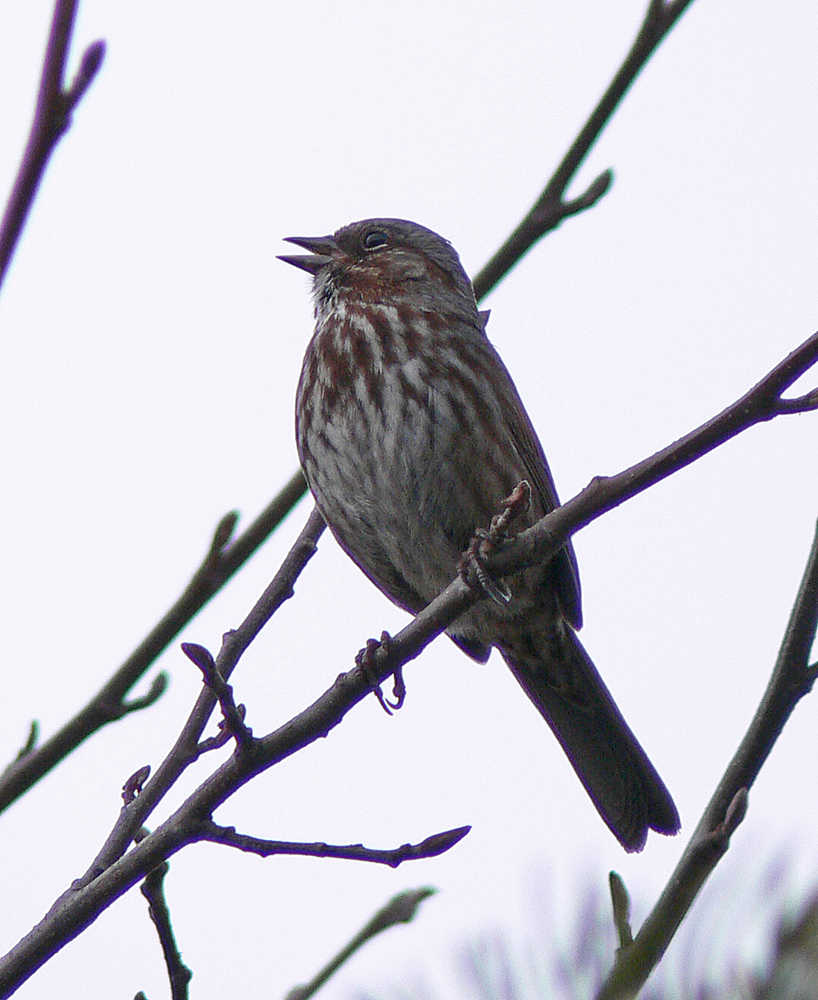
Winter is not the best time for watching land birds. Eagles, crows, and ravens, yes. There are lots of ducks and gulls on the water, and perhaps an occasional flock of shorebirds at the tide line. But small songbirds are rather thin on the ground.
However, the song sparrow is one species that can be observed fairly regularly in winter, if you are in the right places. I see this species most often near the shrubbery that lines the beaches above the high tide mark. It occurs in some other places too, of course, commonly near water. And I have sometimes seen it in the bushes just above the Rainbow Foods parking lot.
Sometimes all one sees is a small, dark form zipping into the bushes, but even this quick glimpse can be enough to help you identify the bird: the right habitat and a small, dark bird that has a relatively long tail (compared to other sparrows, for example). Close-up, you would see the heavily streaked chest as well. Another sparrow could be confused with the song sparrow in spring and summer: The fox sparrow is dark, with a streaked chest, but it is chubbier, the lower bill is pale, and the tail is not particularly long. This species usually nests in densely shrubby habitats that are not associated with beaches, and it is seldom around here in the winter.
Male song sparrows sometimes sing during the winter, but not often. As the days grow longer, they sing more and more enthusiastically. I think of the song in three parts: 1) two or three notes on a single pitch, 2) a long higher note, and 3) a descending warble. It is an easy song to learn, once you’ve heard it a few times.
Song sparrows range all across North America, with lots of geographic variation in plumage, body size, and song. There is so much variation that ornithologists have divided the species into at least twenty-four subspecies. Our local form is larger than most of the others, except for the giant form in the Aleutians, and darker than most of the others. It often happens that birds in humid climates (like ours!) have darker pigmentation than those in drier areas, perhaps because the dark pigments somehow help protect the plumage from molds and bacteria that would damage the feathers.
I know of no studies of the nesting biology of song sparrows in Southeast, so this summary is based on studies done elsewhere. Both sexes of this species are strongly territorial, defending their chosen area from all others of the species. In general, they are socially monogamous, forming pairs in the nesting season. But, as is true of many songbirds, this is not a strict arrangement. Very occasionally, a male is polygynous, with two or, rarely, three females on his territory. And extra-pair copulations sometimes produce broods of chicks that have more than one father.
Nests typically are built on the ground or low in the bushes. Females do all the nest-building and incubation of the eggs, and while the female is in egg-laying mode, each male guards her assiduously—not from predators but from other males, trying to protect his paternity. Both parents raise the chicks, feeding them mostly on insects, and keeping the nest clean. However, in polygynous arrangements, the first female gets most of the male’s help, and the second or third females make do with less help. When the chicks fledge, parents continue to feed them, but as the chicks move around more, each parent takes responsibility for one part of the brood.
The whole nesting cycle takes several weeks. Building the nest requires at least four days, but sometimes more than a week, in bad weather. The eggs (usually three to five of them) are incubated for about two weeks, and chicks stay in the nest for an average of about ten days. Then the fledglings are tended for another three to four weeks. So it takes roughly eight weeks to raise a brood of chicks.
Raising a second brood or even a third brood in a season is common, at least in some areas. The second brood may be started while the parents are still feeding chicks of the first brood. This is more likely to happen when the male parent is very active in parental duties. Therefore, it would seem that brood overlap would be most likely for a male’s first female, allowing her to squeeze in more nesting attempts per season than his secondary females.
Although song sparrows may live as long as eight or nine years, that is very rare. Juvenile survival is, as always, quite low; usually around 25 percent of chicks survive the first year. Broods hatched early in the season often survive somewhat better than those hatched late in the season. Females mature when one year old, and some but not all males do so. Annual adult survival is highly variable, but it is commonly around fifty or sixty percent; this means that each year, only about half of a population makes it to the next year. So most adults don’t live long enough to breed in more than two or three years.
Look for them! And listen for their cheery song as the days grow longer.
Mary F. Willson is a retired professor of ecology.
