
In early January, Parks and Rec hikers meandered through Cowee Meadows over crusty, crunchy snow. Plant stalks and tree branches glittered in their hoarfrost coatings. Pools of standing water supported wonderful and beautiful designs on their frozen surfaces — the more imaginative hikers found chickens, owls, and dragons traced in ice patterns.
Along the edge of the forest we found plenty of evidence that moose had been there quite recently — possibly two individuals. Trampled areas and piles of moose pellets showed that they had lingered for a while, not under the trees but out in the open. A favorite winter browse is willow twigs, but the willows grow in certain places closer to Cowee Creek, so they must have been in search of something else here.
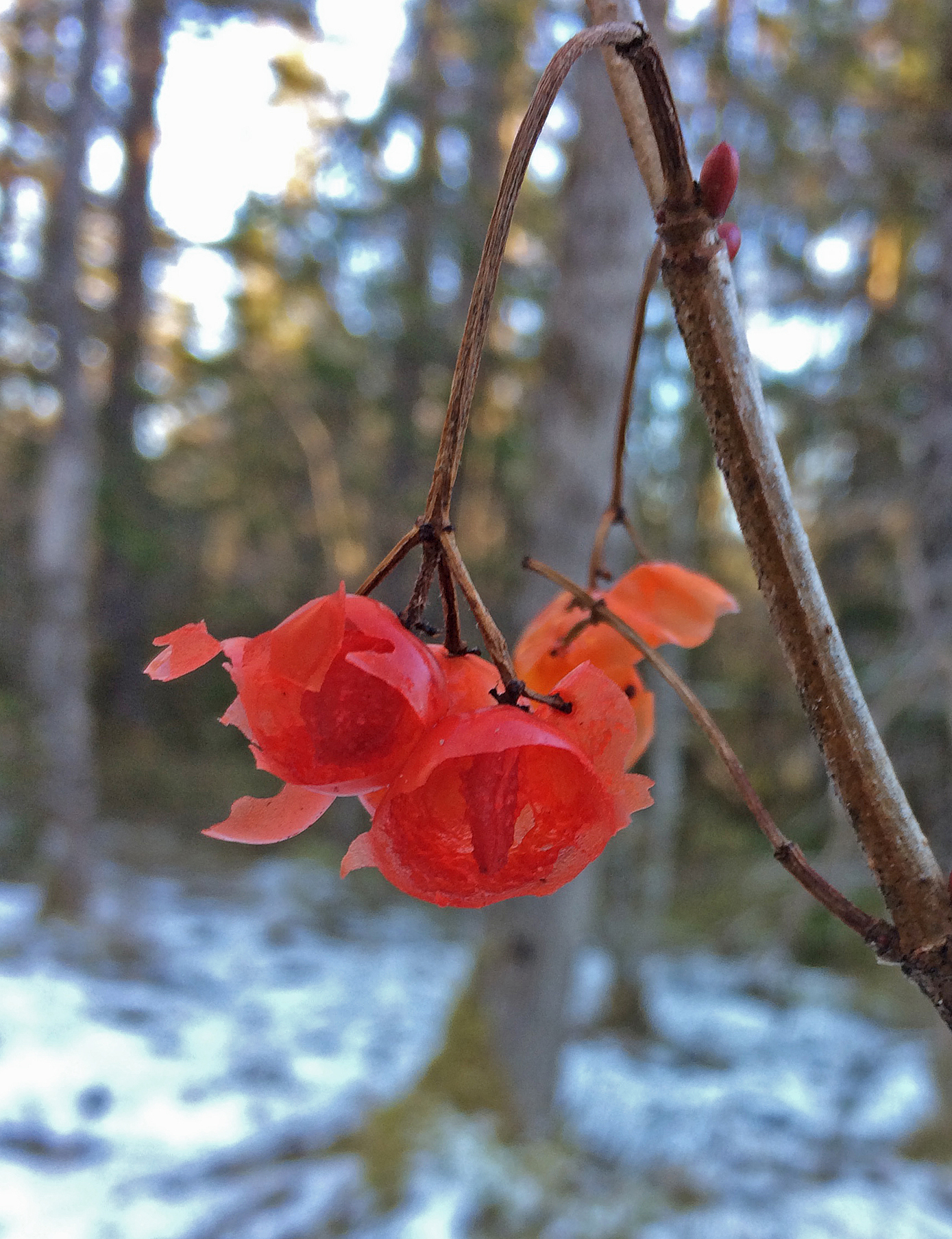
Up in the conifer canopy at the edge of the meadow, we heard birds calling. Our first thought was about cross-bills, but that didn’t really sound right. Then we had it: pine grosbeaks! Pine grosbeaks usually make short-distance migrations each year, but sometimes they irrupt in huge numbers, appearing south of their usual winter range. They often waft through our area in small groups in winter, looking for food. I don’t know what they might have been finding in the tops of spruces, but in the understory they’d found something: Under many of the highbush cranberry shrubs, the snow was decorated with small red stains of berry juice and the berry skins — the seeds had been carefully extracted.
Two weeks later, some Gustavian friends and I were lucky: we happened upon a flock of pine grosbeaks, busily extracting seeds from highbush cranberries. Some berries were picked and masticated to remove the skin and pulp, letting the bird drop that material and swallow the seed. Seeds of other berries were extracted while the berries hung from the bush, and the empty skin was left hanging. This was a year of bumper crops of berries, so there were plenty of berries to choose from. Some of the birds also foraged over the crusty snow, picking up something small, perhaps alder seeds.
In town, in winter, these grosbeaks are sometimes seen in the mountain-ash trees, picking the fruits one by one, peeling off the pulp, and eating the seeds. The scientific name of pine grosbeaks reflects their habitat and this habit: Pinicola enucleator or ‘pine-dweller seed-extractor’. They eat the seeds, buds, and fruits of many species.
Pine grosbeaks don’t seem to be very common anywhere during the nesting season. Although they nest all across northern North America (including Southeast) and in the mountain west, they appear to be sparsely distributed within that range. Their favored habitat is open coniferous forest in most of the breeding range. But in the mid-1980s, they expanded their range into southwestern Alaska, and there they nest in alder thickets.
Their nests are fairly bulky, composed of a loosely constructed, twiggy exterior and an inner nest cup of finer material. Nests are typically placed in dense foliage, often near a tree trunk, mostly two to four meters above the ground. Males are strongly territorial, singing from treetops and chasing intruders. Females build the nest, incubate the three or four eggs, and brood the young chicks, but males help feed the chicks. The chicks are fed a regurgitated paste of insects and vegetative material; the adults develop special pouches in the lower jaw, near the tongue, during the breeding season, and the chicks are fed the mixed paste from these pouches.
Over their wide geographic range, their body size, bill size, and coloration vary significantly; those of Southeast are said to be distinctive, with shorter tails than most others, and some slight differences in size. In general, mature males have red plumage on the head, back, and chest, and females are grayish-greenish above and gray below. Immature males look a lot like females, but some have a few reddish feathers; some young males can breed when one year old, even if they lack the full mature plumage. Full male coloration depends not only on age, but on diet. The red color comes from carotenoids that come from plant food. Birds cannot make these pigments with their own metabolic processes — the pigments only come from plant material that is ingested. Most carotenoids are yellowish, but grosbeaks and other birds can modify the ingested carotenoids to produce the red color. The carotenoid molecules are transported from the digestive system to the feathers, a process that requires some energy. So if a male bird is energy-deprived, or he has not eaten the right food, the development of his red plumage is incomplete or delayed; this serves as an indicator of health and may be used in mate choice by females looking for healthy mates.
The flight calls that we heard differ among families and regions: young birds learn flight calls from their parents, so there is some variation among families, and populations in different areas have distinctive calls. Birds with similar calls tend to flock and roost together in winter.
• Mary F. Willson is a retired professor of ecology.
