
Here are a few recent observations from late February and early March, plus a very cool thing I’ve only read about. So here goes …
As I strolled out toward the Boy Scout beach, I saw a fellow ahead of me with a backpack. As he emerged from the forest he dropped the pack and extracted a big bag. Suddenly, two ravens were at his feet, as if they knew what to expect (and they undoubtedly did know). The man flipped out a few morsels (possibly dog kibbles), which the ravens gathered up and cached in the meadow grass.
Then they came back for more. I hung back, to watch and not spoil the fun. The fellow was a very reliable provider, and the birds followed him all the way around the point and down the beach. They knew a good thing when they saw one! Ravens (and gulls and jays and other birds) learn to recognize particular persons (and cars) when there are reliable rewards, and they also learn which people to avoid.
Out on the old berm, I noted a young, dead spruce, maybe 20-feet tall. It had been completely de-barked, all the way up the trunk. A porcupine had been at work here. I seldom see porcupine chewings on spruces in our area, although hemlocks often bear porcupine scars. There aren’t many hemlocks out near this beach, but there are plenty of them in the nearby forest, and I have seen porcupines trundling across the meadow between forest and berm. So I have to wonder why this particular spruce was so (apparently) delectable, when there were hundreds of others out there to choose from, not to mention all the trees of the forest.
In late February, my home pond had a slushy film of ice, too frail to support a duck, but firm enough to entice smaller critters to venture out. A red squirrel had come from the far bank, leaving a line of mushy footprints. The trail stopped, where a body-sized hole appeared. But the squirrel had saved itself, and another line of footprints led back to the bank. A smaller four-footed animal, maybe a vole, had scurried out from the near the bank and back a few times before giving up. At least I hoped that the little divot at the end of each trail was just the mark of turning around and going back the same way.
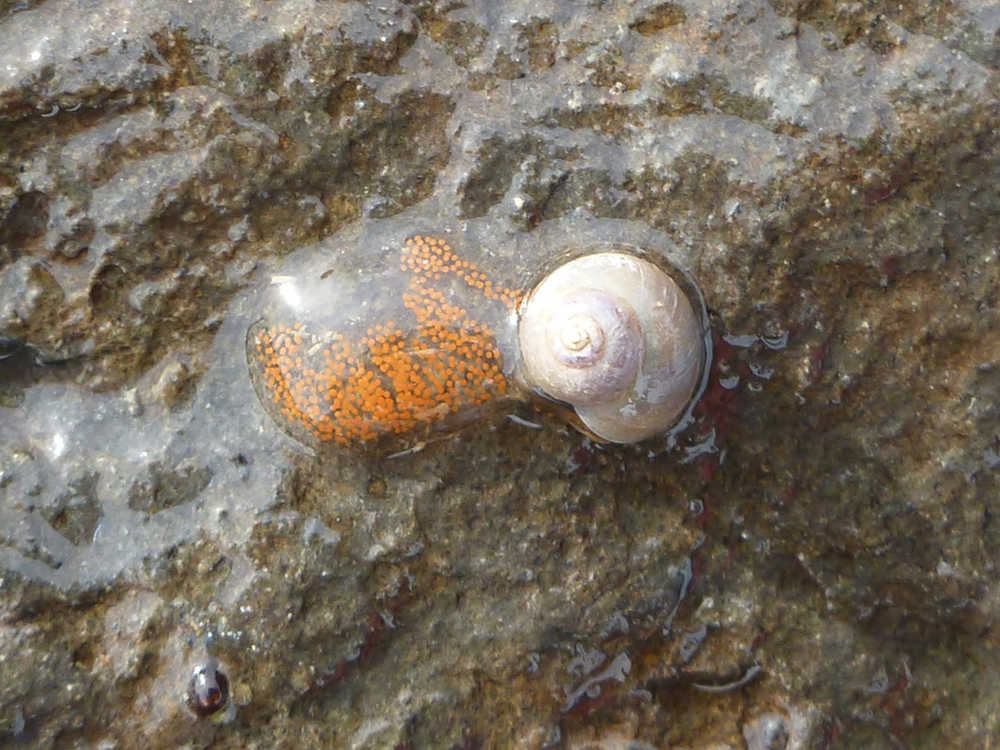
A little tide-pooling on a low tide in March was a pleasant change from the usual walk. In addition to the usual sorts of things and some very small sea stars, we found the tiniest sea urchins I’ve ever seen; they were less than two millimeters across. Snails had been busy laying eggs, both the small margerites, with their tiny eggs in jelly masses, and the bigger whelks, with their stacks of egg capsules. I got a nice surprise, and something new, when I carefully turned over a flat rock and two more-or-less teardrop-shaped, whitish creatures moved quickly away from a sea cucumber. A little research revealed that these were cucumber suckers, small snails that parasitize cucumbers by piercing the skin and sucking up the fluids inside.
Finally, here is the cool thing I’ve only read about. Many glaciers around the world have “glacier mice” on the surface. These are small balls of various species of moss that collect around pebbles or bits of debris. They are not attached to the ice, so they get blown around by the wind; to good imaginations, they appear to be scampering mice. Quite recently, researchers discovered that the mice provide a rich habitat for several kinds of invertebrates, including numerous springtails, tardigrades (a.k.a. water bears), and nematode worms. The insides of the mice are warmer than the ice and hold a little moisture. A whole new biological community thrives there!
I asked some local experts if we had glacier mice on the Mendenhall Glacier, but they said that they had not seen them there. However, the “mice” have been reported on the Gilkey Glacier, which comes off the Juneau icefield, on the Matanuska and possibly the Kennicott, farther to the north and west. It would be interesting to find out what other Alaskan glaciers have these mice. That leaves the obvious question: What determines whether or not glacier mice form on any glacier?
• Mary F. Willson is a retired professor of ecology.
