
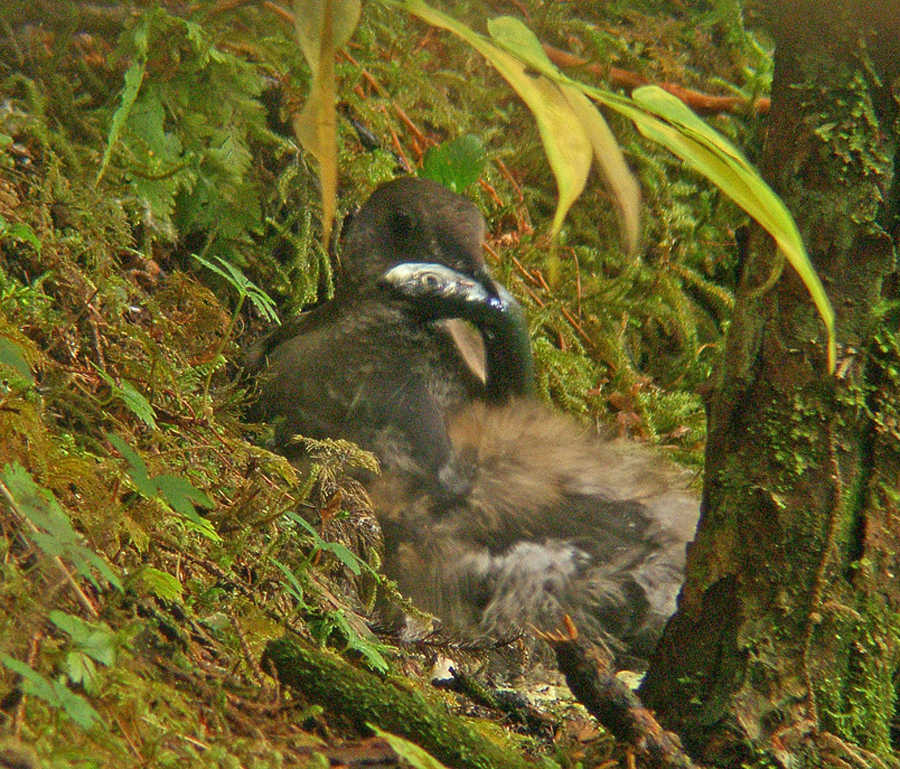
If you venture out on the water, you will see small, dark brown birds that dive with a flick of their wings or take off into the air after a short sprint on the surface. These are murrelets. We have two closely related species, the marbled murrelet and Kittlitz’s murrelet. They are hard to tell apart, but the small white tail feathers of Kittlitz’s murrelet are a good distinguishing feature. We see marbled murrelets all year long, but Kittlitz’s murrelets are usually seen around here in spring and summer.
The marbled murrelet is found from northern California to the Aleutians, while Kittlitz’s murrelet is endemic to Alaska and eastern Russia. In our area, the Kittlitz’s population is concentrated in Glacier Bay, Yakutat Bay, Icy Bay, and similar sites. Marbled murrelets, whose populations in the Pacific Northwest declined an estimated 30 percent between 2000 and 2010, mostly due to loss of nesting habitat, are considered by the IUCN to be globally endangered and by the USFWS as threatened in Washington, Oregon, and California. But in Alaska, the populations appear to be in good shape. On the other hand, the Kittlitz’s murrelet population in Alaska apparently declined dramatically (an estimated 30 percent per year, I’m told) between 1989 and 2000, possibly in response to an oceanic regime shift, but then the population apparently stabilized at the new, much lower level until 2012. Since then, ocean conditions have been changing again, but apparently there are no good data on how the population of Kittlitz’s murrelet has fared more recently. They are listed as endangered by the IUCN, which seems appropriate, given the major decline, but not by USFWS.
Most other seabirds nest colonially, often on cliffs very close to the sea, but murrelets are solitary nesters, sometimes nesting well inland. They depend on concealment and dispersion for protection of the nest. In Southeast Alaska, the nesting habitats of these two species are often different. Marbled murrelets usually are forest nesters, commonly choosing a mossy branch up in a tall spruce or hemlock, but sometimes nesting on the ground on rocky outcrops in the forest or near steep cliffs above treeline. Kittlitz’s murrelets generally prefer open, unvegetated landscapes, nesting on the ground on steep talus slopes among the tumbled boulders. They reach their highest nesting densities near glaciers and glacier-worn landscapes. Marbled murrelets usually nest fairly close to the sea (within about 10 miles, but usually less than one mile), but Kittlitz’s murrelets often nest many miles (up to 50!) inland.
Their foraging habits are also somewhat different. Both feed primarily on small fish, such as sand lance, and large zooplankton. But marbled murrelets typically dive for their prey in quite clear waters, while Kittlitz’s murrelets forage most often in the turbid waters near glaciers and glacial outflows. The larger eyes of Kittlitz’s murrelet may enable them to see in the cloudy water.
Females of both species lay a single egg, which is incubated by both parents for about four weeks or a bit more. Both parents work hard to bring prey to the chick, which stays in the nest for another three or four weeks. The chick is fed several times a day. But Kittlitz’s murrelet parents commonly have to fly many miles, often gaining considerable altitude, between the marine feeding area and the nest site. This costs lots of energy. Marbled murrelet parents don’t generally commute so far and therefore probably spend less energy in chick care.
Nesting success of Kittlitz’s murrelet was quite low during several years of study in Icy Bay; over all, less than 40 percent of nests fledged a chick. Marbled murrelets in the Snettisham area had very low nest success in the two years of study there: only about 20 percent of nests produced a chick. However, a small sample in Icy Bay indicated much better success (almost 70 percent). So nest success may vary a lot among sites or among years. Predatory birds are major sources of mortality for both species in Southeast, but starvation may also contribute significantly to the failure of Kittlitz’s murrelet nests. Despite the estimated low nesting success in one study, the marbled murrelet population in Southeast appears to be stable, and low nest success of Kittlitz’s murrelet does not appear to account for the dramatic population decline. Larger samples of nests and more years of study are needed to ascertain patterns of nesting success.
Studies in Southeast Alaska have indicated why the Kittlitz’s murrelet population here is in trouble. Most Kittlitz’s murrelets, especially females, don’t breed every year. In fact, an average of only about 20 percent of them do so! In some areas, breeding sometimes fails altogether. Breeding is more common in years when there is a good bloom of plankton in spring, which feeds the small fish and zooplankton that are the main prey. Breeding activity is generally very expensive of energy, so years of low prey availability probably don’t give the adults enough fuel to make the effort, especially if the preferred nesting sites are far inland, necessitating a long commute. If they make the effort when conditions are poor, high levels of stress (as measured by stress hormones) during the breeding season in that year reduce the probability of breeding in the following year. In contrast, a higher proportion of individuals of marbled murrelets attempt to breed every year.
Thus, the principal reasons for the population decline of Kittlitz’s murrelets appear to be the frequent failure to breed, which is likely to be related to the food supply. Given the observed importance of glacier-influenced waters to Kittlitz’s murrelets, an obvious deduction is that climate change, with the accompanying recession of glaciers, is probably having a serious negative impact on this species.
Thanks to Michelle Kissling, USFWS, for providing easy access to several scientific papers and for helpful consultation.
• Mary F. Willson is a retired professor of ecology.
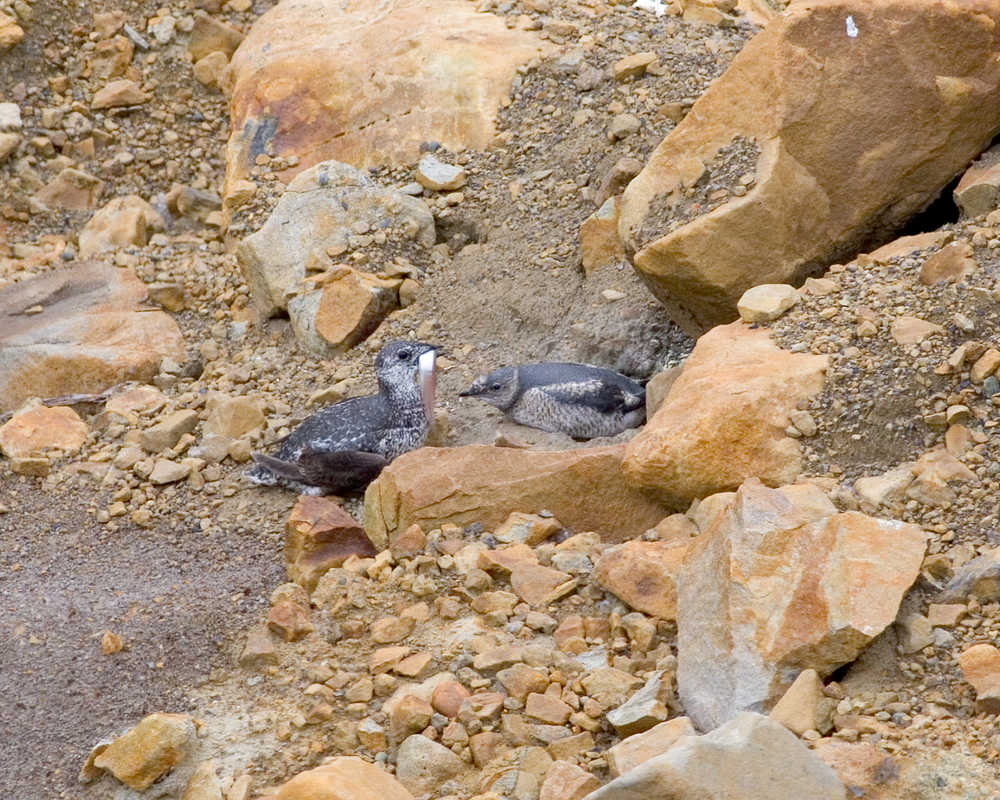
A Kittlitz’s murrelet delivers a fish to its chick at the nest site.
