
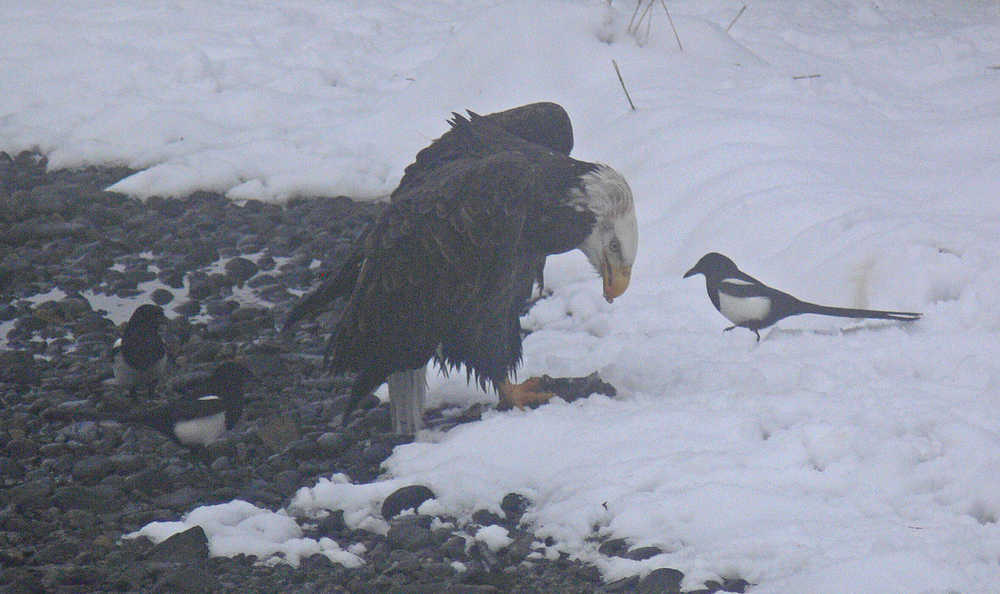
Juneau sees magpies in fall, winter, and early spring, outside of the nesting season. They come to us from nesting areas in the Interior. They are not strong fliers, but that long, elegant tail allows them to make quick changes of direction. These flashy birds sail across the roadways, check out roadkills and dead salmon, raid some kinds of bird feeders, and fossick about the edges of wetlands and woods in search of something edible. Magpies can eat almost anything, be it animal or vegetable. Sometimes they pick ticks from the hides of moose and deer. They eat fruit, catch mice, and gobble up beetles and worms, regurgitating the indigestible bits in pellets. When an eagle holds down a salmon on the shore, magpies team up to rob it: one magpie tweaks the eagle’s tail feathers, while another one snags a chunk of salmon.
These are black-billed magpies (Pica pica). The species is currently considered to comprise about twelve subspecies, spread across much of the northern hemisphere. The North American subspecies nests in the dry, cool parts of the West, geographically isolated from the other subspecies. There are other geographically isolated subspecies—one in northeastern Siberia, one in extreme northwest Africa, and one in (of all places!) a small mountain range in Saudi Arabia. All the others are found in Eurasia, from the UK and Scandinavia southeastward to south China and Thailand.
Some ornithologists think that black-billed magpies may have inhabited North America long ago, before the last major glaciation. They got wiped out, perhaps by environmental changes associated with glacial advances. They then recolonized our continent, coming from Asia over the Bering land bridge.
Down in the valleys of southern and central California lives another species, the yellow-billed magpie (P. nuttalli). These birds may constitute a relict population left over from a time before the last major glaciation. They are quite different from the black-billed species in life history, physiology, and social behavior. Despite all the differences, yellow-bills are thought to be more closely related to North American black-bills than those black-bills are to the Eurasian forms. It may turn out, with more study, that the North American black-bills are really different species than the Eurasian ones, which have quite different behavior and vocalizations.
Magpies form pairs that are ostensibly monogamous, but extra-pair copulations occur (as in many other songbirds), especially involving older males. They do not defend large, multi-purpose territories, but only defend an area around a nest. Our magpies like to nest in trees and large shrubs, but prefer to forage in open country. They build large, domed nests of sticks and line them with mud and grass. It can take six to ten weeks to build this structure—no small investment! Both male and female work on the nest, the male mostly with sticks and the female mostly with the lining.
The female lays an average of about six eggs (but up to nine) and incubates the eggs for about eighteen days; the male brings food to her as she sits. Incubation begins before the last egg is laid, so hatching is not synchronous and the chicks are therefore of different sizes. Chicks stay in the nest, fed by both parents, for about four weeks. There is strong sibling competition for food, and when food is scarce, the smaller chicks may starve (or be killed by bigger chicks). As a result, the number of fledglings per nest can be markedly smaller than the number of eggs.
After the chicks leave the nest, they are fed by the adults for six to eight more weeks, and sibling rivalry continues. When they become independent, the juveniles (especially males) generally form winter flocks, with a strong dominance hierarchy.
Females mature at age 1 year, males usually at age 2 years. But average life expectancy is not great: females 2 years, males 3.5 years. So, on average, each bird only gets about two nesting seasons and thus two chances to rear young.
Magpies belong to the corvid family, along with ravens, crows, and jays. Many of the corvids, including magpies, have a fascinating behavior known from only a few other animals (such as elephants). They conduct what are called ‘funerals’. If a magpie dies, the first bird to notice the body calls in other magpies, and they all gather around the corpse for a short time. It’s a bit like conducting a wake in human society, although the exact function of these funerals is not known.
• Mary F. Willson is a retired professor of ecology.
