
By the end of summer the numbers of sockeye in Steep Creek had declined markedly, but there were still enough that a female bear with two cubs was able to catch five of them in about thirty minutes. When I came upon them, mama and one cub were busily chowing down on a fresh sockeye, while cub number two was perched up in a big spruce. Pretty soon, mama went out and got another fish—it took her maybe three minutes—to share (somewhat grudgingly, it seemed) with the first cub.
Suddenly, we all heard a loud ruckus just down the trail, as two young bicyclists approached. Fortunately, a ranger was on duty in the area and the raucous disturbance was quelled. But the bears were agitated, and cub number two was sent up the tree to join number one. After a watchful period, the female went back to fishing and caught three more fish in less than twenty minutes, but she didn’t share them.
Another pleasing bear observation: one day I drove up Riverside Drive, with no other vehicles in sight. Out of the brush on one side of the road popped a young bear. It looked both ways, saw me coming, and stopped. I stopped too. Then the bear took another look and rambled safely across the road. A street-wise bruin!
The Crow Point trail near the Boy Scout camp was littered with washed-up, pecked-over chum carcasses. I salvaged some nice clean vertebrae that still had all the ribs and dorsal spines attached: these were useful to me for clarifying a few long-standing puzzles of comparative anatomy—comparing the spinal columns of fish, deer, bears, whales, and whatever else I can get my hands on.
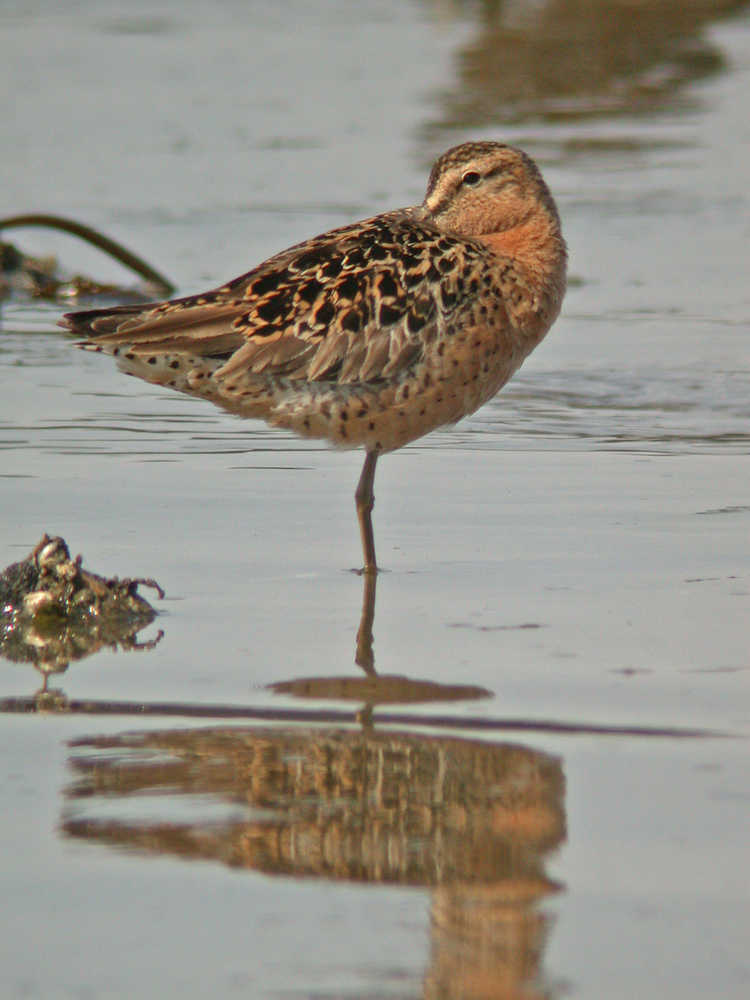
Out on the sandy beaches, I found five dowitchers, all sleeping, with long bills tucked over their shoulders into their feathers. Some were standing on two legs, some on one leg. I was amused to see that as the tide came in, the one-legged individuals just hopped a few steps up-beach without bothering to lower the second leg—which of course was fully functional but resting comfortably up in the belly feathers. I’m not sure the birds even came fully awake—they seemed to go right back to sleep.
Signs of autumn were everywhere: gold leaves of mayflower, orange and red leaves of fireweed, all-shades-of-red leaves of highbush cranberry. Bands of migrating warblers were on the move, searching among the leaves for insects to fuel their southward journey. Mixed flocks of Lincoln’s sparrows and savannah sparrows rustled about in the brush. When I got back to my car, I fund a woolly-bear caterpillar crawling up a rear tire. I suggested to it that a wheel well was probably not a good place to pupate and assisted its transfer to a more productive spot.
Back home, I glanced out a window and saw a red squirrel trying to haul a thick, four-inch-long, white cylinder (maybe a mushroom stem) up a tree. The squirrel was having a tough time with this object, which often seemed to crumble or break, so the squirrel lost its tooth-hold. Somehow, the squirrel always managed to catch the thing when it started to fall, but progress up the tree was slow, irregular, and arduous. The object got shorter with every attempt to haul it up to the next level; by the time the hard-working squirrel was out of sight, its prize was only about an inch long.
The annual Juneau Symphony whale-watching cruise was a treat: Great food, lovely string quartet, good conversations, and best of all, spectacular whale-watching. Several humpback whales were busy in the area just south of North Pass. All of them were lunge-feeding—making shallow dives and surfacing on their sides with mouths agape as they surged forward. A group of three whales seemed to collaborate; they came up side by side, so close together that it was hard to sort out which jaw belonged to whom. We saw an occasional pectoral fin waving, or half a fluke emerging. This activity went on a good long while; I had never seen such prolonged, concerted lunge-feeding before. We could not identify the prey that was so assiduously sought, but we did not see small fish jumping off to the side in efforts to elude the giant maws (as we often see when the whales feed on schools of small fish), so perhaps krill were the big attraction for the hunters.
• Mary F. Willson is a retired professor of ecology.
