
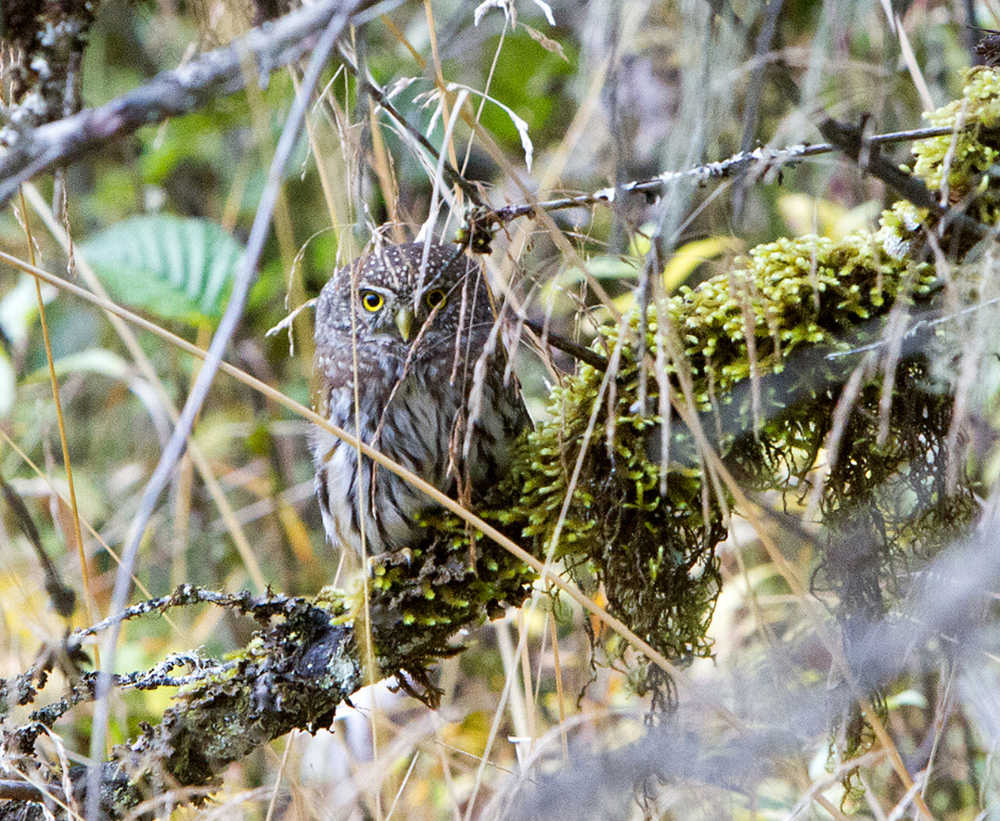
A northern pygmy owl (the very one that flew across the road for us) pauses in a tangle of trees and branches near Juneau in October.

A northern pygmy owl (the very one that flew across the road for us) pauses in a tangle of trees and branches near Juneau in October.

On the Trails: Early fall observations

In the meadows near Cowee Creek, a few late flowers bloomed. Salmon carcasses littered the mudflats and creek bank. High-bush cranberry shrubs were decorated with bright red berries.

As friends and I slogged through the wet meadows, thinking about the possibility of bears in the area, we noticed something odd: a dead branch suddenly moved along the forest edge, about six feet off the ground. Oooops, the ‘branch’ was attached to a large brown creature–not a branch, of course, but moose antlers! This one bore a small set of antlers, and he was accompanied by a female. They moved off, very gracefully, into the edge of the forest. Aha—a consorting pair—it’s the mating season. Moose are seldom seen along our road system, but this year there have been several reports of moose in the general area of Echo Cove.

A week or two later, we revisited this area, and this time the chief interest lay in what was recorded in the mud: Tracks of otter and mink along the creek, large tracks of moose and smaller ones of an adult deer in the trail. Best of all was the footprint of a brown bear heading south and, on top of it, a tiny track of a deer fawn, heading north.

The area around Steep Creek usually offers some interesting observations. In early October, the female black bear known as Nicky was seen on several occasions ambling peaceably along the creek, looking increasingly prosperous. She is accustomed to the presence of people (as long as the people behave well) and calmly does her bear-things. The coho were starting to come in, and so Nicky should become even more rotund. In the bear world, fat mamas are good mamas, because the fat stores fuel lactation and successful cub development. We are hoping Nicky will have a cub or two, next spring.

As we stood in the road, checking out a few fish in the stream (and counting speeding vehicles, all of which ignored the speed limits), a small bird fluttered across the road and landed on a low branch in the brush. A strange manner of flying, and unexpected white marks on the plumage. What could it be? We crept close and finally spotted the tiny, immobile bird—nearly invisible. A northern pygmy owl! Then we heard the familiar, whistled ‘tu-tu-tu-tu’ coming from up in a cottonwood, and another one flew across the road. Although pygmy owls are not uncommon here, I don’t see or hear them very often, so this was a treat.

Pygmy owls are not the smallest of owls, but they are indeed small, only six or seven inches long from tip to tail, and weighing roughly two ounces. They forage mostly on small mammals, birds, insects, and sometimes reptiles, and occasionally raid bird nests. They can kill and carry off prey larger than themselves. Unlike many other owls, they hunt primarily by eyesight rather than hearing, and often forage in the daylight hours.

Fierce little predators, they are, and I got a first-hand idea of just how fierce years ago when I studied Chilean forest birds. We had set up a line of mist nets to capture (and release) small birds as one means of assessing the diversity of birds in a certain site. When we checked the nets, we noticed that several birds had been caught, and right next to a small songbird was a southern pygmy owl (very similar in looks, sound, and behavior to our northern species). I carefully extracted the owl from the net. Its talons promptly clamped onto my hand authoritatively, and soon red streaks were running down to my wrist. After a photo was taken, I released the owl and, undeterred by its own capture, it flew straightaway into the next net after another captured songbird.

Indomitable! No stopping that one!

• Mary F. Willson is a retired professor of ecology.

More in Neighbors

Peggy McKee Barnhill (Courtesy photo)
Gimme a Smile: How much snow can one backyard hold?

Snow, snow, everywhere, and no place to put it!

The Spruce Root team gathers for a retreat in Sitka. Spruce Root, is an Indigenous institution that provides all Southeast Alaskans with access to business development resources. (Photo by Lione Clare)
Woven Peoples and Places: Wealth lives in our communities

Sustainable Southeast Partnership reflects on a values-aligned approach to financial wellness.

Actors in These Birds, a play inspired by death, flowers and Farkle, hold ‘flowers’ during a performance at the UAS Egan Library on Saturday, Jan. 31. (photo courtesy Claire Richardson)
Living and Growing: Why stories of living and dying in Juneau matter

What if we gave our town a safe space to talk about living and dying with family and friends?

calendar
Weekly events guide: Juneau community calendar for Feb. 2 – Feb. 8

Visit Juneau Arts and Humanities Council at JAHC.org for more details on this week’s happenings.

calendar
Weekly events guide: Juneau community calendar for Jan. 26 – Feb. 1

Visit Juneau Arts and Humanities Council at JAHC.org for more details on this week’s happenings.

Courtesy photo
Adam Bauer of the Local Spiritual Assembly of Bahá’ís of Juneau.
Living and Growing: Surfing into the future

Many religious traditions draw strength from the past.

calendar (web only)
Weekly events guide: Juneau community calendar for Jan. 19-25

Visit Juneau Arts and Humanities Council at JAHC.org for more details on this week’s happenings.

(web only)
Weekly events guide: Juneau community calendar for Jan. 12-18

Visit Juneau Arts and Humanities Council at JAHC.org for more details on this week’s happenings.

Four members of the Riley Creek wolf pack, including the matriarch, “Riley,” dig a moose carcass frozen from creek ice in May 2016. National Park Service trail camera photo
Alaska Science Forum: The Riley Creek pack’s sole survivor

Born in May, 2009, Riley first saw sunlight after crawling from a hole dug in the roots of an old spruce above the Teklanika River.

Sun shines through the canopy in the Tongass National Forest. (Photo by Brian Logan/U.S. Forest Service)
Opinion: Let’s start the New Year with an Alaskan-style wellness movement

Instead of simplified happiness and self-esteem, our Alaskan movement will seize the joy of duty.

January community calendar
Weekly events guide: Juneau community calendar for Jan. 5-11

Visit Juneau Arts and Humanities Council at JAHC.org for more details on this week’s happenings.

Kaa Yahaayí Shkalneegi Muriel Reid photo
In 2024, SSP’s Regional Catalysts attended and helped with the Kake Culture Camp hosted by the Organized Village of Kake. The goal was to be in community, grow our relationships, and identify opportunities to support community priorities determined by the community itself.
In 2024, SSP’s Regional Catalysts attended and helped with the Kake Culture Camp hosted by the Organized Village of Kake. The goal was to be in community, grow our relationships, and identify opportunities to support community priorities determined by the community itself. (Ḵaa Yahaayí Shkalneegi Muriel Reid photo)
Woven Peoples and Place: Don’t be an island, be amongst the people

Láaganaay Tsiits Git’anee and Shaelene Grace Moler reflect on celebrating values in action.