
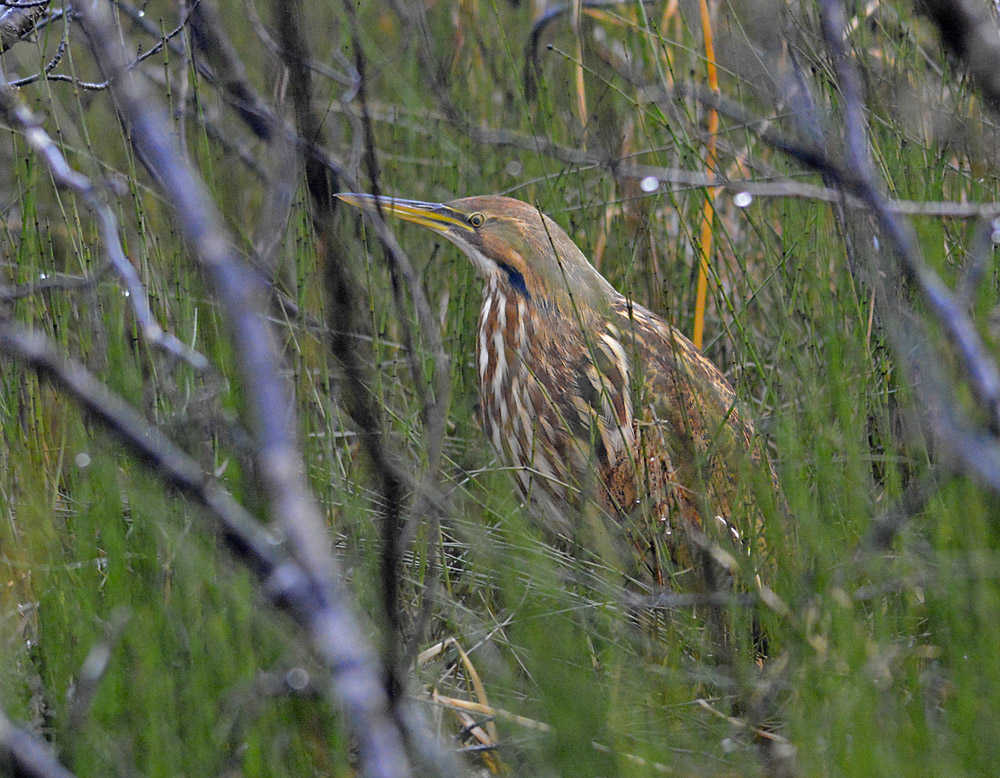
An elusive American bittern hunts and hides in an alder swamp.

An elusive American bittern hunts and hides in an alder swamp.

On the Trails: Another rare bird sighting – a bittern

On day in early-mid November, I was splashing and splodging around in one of the campground lakes, noting signs of beaver activity. As I emerged from this little exploration and came up onto the road, a streaky brown heron with dark malar stripes (like long mustachios) walked across the road in front of me. Smaller than our familiar great blue heron, this was an American bittern, a bird I had not seen for many decades. This one calmly walked from the road down into the alder swamp from which I had just come. It quickly disappeared in the thickets.

That was mildly exciting, for I suspected that bitterns were uncommon around here. So I sent a message to one of Juneau’s ace bird-watchers, who rounded up a few more “birdos,” and they all enjoyed seeing this locally rare bird. The cameras were clicking, to make the record complete.

This sighting was not as weird and wonderful as those of a hooded oriole in the Mendenhall Valley or the yellow-throated warbler in Gustavus this September. But a compilation of previous sightings in Southeast showed that bitterns have only been recorded in Juneau on three previous occasions: in late summer and fall of 1951, 1958, and 1961. Of the 20 other records, at various seasons, most came from the Stikine area, with two each from the Chickamin, the Chilkat, and Gustavus. A few of the Stikine records were of a calling male, in summer, suggesting that bitterns may occasionally breed there — or try to. Only very diligent searching is likely to find the answer.

Notoriously secretive, bitterns are among the least-studied birds on the continent. They may be more often heard than seen, at least in the breeding season. The males produce a deep, two-toned call that has earned them the sobriquet of “thunder-pump.” Very un-bird-like!

If a calling male attracts a female, it is thought that she does all the work of finding a nest site, making a nest in the marsh or in dense cover nearby, incubating the three to five eggs, and tending the chicks. If that is correct, then one might expect to find that a male often has more than one female and fathers more than one brood of chicks in a season. It would probably take great patience or very good luck to confirm or deny that expectation, given the secretive habits of bitterns.

Bitterns are migratory, at least in the northern parts of their breeding range, which extends — in the Interior — to northern B.C. Some bitterns apparently winter as far north as the Puget Sound region. It would be interesting to find out if our recent mild winters encourage bitterns to wander our way more often.

• Mary F. Willson is a retired professor of ecology.

More in Neighbors

Peggy McKee Barnhill (Courtesy photo)
Gimme a Smile: How much snow can one backyard hold?

Snow, snow, everywhere, and no place to put it!

The Spruce Root team gathers for a retreat in Sitka. Spruce Root, is an Indigenous institution that provides all Southeast Alaskans with access to business development resources. (Photo by Lione Clare)
Woven Peoples and Places: Wealth lives in our communities

Sustainable Southeast Partnership reflects on a values-aligned approach to financial wellness.

Actors in These Birds, a play inspired by death, flowers and Farkle, hold ‘flowers’ during a performance at the UAS Egan Library on Saturday, Jan. 31. (photo courtesy Claire Richardson)
Living and Growing: Why stories of living and dying in Juneau matter

What if we gave our town a safe space to talk about living and dying with family and friends?

calendar
Weekly events guide: Juneau community calendar for Feb. 2 – Feb. 8

Visit Juneau Arts and Humanities Council at JAHC.org for more details on this week’s happenings.

calendar
Weekly events guide: Juneau community calendar for Jan. 26 – Feb. 1

Visit Juneau Arts and Humanities Council at JAHC.org for more details on this week’s happenings.

Courtesy photo
Adam Bauer of the Local Spiritual Assembly of Bahá’ís of Juneau.
Living and Growing: Surfing into the future

Many religious traditions draw strength from the past.

calendar (web only)
Weekly events guide: Juneau community calendar for Jan. 19-25

Visit Juneau Arts and Humanities Council at JAHC.org for more details on this week’s happenings.

(web only)
Weekly events guide: Juneau community calendar for Jan. 12-18

Visit Juneau Arts and Humanities Council at JAHC.org for more details on this week’s happenings.

Four members of the Riley Creek wolf pack, including the matriarch, “Riley,” dig a moose carcass frozen from creek ice in May 2016. National Park Service trail camera photo
Alaska Science Forum: The Riley Creek pack’s sole survivor

Born in May, 2009, Riley first saw sunlight after crawling from a hole dug in the roots of an old spruce above the Teklanika River.

Sun shines through the canopy in the Tongass National Forest. (Photo by Brian Logan/U.S. Forest Service)
Opinion: Let’s start the New Year with an Alaskan-style wellness movement

Instead of simplified happiness and self-esteem, our Alaskan movement will seize the joy of duty.

January community calendar
Weekly events guide: Juneau community calendar for Jan. 5-11

Visit Juneau Arts and Humanities Council at JAHC.org for more details on this week’s happenings.

Kaa Yahaayí Shkalneegi Muriel Reid photo
In 2024, SSP’s Regional Catalysts attended and helped with the Kake Culture Camp hosted by the Organized Village of Kake. The goal was to be in community, grow our relationships, and identify opportunities to support community priorities determined by the community itself.
In 2024, SSP’s Regional Catalysts attended and helped with the Kake Culture Camp hosted by the Organized Village of Kake. The goal was to be in community, grow our relationships, and identify opportunities to support community priorities determined by the community itself. (Ḵaa Yahaayí Shkalneegi Muriel Reid photo)
Woven Peoples and Place: Don’t be an island, be amongst the people

Láaganaay Tsiits Git’anee and Shaelene Grace Moler reflect on celebrating values in action.