
As I was reading a research paper about the foraging behaviors of killer whales (orcas), I found a small paragraph about some observations in Prince William Sound that seemed, at first glance, peculiar.
The researchers reported that Dall’s porpoises were often seen in close association with killer whales—swimming with a pod of the whales, popping up in front of the whales’ noses, and even playing with the whales’ calves! One Dall’s porpoise stayed with a pod for more than four months. These observations begin to make sense when one recognizes that these killer whales were residents—the type of killer whale that eats only fish. Clearly, it would be folly for the porpoises to hang out with transient killer whales, which gobble up porpoises, seals, sea lions, and even other whales!
Other marine mammals that are prey for transient killer whales were also associated with pods of resident killer whales in the same study. Steller sea lions dove in and out among the whales on several occasions. A minke whale swam with a resident pod for several hours.
These observations were sufficiently frequent and consistent to suggest that the porpoises, sea lions, and minke whale were probably getting protection from predators such as the transient orcas. Transients and residents don’t mix, so by hanging out with residents, the other mammals increased their chances of avoiding the transients.
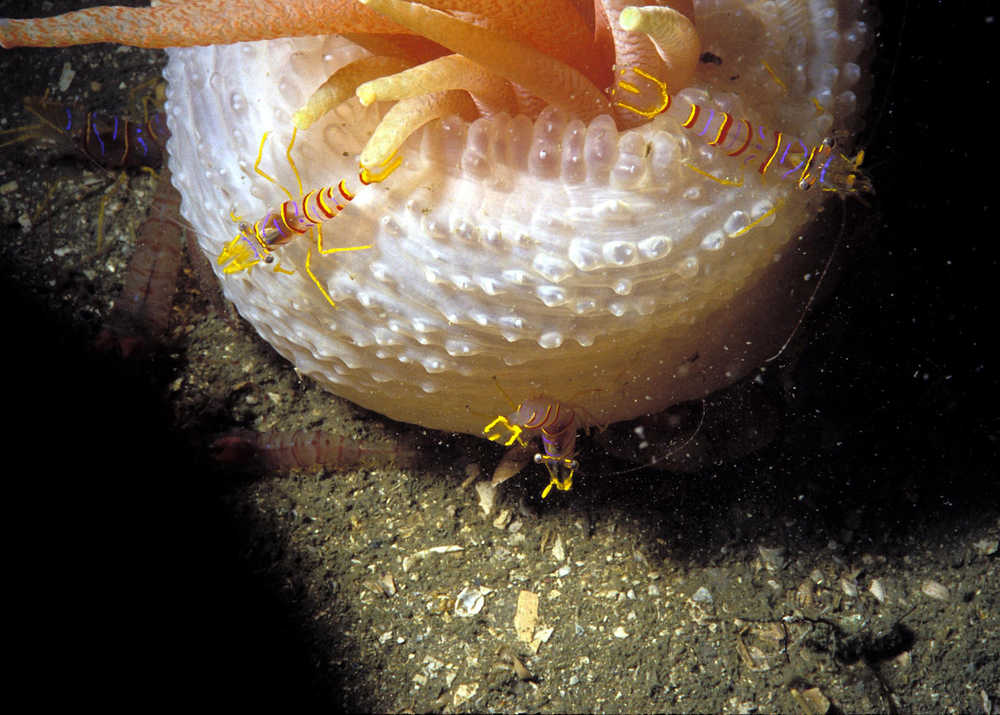
Those observations got me thinking about other protective associations. Here are various examples: Several kinds of fishes associate with sea anemones. For instance, clownfishes make themselves impervious to the stinging cells of their particular kind of anemone by making tentative approaches, gradually acquiring a covering of the anemone’s mucus—which then prevents the discharge of the stinging cells when the clownfish touches the host anemone’s tentacles. Some fishes that are close associates of anemones even feed their anemone by dropping bits of food into the anemone’s mouth.
The lion’s mane jellyfish of our cold North Pacific waters harbors a variety of small fishes and invertebrates among its tentacles. The portugese man-of- war jellyfish hosts a small fish that color-matches the dangling tentacles of the jellyfish; the fish is partially immune to the stinging cells of the tentacles. Still other small fishes lurk among the spines of sea urchins; their color patterns and behavior make them relatively inconspicuous there.
The sandwich tern is reported to nest very commonly in colonies of black-headed gulls or arctic terns, where the active nest defenses of those birds help protect the nests of the sandwich tern too. Some neotropical wrens like to nest in acacia trees that are inhabited by protective ants (or wasps), favoring trees with aggressive, active ants, which can deter predation by other birds, monkeys, and snakes.
A most unusual case was reported for the relationship between the giant cowbird and nesting oropendulas and caciques (colonial blackbirds that makes deep, pendant nests) in Panama. The cowbirds are brood parasites, laying their eggs in other birds’ nests, usually to the detriment of the hosts’ chicks. Giant cowbirds favor oropendulas and their relatives as hosts. Normally, the hosts would try to keep the cowbirds from placing eggs in the host nest, but in this case, strong defense against the cowbirds only happened in some colonies—those that were also defended by aggressive wasps and bees. In other colonies, with no protective wasps, the cowbirds were less unwelcome. Why would oropendulas ever allow cowbirds to drop eggs in their nests?
A major enemy of oropendula and cacique chicks is a botfly. Adult botflies lay eggs on the chicks, and the botfly larvae burrow into and feed on the chicks’ bodies. Chicks with botfly infestations often die. Apparently the wasps and bees present in some colonies somehow reduced botfly attacks. In the other colonies, without wasps and bees and where cowbirds were allowed, it turned out that cowbird chicks preened their host nest-mates, removing botflies, so the host chicks actually survived better with cowbirds than without them.
It is not clear how widespread that wonderfully complex situation might be—does it occur in other parts of Latin America, with other oropendulas and caciques, with other wasps or bees and other botflies? Or is it unique to the local circumstances of that study? Then we can ask: What made those circumstances so special?
Mary F. Willson is a retired professor of ecology.
