
When the ferries are running, it’s an easy ride to Gustavus: about four and a half hours, usually, with chance of seeing Dall’s porpoises and other marine critters. The ferry often has a Monday-Wednesday schedule, which makes a quick two-night visit quite possible. The great, wide sandy beaches over there are a big draw; they offer a very different habitat from anything here in Juneau and therefore the possibility of seeing different animals, and it’s easy walking, too.
I made a visit there in mid-January. My naturalist friend had set a trail camera at a place where moose habitually cross a wet ditch, carving deep, narrow trails in the banks. The camera captured plenty of moose images, including mamas with calves. One image showed a very odd thing down in one corner, and for a long time we couldn’t figure it out. Then my clever friend got it: ‘twas the rear end of a duck, dabbling in the ditch in the dark of the night. All we could see was an end-on view of the tail with crossed wingtips above. Very odd-looking, indeed.
Out on the grassy flats where spruces have begun to colonize, we found owl pellets, probably of a short-eared owl, containing tiny mammal bones and a shiny beetle. We noticed that clumps of young spruces often seemed to grow on low mounds, where drainage might be better than in the swales. But do they need to grow on these slightly elevated places? Apparently not, because we found a number of very small spruces getting started in the low spots. So maybe a clump of little trees makes its own mound when needles and twigs are shed, or the branches intercept wind-driven dust and silt??
On the sandy beach, we enjoyed following the tracks of a raven fossicking in the tidal wrack and digging up some treasure from the wet sand. There weren’t many mollusk shells left below the high tide line, but I did find one nice piddock shell; just one, though, a contrast with last summer when there were many. Piddocks are burrowing clams, with a jagged edge on the shell for scraping a way into wood or packed sand or even soft rock. Other shells were scarce too: a few whelks in good condition, and some cockles and ordinary clams.
We made a brief foray into one of those long meadows that eventually drain out onto the beaches. Moose tracks going every which way, of course; moose are really common over there. Wolves had gone single-file as they entered the meadow and then fanned out, leaving their big paw prints on the way to the beach.
A rivulet that meandered through the meadow had some open water, despite the recent low temperatures. Peering down into the openings of the ice, we could see amphipods, caddisfly larvae, a diving beetle, and a couple of very small juvenile salmonids that quickly dashed for cover. The water temperature couldn’t have been much above freezing, yet all these critters were active.
We returned to the car on a game trail through the woods. Many critters used this trail, at least in places: moose, wolf, coyote, and best of all, a wolverine that had gone from the trail to the meadow, leaving nice clear footprints. Later, we went back to set the trail camera in this area and hope for some good videos. Along the road, we chanced upon a flock of pine grosbeaks, busily foraging on seeds (more on this next week).
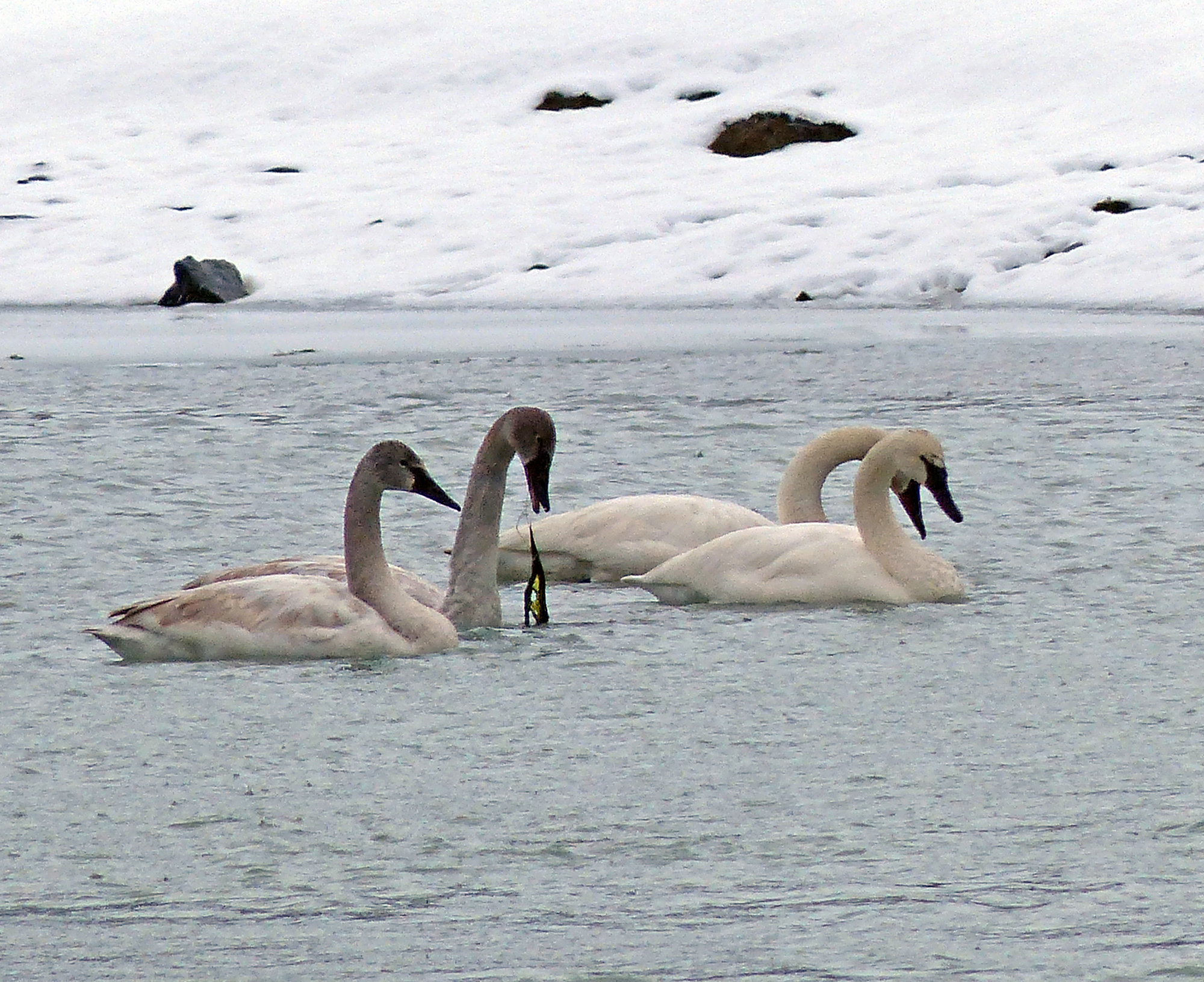
Back at the house, looking out on a bend of the Salmon River, we were treated to a small parade of trumpeter swans: a pair of adults, then another pair with a handsome gray cygnet. They pulled out on a gravel bar a little way downstream and so gave us a good look at them. An uncommon sight here in winter, although much of the Alaska-nesting population winters along the coast in various places. The swans have the interesting habit of incubating their eggs on their enormous feet, rather than in a featherless incubation patch on the adult’s belly, and both male and female can incubate. Cygnets keep some of their gray juvenile plumage into their second year, becoming fully white-feathered by the next year. Although occasionally they may pair up and start nesting when they are two or three years old, this does not unusually happen until they are about four years old.
• Mary F. Willson is a retired professor of ecology.
