
At 11 p.m. on a spring night in 2008, Logan Miller and Nick Rutecki decided to walk the 12 miles from a friend’s house to Rutecki’s.
That decision was the start of something much bigger.
“I still remember the excitement of leaving — walking into the dark foggy night with just a light jacket on,” Miller wrote in the duo’s blog. “We slowly walked along paths and roads, through the soft, eerie orange glow of Juneau’s streetlights … to Nick’s house. We sat on his roof as the early summer sun began to rise somewhere behind Juneau’s thick cloud ceiling, and the wetlands became a pale gray-green, with silver sloughs of salt water running through them. As we perched on his shingles and watched the clouds break with light, we talked about one day finishing college, and just walking.”
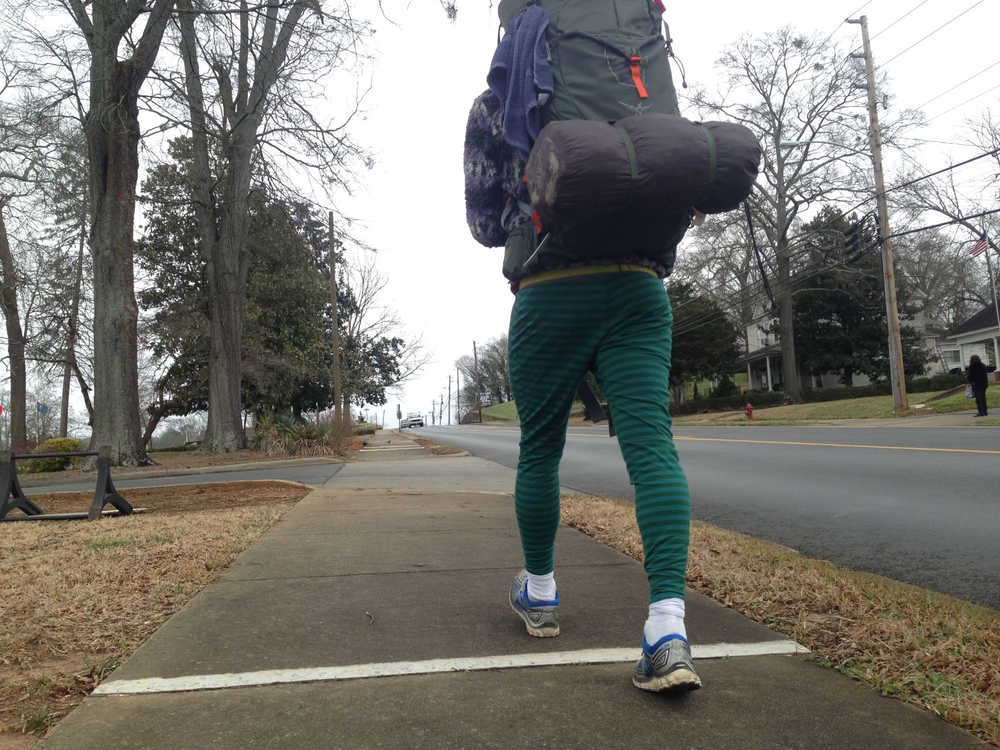
Now, eight years later, that’s what they’re doing. At the end of 2015, Miller and Rutecki set off from New Orleans and became “two guys walking around America with backpacks and no plans,” as they describe themselves on the blog. So far, they’ve walked more than 500 miles.
Part of the reason they like walking — as opposed to bicycling, which they also talked about doing — is its slow pace.
The South would be a good place to start, they figured, because it was more likely to be warm. That hasn’t worked out that well; the South has been seeing some cold weather.
While sleeping in a shelter on the Applachian trail, they and a few through-hikers — people hiking the trail from its bottom, Springer Mountain in Georgia, to the top, Mount Katahdin in Maine — ended up fending off snow blowing into the shelter.
“Everyone was pretty wet and cold,” Miller said.
Another reason they chose to start walking in the South is because, after growing up in Alaska, “it’s the most out of our comfort zone you get, culturally, while still being in the same country,” Miller said.
“There’s enough to see in America that we didn’t really want to leave,” Rutecki added.
So far, they’ve walked from New Orleans to Pensacola, Florida, then — after a break to visit family for the holidays — hopped over to Mobile, Alabama, walked through Alabama, through Atlanta, and are now in northern Georgia, both on and off the Appalachian Trail.
Though they like the trail, they prefer to stick to the roads, as Miller describes in another blog entry — because “98% of Americans will never hike a long-distance trail, and when traveling by roads and towns, we get to spend time with those people every day. And that is really what the Walking Trip is about.”
Some of those people have made an impact. Because of the slow pace of the walkers’ trip, they have days to think about them.
In Alabama, Miller wrote about a girl the two met, whose happy, loving demeanor inspired him to call her “Wisp” on the blog. She ran after them with a small backpack, saying she’d walk with them for a while; they all sat down in the woods to talk, she pulled out some marijuana, two cops walked up, and she got arrested.
“She was cute, and she was really fun for me to talk to, and then it was almost like a mild crush — and then she got taken away just as fast,” Rutecki said. “Things happen at such a slow pace, when you’re out walking around, that was quite the pick up.”
Other people they’ve met have tried to save their souls, give them rides, have gifted them oranges, offered the places to stay, and more.
So far, they’ve found most people are “incredibly generous and open, but a lot of those people are also still very wary,” Miller said. “They’re always warning us of the dangers out there and stuff like that. That’s kind of an interesting thing. We go to small towns, and people tell us cities are dangerous. We go to cities, and people tell us small towns are dangerous. So far, nowhere’s actually been dangerous, knock on wood.”
Though people may be suspicious of them initially, “once you’re in that community and you’re deemed to be a safe member of it, then the hospitality is just incredible,” he said.
That’s one of the things their blog focuses on, Miller wrote — “the unexpected and often comical situations we encounter, with a theme of showing the remarkable goodness and trust of the American people that we regularly experience.”
Read the Walking Trip blog at www.thewalkingtrip.com.
• Contact Outdoors editor Mary Catharine Martin at maryc.martin@capweek.com.
Editor’s Note:
This is the first week featuring a column by Logan Miller, who is walking around America with fellow Juneauite Nick Rutecki. Keep an eye out for his thoughtful ruminations on the country they walk through and the people they meet in future Outdoors sections.
