
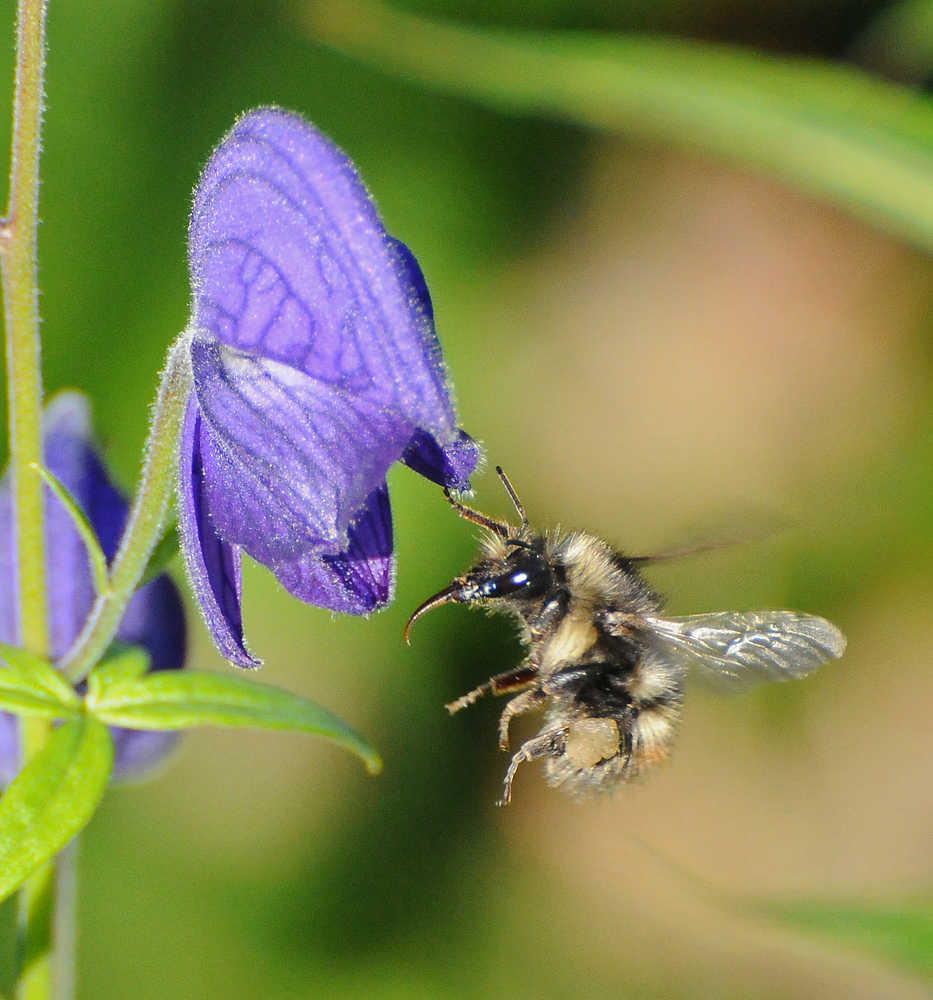
A bumblebee colony begins in spring, when a queen bee emerges from hibernation and searches for nectar and pollen.
She mated the previous fall, so her eggs are fertilized. She sets up shop in an old mouse or bird nest, or a tree cavity, perhaps adding some dry grass insulation. There she lays a small clump of eggs, maybe eight or ten of them.
She incubates them for a few days, using warmth generated by her body. When larvae hatch from the eggs, they are fed on nectar and pollen collected by the queen; they develop into adult workers (female) in about two weeks or so.
As the summer progresses, the queen will lay numerous new batches of eggs, and the new larvae are fed by the workers from earlier broods. The colony grows as new batches of workers are produced through the season, but each worker probably lives only about two weeks.
When a new worker bee emerges from the nest for the first time, she has to figure out how to exploit the flowers that are available at that time of year. This may take her a day or two. Some flowers are simple, open cups, easy to enter, easy to probe for nectar, easy to pick up pollen and pack it in the “baskets” on the hind legs. For example, daisies, goldenrods, and salmonberries offer easy pickings.
Other flowers are more complicated and require considerable experience before a worker can exploit them effectively and efficiently. Lupine and beach pea flowers have to be opened and entered in particular ways. The nectar of monkshood can only be reached by crawling into the lower part of the flower and reaching up into the hood (or sometimes by chewing a hole in the side of the hood!). Monkshood pollen is quite accessible in the lower part of the flower. So the bee’s behavior may depend on whether she is foraging for pollen (to provide protein, minerals, and vitamins for growing larvae) or nectar (to provide energy needed for larval growth; this may determine the eventual body size of the larvae and new workers).
In addition to learning how to operate each kind of flower, a novice bee has to learn how to find them. Unlike honeybees, which communicate their foraging finds to others at the hive, bumblebees are individualists—each one has to figure things out for herself, so novice bees do a lot of exploring and sampling of different kinds of flower. Then each bee usually specializes on certain flowers and becomes adept at exploiting them. As she explores, she learns where the best ones (for her) are located, and she may use a foraging route regularly, which makes her foraging trips quicker and more efficient than random searching.
However, as her chosen species of flower comes to the end of its blooming period, she may (if she has lived so long) have to start exploring all over again.
One overcast day in early August, a few friends sat down on rocks in a soggy meadow below Naked Man Lake on Douglas. All around us were gentians (Gentiana platypetala) with tightly closed, sky-blue flowers. A bumblebee clung to the side of one flower, feebly pawing at the tops of the closed petals, as if trying to open them so it could crawl in.
No luck.
But nearby was one flower whose petal tips had separated ever so slightly. Now came a tiny bee, who popped through the narrow gap and spent a good 10 minutes or more happily scrobbling about within the flower. I could see its silhouette through the pale parts at the bases of the petals. All the other gentian flowers in the area remained well closed and unvisited; I think they only open well when the sun shines, but I did not find any published studies about the pollination biology of this species.
The next day, hoping vainly for some sunshine, I happened to venture up to the gentian fields on Gold Ridge. The day was warm but overcast, and the gentians were all closed. However, two of them had holes chewed in the side of the closed flower, as if perhaps some bee had desperately wanted what was inside.
Bumblebees were flying about here and here but not visiting the sky-blue gentians, the many harebells, or the very common monkshood. I saw one bee on the few dwarf fireweeds, one bee on the last rattlesnake-root flowers, one bee on the last northern geraniums, one bee on an uncommon arnica, and one on a little patch of groundsel. In short, the bees were visiting the rarer flowers in the meadows.
Were those individuals all specialists on those particular species of flower, getting the last of the season, or were they desperate seekers of food because their own specialty flowers were finished, or….? And where were the individuals that could be foraging on the numerous monkshood flowers?
• Mary F. Willson is a retired professor of ecology.
