
The tide was moderately low, a minus 3.9 or so, and four of us had the privilege of tagging along with a genial visiting algologist (technically a phycologist) on a stroll through the intertidal zone. As true neophytes (the word literally means ‘new plant’!), we hoped to learn to identify a few of the common intertidal algae. Knowing the name of an organism is just a beginning: if you know the name, then you can probably look it up and find out a bit more about its natural history. A name in a vacuum isn’t very interesting.
We ambled across rocks and mudflats as the Latin scientific names (along with identification cues) were dropping thick and fast. One of us took notes, rendering the names phonetically—to be corrected later, along with brief tidbits of natural history—to be amplified later. So we had homework to do (as did the algologist, whose specimen bag was getting fat).
There are thousands of species of algae, ranging in size from microscopic one-celled kinds to giant meters-long kelps, and ranging in form from strings and ropes, to bristly mats and dainty frills, to hefty blades, to bubbles and blobs, and everything in between. Their life histories are equally varied, spurring me to contemplate a future essay on what is called ‘alternation of generations’, something that is characteristic of most plants but not found in animals.
In the meantime, here is a tiny sample of our finds on this excursion—the ones we found most readily distinctive.
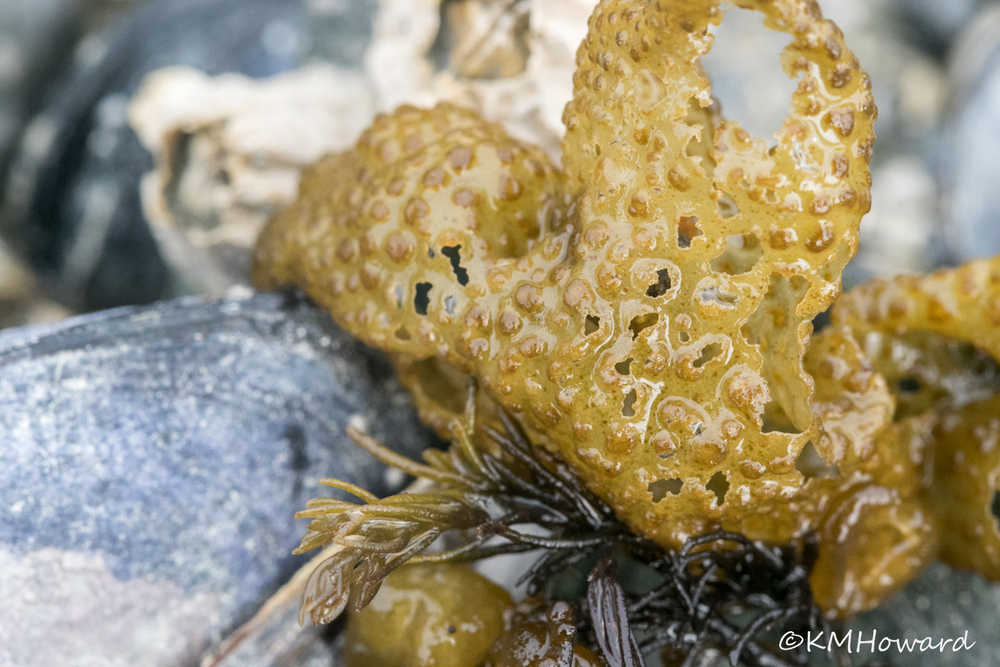
• Sea cauliflower (a.k.a. sea potato or brain seaweed). Leathesia marina, classified as a brown alga.
This is a lumpy, spongy, yellowish-brown alga, hollow except when quite young; when this blob is squeezed, it breaks apart into filaments, not mush. It is an annual plant (meaning that it does not live from year to year) in the mid to low intertidal zone. It often grows as an epiphyte on other species of algae, but it also grows on rock. The visible blob produces spores that germinate into tiny egg- and sperm-producing plants; when a sperm fertilizes an egg, the resulting zygote grows into the spore-producing blob. The alternation of a spore-producing plant with a gamete-producing plant in the life cycle is the basis for the term ‘alternation of generations.’ One research study found that mortality increased when the plants were crowded and when wave action became too severe. This is one of several species of alga that have antiviral properties and therefore some medicinal value for humans.
• Studded sea balloons. Soranthera ulvoidea, classified as a brown alga. The “balloons” are pale brownish sacs up to about two inches long. The surface is studded with darker pimples, which indicate locations of spore formation. As in the sea cauliflower, the spore-producing individual grows from a fertilized egg on a small plant in the alternate portion of the life cycle. This species is an annual that only grows as an epiphyte on other algae of two particular genera. A researcher investigated the possible consequences of this epiphyte on the host, and found that the presence of the epiphyte increased the drag (caused by water currents) on the host and tended to make the host detach from its substrate (which is generally lethal to the host), but sometimes the epiphyte detached first, and no harm came to the host. Indeed, it seems that the presence of the epiphyte reduced grazing on the host by amphipods, which preferred to eat the epiphyte.
• Sea sacs (Halosaccion glandiformis), classified as a red alga. The long, slender, thin-walled, finger-like sacs are reddish-purple when young but bleach to brownish-yellow as they age during the summer, before dying back in the fall. Each sac is perforated with tiny pores that let in sea water. The sacs fill with water except for a gas bubble at the tip. When exposed to air, the sacs lose water by evaporation and through the pores, while surface tension at the pores prevents entry of air. A good supply of internal water allows the sacs to survive exposure to air longer than if the sacs are empty; photosynthesis (the process by which carbon dioxide and water are converted to carbohydrates and oxygen) can be conducted using carbon dioxide from the contained water. If a small hole develops at the base of a sac, little amphipods and worms may crawl in and use it for a refuge.
The visible sac may be a male or a “tetrasporophyte” that developed on a microscopic female. The tetrasporophyte puts out spores in groups of four (hence the “tetra”), two males and two females. The females are mature sexually at a very young age. They catch non-motile sperm on special hairs, and the resulting zygotes develop into a new tetrasporophyte, while the tiny female disappears. The sources of sperm for the zygote are males of the previous generation, because the males produced at the same time as these females are not yet mature. A research study showed that the spores settle and germinate best on surfaces that are rough at a micro-scale, rather than on smooth surfaces.
Thanks to Dr. Sandra Lindstrom for a good field trip and Dr. Mandy Lindeberg for additional instruction.
Note: these algae, like many others, have had numerous common and scientific names over the years. Common names often vary from place to place. Changes in scientific names generally reflect altered and improved understanding of genetic relationships.
• Mary F. Willson is a retired professor of ecology.
Related stories:
Off the Trails: Some June sightings
