
We took the old way up to Cropley Lake, through the woods, working our way around or over windthrows and mudholes. The sun blazed out of a blue sky, raising temperatures into the mid to high 70’s — very hot indeed, by Juneau standards! Once in the big meadows near the lake, it was time for tea and lunch in the shade. On the far side of the lake, we found wolf scat containing snowshoe hare fur and bones, and the coltsfoot was already in bloom. One remnant snow patch posed no problems, but the ground was quite squishy in many places.
Three-leaf goldthread was the most common wildflower in bloom. Its flowers are totally unlike those of the closely-related fern-leaf goldthread, only the fruiting capsules show that they are related. The flowers of the three-leaf species offer nectar to visiting gnats in five tiny golden trumpets encircled by five round white petals; the other species has neither the trumpets nor the white petals. One small area held a wildflower garden of white three-leaf goldthread, pink bog blueberry, pink bog rosemary, and a single white cloudberry.
On another day near Eaglecrest, a white-crowned sparrow and a junco foraged close together in a ditch with running water. Both birds were fly-catching — jumping up to nab some tiny insects. Their stout, conical bills are not adapted specifically for fly-catching but rather for cracking seeds. Nevertheless, these birds catch a lot of bugs, especially in spring and summer and feed their chicks on bugs, too; that conical bill works quite well for bug-catching.
A trip up Gold Ridge above the tram crossed several snow patches and the upper reaches were still very snowy. Midway along, we settled for watching two marmots near the snowy entrance of their den. Both sprawled in the sun for long minutes, one on snow, one on grass, barely moving except to scratch. Finally they ambled off into the brush, one of them nibbling on salmonberry leaves. Nearby, a willow ptarmigan clucked at us, cast a wary eye over its shoulder, and took refuge under some small confers, still clucking. All the while, male fox sparrows sang, advertising their territories.
A weekend in early May brought some of the lowest tides of the year, so of course I couldn’t miss that. There were lots of sea stars and sea cucumbers and other usual things, but I saw my first rose star, all prickly and mottled red, pink and white. We found a big Neptunea whelk laying its spiral coil of egg cases. I saw the tiniest hermit crab I’ve ever seen — living in a periwinkle shell about three millimeters wide. While we watched, it waved its delicate wee pincers, as if to say, “Move on!” We found one of the spectacular red hermit crabs, too. On a previous excursion, we had found several of them living in Neptunea whelk shells; this one was trying to fit its rather hefty rear end into a Neptunea shell that seemed to be too small. We left it to the struggle, wondering if sufficiently large snail shells are hard to find.
Out on the sand flats at Eagle Beach State Park, there were several bear-dug pits with clumps of rice root (or chocolate lily) left behind, so it was hard to guess what the bear was after. Several large scat piles showed that he had eaten well, and quite recently. This is reported to be a good-sized beast, known as Big Head to the amiable fellows that work there.
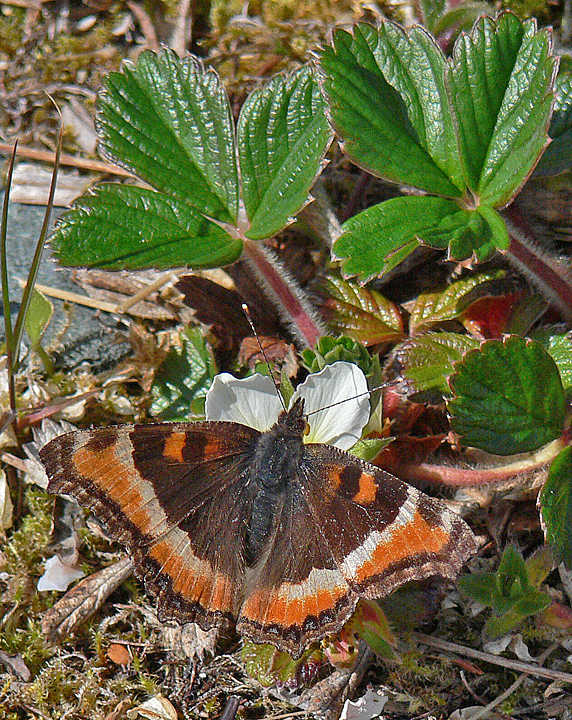
I was very pleased to see a colorful butterfly sunning itself on the sand, tilting to and fro when buffeted slightly by the breeze. This was a Milbert’s tortoiseshell, known for its sun-basking behavior. It is not common here, so this was a treat. In contrast to the colorful upper side of the wings, the underside is also beautiful but in subtle browns in a camouflaging pattern, so when the wings are folded the butterfly looks like dead leaves or bark. It winters as an adult (as does the mourning cloak), sometimes in small groups. They feed on flowers, no doubt effecting some pollination, but also on tree sap and rotten fruits. The spiny larvae feed on stinging nettles; young larvae feed in groups inside a web on the underside of a leaf, but older larvae are solitary, sheltering inside folded leaves tied with silk.
We could use a few more of those larvae on couple of local trailsides, where bare knees are at risk.
• Mary F. Willson is a retired professor of ecology.
