
In mid November, the tide tables told us that there would be some big (over 20-foot) tides during the daylight hours. These were associated with a full moon, but not an ordinary full moon. This was a “super full moon,” although I didn’t expect to see it through the thick cloud cover. However, just at the right time (for me), a sizable hole opened in the clouds and there was a shiny, bright moon.
The terms “super full moon” is not an official astronomical label; it just refers to occasions when the moon looks a bit bigger and brighter than ordinary full moons. They occur when the time of a full moon coincides with the time when the moon, in its elliptical orbit, is closest to Earth. Here in the northern hemisphere, they look bigger in winter than in summer because that’s a time when the earth is closer to the sun, so the sun’s gravity brings the moon in a little closer. The last especially large super full moon occurred in 1948, and the next one is predicted for 2034, so for most of us, it was a bit of luck to see this one.
Just for fun, a friend and I strolled down to some North Douglas beaches to watch the big tide come in. There would be no beach left at the peak of the tide, but that was OK with us because we perched on a log at the very upper beach fringe to have late-morning tea and crumpets and look around. A couple of yarrow plants had lost their leaves but still sported belated white flowers. In and out of the boulders just above the incoming tide darted a nervous song sparrow that kept looking over its shoulder at us. A raven perched overhead and crooned a soft, sweet song.
A crowd of glaucous-winged gulls tolerated our quiet proximity and went on foraging among the cobbles as the water rose. Several of them winkled up mussels that they found among the cobbles. Each mussel was dropped a few times, but fell only a few inches — surely not enough to break the shell, but maybe a good way to orient the shell suitably for swallowing. Then the mussels were picked up and gulped down whole, even the ones with barnacles encrusting the shells. Gulls must have tough gullets. They swallow other rough, tough prey, including sea stars and chitons. However, good, detailed information on the stomachs of gulls seems to be hard to come by. Most sources indicate that, like other birds, they have a two-part stomach: the first part (proventriculus) is expandable and glandular, producing digestive enzymes; the second part (gizzard) is somewhat muscular, for grinding and crushing. Food can be passed back and forth between the two stomachs until it’s well digested and ready to move on to the intestine; undigested hard parts can be wadded up and regurgitated.
Other gulls yanked up little wads of seaweed, often dropping them repeatedly and eventually working over them with their bills. Were they getting tiny mussels, or amphipods, or small scraped-off barnacles, or what?
Something spooked the gull crowd into the air, but they settled down a short distance down the disappearing beach. A huge log and a boulder made attractive resting spots. With relatively little hassle, they arranged themselves about a foot apart, although an occasional interloper tried to wedge in and was repulsed.
Out in the bay we found entertainment in the squadron of Barrow’s goldeneyes that paraded back and forth. A flotilla of harlequin ducks wandered around, along with a few buffleheads and little platoon of mergansers. Two sleepy male mallards floated quietly. In the distance was a line of surf scoters and a cruising humpback whale.
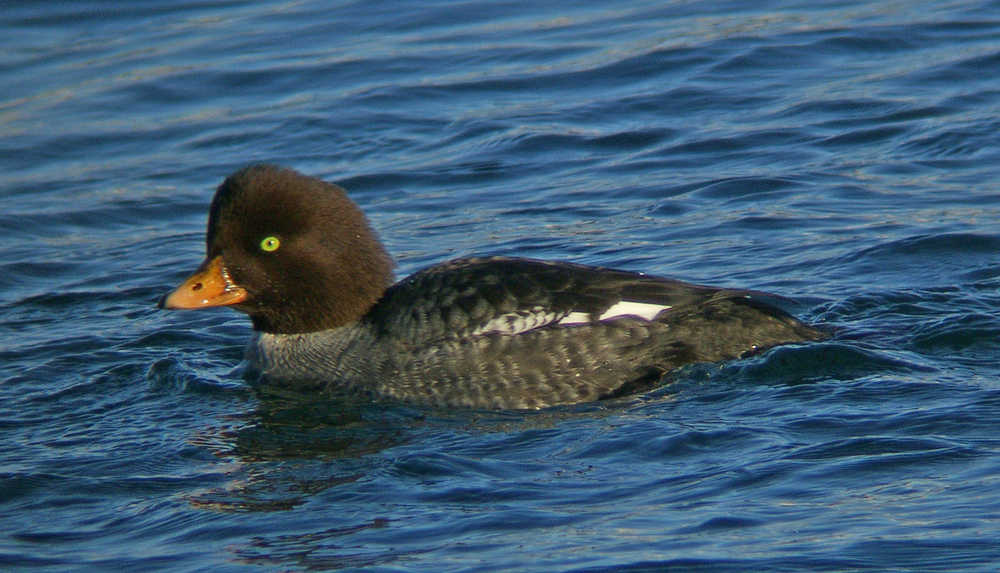
Along the shore — just a little too far away to allow easy identification — were some diving ducks making a big splash. Much peering through binoculars, much grumbling, and considerable confusion, but by dint of the process of elimination (NOT a bufflehead, NOT a scaup, etc.) joined with glimpses of useful features, we arrived at a decision: two female goldeneyes, who were flapping vigorously and nearly continuously. But this was not merely bathing, which we first thought; they appeared to be displaying to each other. Do female goldeneyes often engage in such behavior? No males were in the vicinity. So what was all this flap about?
• Mary F. Willson is a retired professor of ecology.
