
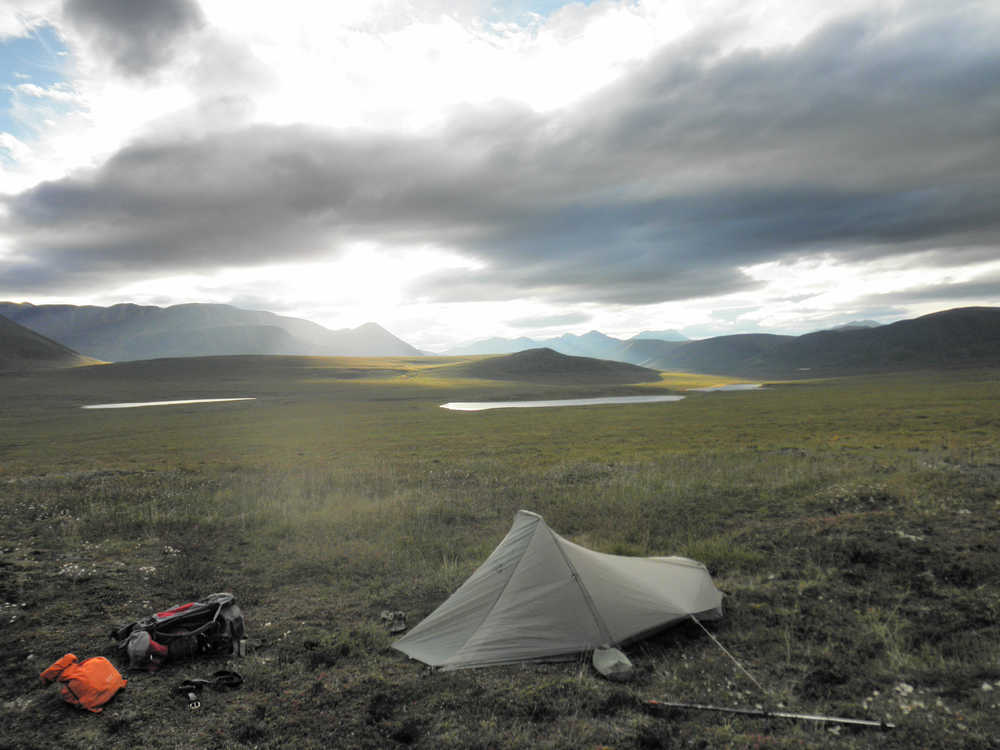
Author’s note: This is the second installment of a three-part series about wolves I met during a walk in the Brooks Range. This piece begins 17 days after last week’s column detailing experiences with a desperate wolf. Originally, I planned this to be about my next encounter with wolves but I ran out of space. Next Friday will be about wolves, I promise. I reference “pulsations,” a strange phenomenon I experienced during this journey. If you want to read more about them here is a web address: http://juneauempire.com/outdoors/2015-10-02/brooks-range-pulsations-my-own-unsolved-mystery
I watched the sun setting on mountains above the headwaters of the Alatna River as the pulsations reverberated so heavily I shuddered at times. The world seemed motionless; even the scattered bands of caribou appeared frozen.
It was near the headwaters of the Alatna River, according to the ethnographer Nicholas J. Gubser, that the Nunamiut believe their original ancestors were given the gift of life.
In his book “The Nunamiut Eskimos: Hunters of Caribou,” Gubser relates, from a creation story he was told in Anaktuvuk Pass, that a benevolent giant named Aiyagomahala created the Nunamiut and then showed them how to hunt and trade. He taught ethics, kindness, love and warned about the dangers of anger. In those times the world was very different. Animals and people talked, shape-shifted, married and had children with each other.
Before vanishing, Aiyagomahala stuck a mitten into the ground and mountains—known as the Arrigetch Peaks—formed in its place to remind the Nunamiut of their creator.
Sitting cross-legged, watching the last of the day’s light pour through clouds and sharpen the silhouettes of rolling mountains, I couldn’t have imagined a more beautiful place for life to begin.
The next morning I followed the Alatna south. Caribou ran nervously in circles and Dall sheep grazed high on mountain slopes. A large blond bear with dark legs swaggered in my direction. After he blundered into a small group of caribou, causing them to flee with clicking tendons across the tundra, his swagger became even more exaggerated.
I’d lost count of how many grizzlies I’d seen, but at that point it was somewhere in the thirties or forties. A few aggressive encounters, combined with dwindling food rations, had me a little edgy.
The last somewhat spooky encounter had been two days prior. Late that evening, I dropped my pack on a knoll that looked like an ideal camp spot. I walked a few yards away to stretch my back and stumbled on the bloody leg and shoulder of a caribou lying on the tundra. The caribou had been killed earlier that day. For a moment I considered feasting.
I studied my surroundings; there was a very good chance a grizzly was bedded nearby. I shouldered my pack and quickly moved away into the darkness. Early the next morning I walked beneath a series of black tors, 30-foot-tall protrusions of ancient granite, near a small alpine lake. Scattered groups of caribou traversed the mountainsides.
A grizzly slunk out from behind a tor and jogged along the lake towards me. It had its head down and appeared to not know I was there.
I snuck into the maze of granite, rapidly moving away from the bear’s path. A few minutes later, I looked back to see the bear had doubled back and was coming across the tundra in my direction.
I stood still and waited with pistol in one hand an bear spray in the other.
The bear paused about a hundred yards away and I slowly continued walking. The bear followed. After a tense 20 minutes, it clambered up a scree slope and paralleled me for a while longer at a much more comfortable distance.
Two days later, in the Altana River valley, I skirted around the big blond bear without it becoming aware of my presence. A few hours later, I followed the tracks of a small grizzly and a group of caribou along a creek bed towards the continental divide. Caribou bones, skulls and even the remains of a carcass lay on and jutted out of the gravel bed.
Many of the creeks and rivers I’d followed felt like traveling through a graveyard.
“Coming around,” I hollered, holding a can of bear spray in my hand, as I walked around a bend. The rush of the creek mostly drowned out my warning.
Late in the day, in a steady drizzle and fog, I reached the top of the pass between the Alatna and Noatak watersheds.
For dinner I had water. I’d save a Cliff bar, the last of my food, for as long as I could.
In the morning the fog was too thick to travel without risking blundering into a bear. Around noon, I heard deep breathing and heavy steps approaching
Quietly, I slipped out of the tiny tent and stared into the swirling gray.
The thing sensed me, froze and quieted its breathing.
“I’m here,” I said softly.
The creature exhaled and slowly approached. A shape gradually began to appear. Soon a huge set of antlers manifested.
“Hello caribou,” I said as it came a little closer to study me. Two other big bulls appeared, paused for a few moment before all three continued on through the fog.
• Bjorn Dihle is a Juneau writer. He can be reached at bjorndihle@yahoo.com.
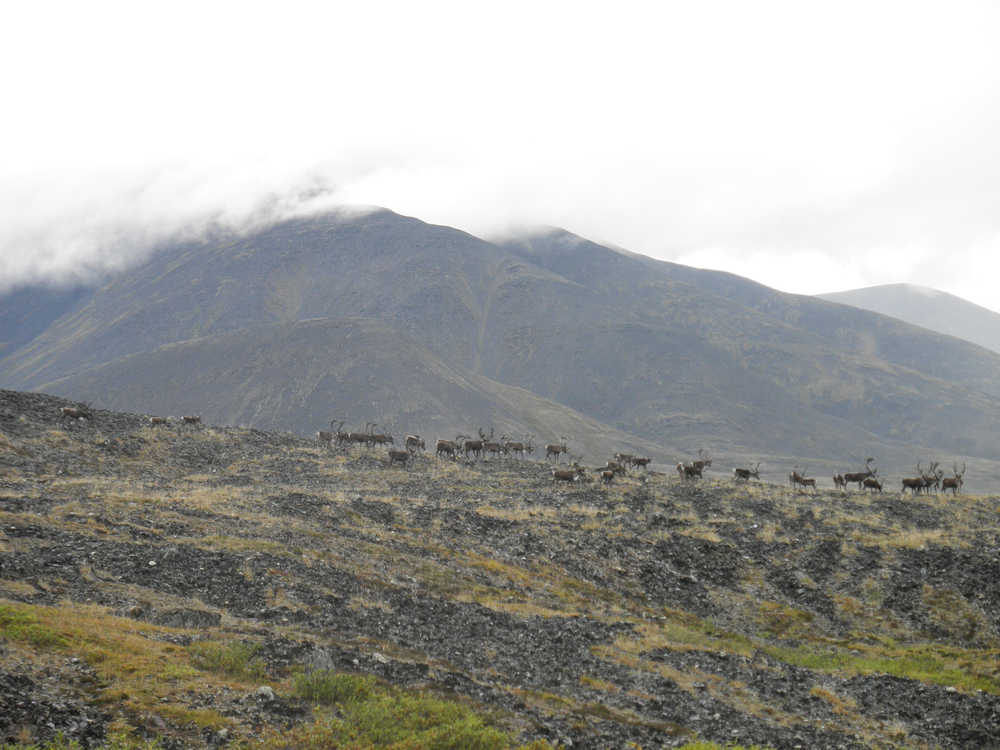
A herd of caribou in the Central Brooks Range.
