
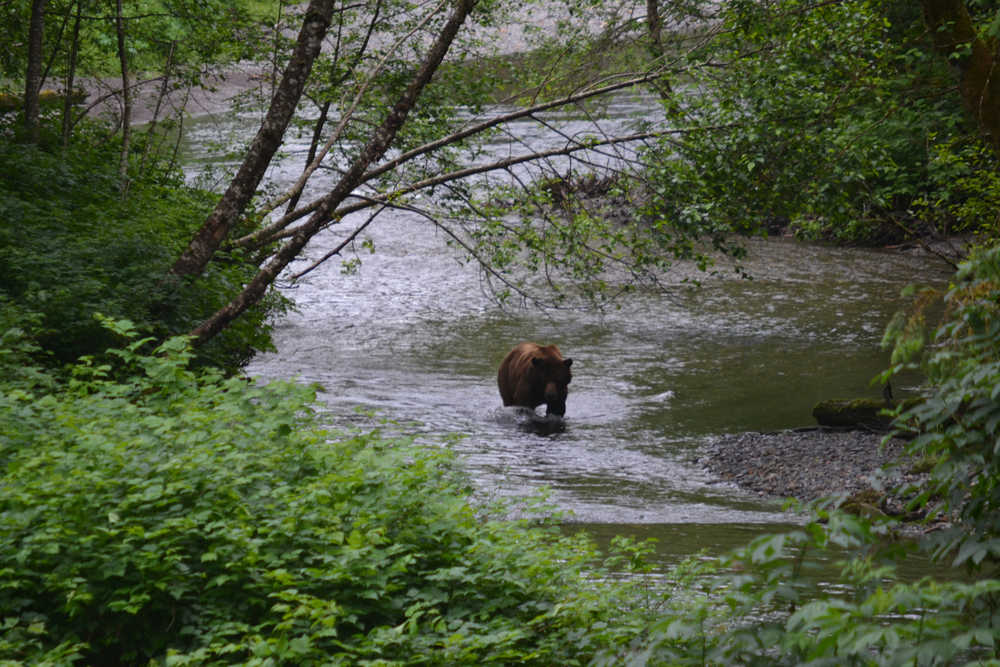
Late in life, Ralph Young, a bear guide, found himself sitting alone at a bar in Petersburg, well before five o’clock. His wife had left him on grounds of “incompatibility of temperament.” He writes in his book, “Grizzlies Don’t Come Easy,” “I loved my wife, but I loved the bears more. That’s legal grounds for divorce in Alaska and perhaps elsewhere as well.” He’d become an obese drunk. The wilderness he’d known in his youth was lost. The high adventure of stalking brown bears with famous trophy hunters like Jack O’Connor was mostly, at best, a bittersweet memory.
Then, something like a switch flipped inside him. He left his unfinished drink on the bar, got up and left. It was late in the year and snow was creeping down the mountains. The sound of geese honking carried through the air, and the light grew dimmer with each passing day. It was time to stagger home.
Home for Young was the mountains, forests and ocean of Southeast Alaska. He put together a kit, untied his skiff and motored out into the swift current of the Wrangell Narrows, past Sasby Island and into the slate-gray of Frederick Sound. He dropped anchor in a protected cove of a bay that he purposely didn’t name, although anyone familiar with the area would know it from reading his descriptions. Inside the guard timber were the relics from a camp he used to share with his friend and seal-hunting partner, a man he referred to as “Sock-less George.” George had gone missing, swallowed by the ocean or the land some years prior.
Young shot a seal for food, slept out and wandered. He looked for and found gold and then decided he didn’t want it. He got beat up and almost died in the crush of a maze of icebergs. He had a religious experience. Normal stuff that happens when a person goes out alone into the Southeast backcountry.
I never met Young—he died an old man in 1985, when I was a toddler. I’ve asked some Petersburg old timers about him and “rough” is the word that seems to come up the most frequently. I know him through the words of his two books, “My Lost Wilderness” and “Grizzlies Don’t Come Easy,” both of which he wrote shortly before he died. For me, there are few other books that ache of Southeast Alaska so profoundly.
I’d like to think life got better for Young when he returned to town, that the ornery old cuss was able to bury his past real and imagined sins and demons. Life is hard enough already, and most of us don’t make it any easier on ourselves. Young’s health fell apart in the following year. He gave up guiding soon after. He still made periodical journeys into the wilderness, but more and more these trips became journeys of nostalgia rather than discovery.
Young mused about the possibility of there being a bear somewhere in the rainforest with his number on it. He’d been in on hundreds of kills and charged several times by bears wounded by his clients, yet he’d never been so much as touched by a living bear. His longing seems romantic, but understandable.
He’d spent his life killing what he loved. Maybe what he loved was killing him, too, but in a painfully slow and passionless manner. The sudden rush of a bear, the intimacy and horror of its touch and the possibility of being consumed: there was no way to get closer to the bear.
Instead, Young tried to pay his debt to bears and wilderness by fighting to keep Admiralty Island from being thoroughly logged. K.J. Metcalf, the president of Friends of Admiralty, remembers Young showing up to meetings in the 1970s and telling him that he would do anything to save Admiralty Island.
Last August, on Admiralty Island, my older brother Luke and I carried deer off a mountain down to the ocean. Tired but happy, we inflated a raft near a small stream that had clusters of pink salmon spawning. We heard the bear before we saw it galloping down the stream, chasing fish, in our direction. A quick yell made it peel off and run for the woods. Later, a sow with a cub emerged on the tide flat. Deer came out to feed near dusk. Harbor seals swam around Luke’s boat, eyeing us with curiosity. Bald eagles and ravens were perched in trees watching. Blue heron, ducks and geese were everywhere, filling the world with their calls.
I thought of Young and understood his brutal love for this place.
Bjorn Dihle is a Juneau writer. You can reach him at bjorndihle@gmail.com.
