
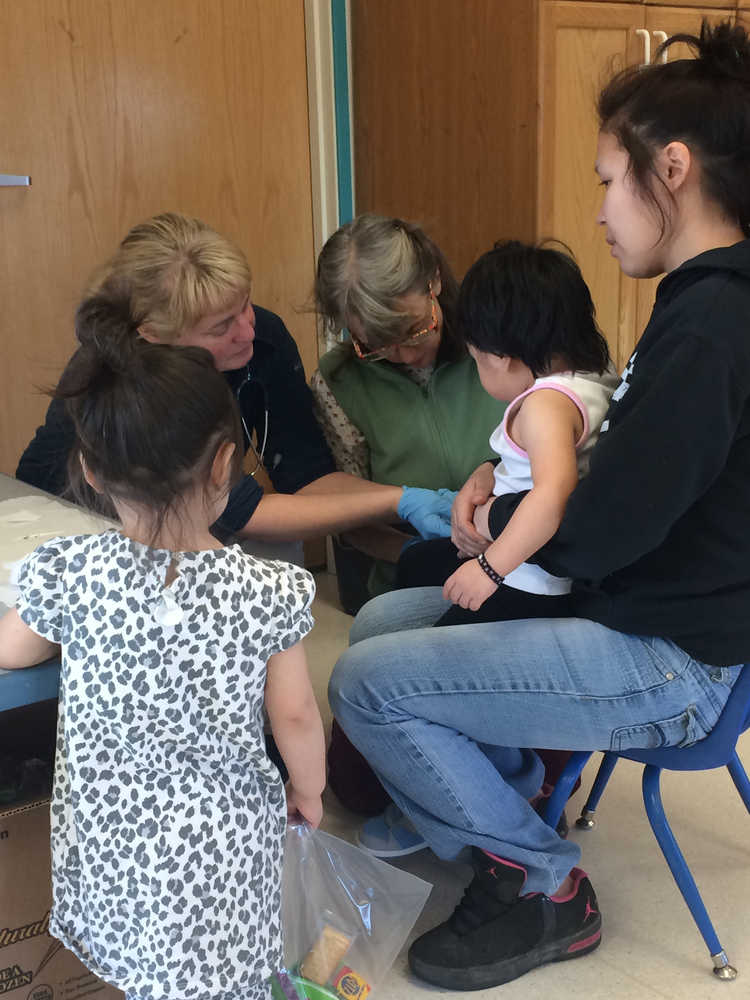
Five years ago, Janet Schultz had a stubborn problem to solve: More than 40 Head Start programs in rural Alaska were in danger of losing funding because they couldn’t meet a federal requirement to give their students comprehensive health-screening exams within 90 days of enrolling.
Schultz, a nurse practitioner and Head Start senior official, knew the program helps kids under the age of five who are growing up in economically disadvantaged homes — especially in isolated places like rural Alaska villages. It helps children learn and thrive, nurturing their health and preparing them for social challenges they’ll face in kindergarten.
“Head Start needed those screenings and nurse practitioner programs have trouble finding placements of students, getting education needed for their students,” Liz Driscoll, an adjunct professor at University of Alaska Anchorage’s School of Nursing, said. “She put the two together in the middle of the night — aha! — a mutually beneficial partnership.”
Schultz cold-called the UAA School of Nursing in December 2012 and spoke with UAA’s Professor Dianne Tarrant and Assistant Professor Naomi Torrance about engaging the family nurse practitioner students in a project that would keep those rural Head Start programs open.
“It’s a big deal if the Head Start center loses its funding,” she said. “They put together a conference call with UAA and the Head Start grantees in Alaska.”
Those grantees often couldn’t comply with the required health screenings because they couldn’t transport — fly — the children to a clinic in a larger village or town, timing the trip with an often-temporary visit from a healthcare provider.
Out of that conversation grew Project Partnership for Alaska’s Kids — better known as Project PAK. Since its start in 2013, four UAA faculty and about 15 students have traveled to Head Start locations in Allakaket, Fort Yukon, Grayling, Hooper Bay, Kwethluk, Nunapitchuk, Pilot Station, Tok and Venetie.
“In their first clinical semester, they’re in their pediatric rotation and this is a pediatric opportunity,” Driscoll said. “We can take three or four: We’re limited by the small size of the planes and the funding. One trip is on the road system — to Tok. All the rest have been remote.”
‘The kids really
took to us’
The biggest challenge has always been finding the $3,000-$5,000 needed to pay for each trip, Driscoll said.
“The cost depends on how many places we go, whether it’s a regularly scheduled flight or charter,” Driscoll said. “We always sleep in the Head Start building itself and bring all our own food — sleeping bags and a cooler of food. When we go to some of these remote villages, the Head Start center may be one of four or five public buildings. The Head Start buildings always have running water, bathrooms and a kitchen.”
A grant paid for equipment that tests for lead exposure and anemia “which are two requirements for Head Start because they greatly affect brain development,” Driscoll said, “but money is also needed to buy tongue depressors, reflex hammers and other supplies needed to provide the physicals.
“The basic things you need to do a well-child physical,” she said. “It ends up being 50 pounds of equipment. We have to have gloves, lancets to prick the finger and get a drop of blood, a variety of colorful bandaids with cartoon characters on them for the children to choose from.”
The one treatment they provide is dental fluoride varnish for teeth, “otherwise, we are only doing well-child visits,” she said. “If we do identify a concern — an active ear infection or rash — we make a referral to whoever is the healthcare provider to that child.”
Nunapitchuk was a favorite place to visit.
“It’s a much slower pace than Anchorage and everyone there knows everyone else because it’s such a small place,” she said. “The kids there really took to us. After we spent the day seeing the kids at the Head Start center, we went for a walk after dinner and they just were eager to show us all over the village — where they like to play, showed us the school. They were really welcoming, and excited we were there.”
Palassa Beans manages Pilot Station’s Early Head Start.
“What [the UAA instructor and NP students] do is they have the staff set up appointments for them, set up a schedule,” said Beans, whose grandchild has received an examination from UAA students. “The Early Head Start home visitors and the family advocate are there to help. They really do let us get caught up with our requirements. It helps. And they’re really friendly.”
‘I was immediately
interested’
Monica Perez-Verdia is a family nurse practitioner pursuing her master of nursing science degree at UAA. She’s originally from Mexico City, but lived and attended school in Texas for many years. While working in Texas, she got to know some traveling nurses who were coming to Alaska for summer work.
“I had always wanted to come to Alaska,” she said. “I came for a vacation and absolutely loved it. I moved here the following summer with those nurses. At the end of their contracts, they all left, and I stayed. I ended up going to nursing school here at UAA.”
During orientation to the graduate program at UAA, she learned a select few people would be able to take part in Project PAK. She had never visited rural Alaska, despite the fact that her husband was raised in Barrow and frequently travels to rural areas for work.
“I was immediately interested in the opportunity not only to travel to rural Alaska — which I had always wanted to do — but for additional pediatric experience doing physicals,” she said.
Monica called former students and the faculty to clarify packing needs and clinical preparation.
“We took a small plane, which was actually very fun,” she said. “One of my cohort classmates was with us, as well as two students in the cohort ahead of us. We were accompanied by one faculty member, who has been on numerous trips. Beyond the usual pediatric school-related materials, we watched and read material regarding dental care for this trip.”
Monica says the trip gave her more confidence going into her pediatric rotation.
“I was able to work with a student that was one year ahead of me in the program and who had been on a trip in the past,” she said. “We were able to do exams at a less intense pace than in a clinic. Doing multiple physicals back to back for various age groups was a fantastic way to reinforce learning.”
Project PAK made it possible for Monica and the group to provide small children in rural areas with a head-to-toe physical as they entered Head Start.
“[That] will set them up for success as they enter school,” Monica said of Head Start. “Early learning is such an important part of early education, especially in rural Alaska. Bringing exams to rural areas is really important in areas where it may not have occurred otherwise. I believe we went out there and made a long-term difference for families.”
• Written by Tracy Kalytiak, University of Alaska Anchorage.
More Neighbors
Guy About Town: 30,000 maps of Juneau
Scouts go on 217-mile high adventure trek
Living & Growing: What the Interfaith Council brings to the table
