
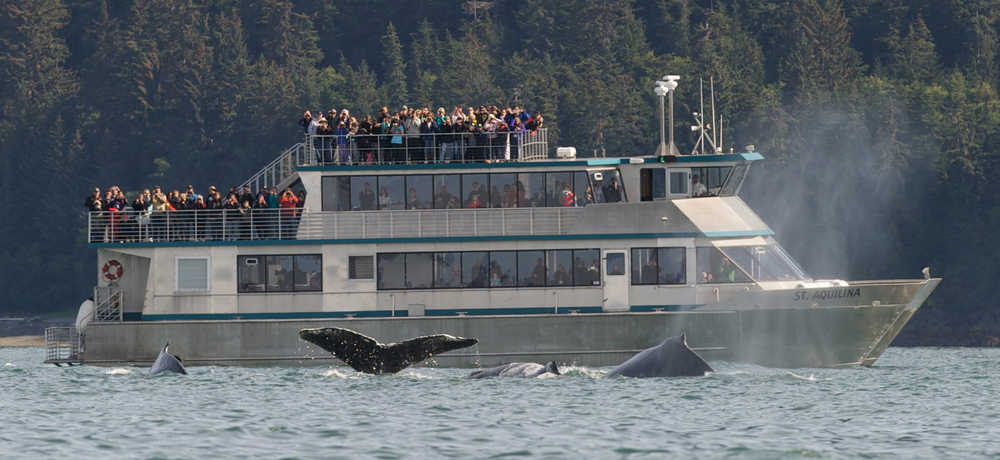
Whale watching operators have noticed more communication, less crowding, fewer complaints and more awareness of speed and time spent with whales, according to feedback given at NOAA’s pre-season Whale SENSE meeting.
As it hits its first anniversary in Juneau, NOAA’s Whale SENSE program, a voluntary partnership between whale watching boat operators, is credited with opening up a dialogue on the water.
Whale SENSE’s conduct on the water training has put Juneau companies on the same page, said Gastineau Guiding owner Bob Janes.
“Captains talk more to each other, that didn’t exist before,” Janes said. “We not only communicate with each other for positions to best give the whales the room they need, but also call each other out if that needs to be done. … It gave us as companies a method to allow our captains and naturalists to police each other a little bit better.”
[Watch for whales, experts say.]
Companies that participate in the program agree to go beyond federal humpback whale approach regulations, reduce speed on approach and departure, and reduce time spent with whales. Participating guides must complete Whale SENSE training and inform passengers about protection laws, ecology, threats and conservation.
With whale watching already a booming industry in Southeast Alaska — numbers of visitors, companies, and even whales, are on the rise — Gastineau Guiding and five other companies (Allen Marine, Dolphin Tours, Rum Runner Charters, Alaska Galore and Juneau Whale Watch) felt they couldn’t wait for legal regulations to catch up with industry.
Aleria Jensen, a marine mammal specialist and program coordinator for NOAA, said the model used on the east coast, where Whale SENSE started, wouldn’t fit Southeast’s geography. NOAA worked in conjunction with operators to adapt the program during winter 2015.
“We have a relatively small area with a large number of vessels, so there is an ongoing issue with crowding here,” Jensen said. “Some of the things that we changed were the distances around which a vessel might begin to slow around a whale. We changed those distances, recognizing that our waterways are narrower, operators are maneuvering around islands, whereas the East Coast is working in an open-water environment.”
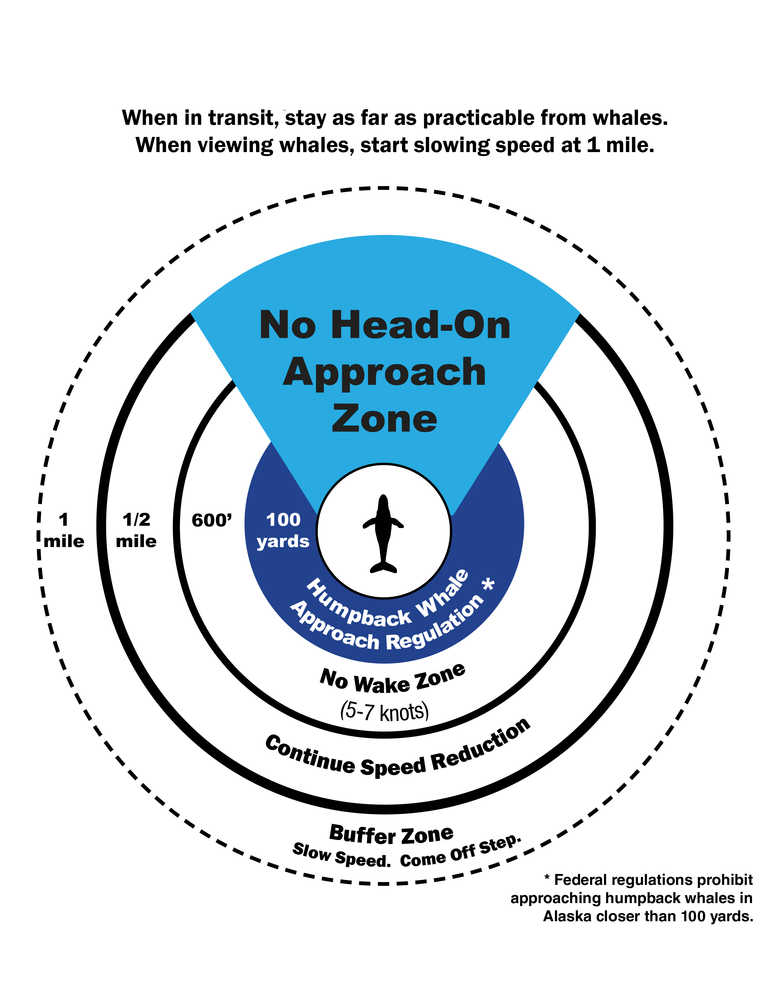
Federal regulations require whale watching boats to stay 100 yards away from humpback whales, not approach them head on and operate at a slow and safe speed in their vicinity. Whale SENSE further specifies that boats come off step, or to cease riding on the top of the water, before coming closer than half a mile to humpbacks and to slow to five to seven knots within 600 yards.
In addition to distance and speed requirements, boats must minimize noise, avoid sudden changes in speed and direction, limit viewing time on each animal to 30 minutes, maintain communication and coordinate viewing times with other boats, and to avoid putting vessels in reverse, which creates more disruptive noise to whales.
According to Jensen and Janes, the increased specificity of Whale SENSE’s water conduct rules are a big part of the program’s impact.
In addition to more concrete regulations on the water, Whale SENSE requires company employees to complete a comprehensive training course in order to ensure companies share accurate information about marine mammals.
Participating companies must also implement an ocean stewardship program which links to NOAA’s marine literacy principles. Examples of stewardship projects include recycling or internship programs and marine debris and beach clean-up initiatives. To fulfill its requirements, Allen Marine spearheaded an Admiralty Island shoreline cleanup expedition last summer.
According to Janes the program still has years of development ahead and it’s not a silver bullet for protecting marine mammals from the effects of whale watching. He said the most important part of growing the program will be educating Juneau’s water-going population about responsible whale watching practices, and to encourage participation from the public.
Whale SENSE will give a free training at 1:30 to 3 p.m. at UAS on May 6. Jensen will lead the training in conjunction with the Alaska Coastal Rainforest Center’s Juneau Marine Naturalist Symposium which takes place at the Egan Lecture Hall from 8:30 a.m. to 12:00 p.m.
Members of the public can file written complaints with NOAA if they observe participating companies violating Whale SENSE or federal regulations, or to call the NOAA Fisheries Alaska Protected Resource Office at (907)-586-7235.
Those interested in more information about Whale SENSE can visit whalesense.org.
Related Stories:
Photo: Juneau boaters chase a pod of orcas
Juneau tour operator fined, too close to whales
Humpback sinks sailboat near Hoonah
Humpback whales slow to arrive in Hawaii this year
NOAA: Humpback whales’ recovery a success story
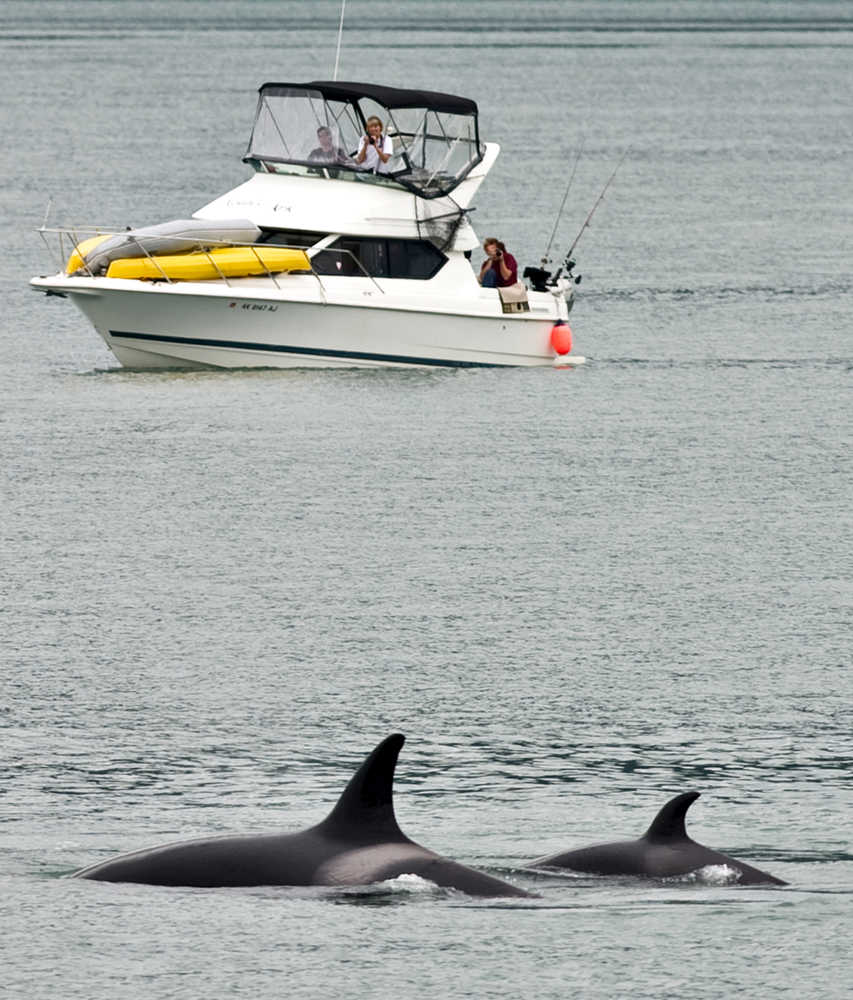
Recreational boaters watch two orca whales swim near Juneau in July 2011.
Recreational boaters watch two orca whales swim near Juneau in July 2011.
