
Mique’l Dangeli has been a little busy. In between being an artist-in-residence at the Scotiabank Dance Center in Vancouver, leading the internationally renowned Git Hayetsk (People of the Copper Shield) dance group with her husband Mike, her son starting college in B.C. and visiting her family in Metlakatla, she started teaching art history at the University of Alaska Southeast Juneau campus this fall.
Dangeli (her Tsimshian name Sm Łoodm ’Nüüsm and Tlingit name Táakw Shaawát) was the first Alaska Native to graduate with a PhD focusing on Northwest Coast art history and will be the first tenure-track professor at UAS’ growing Alaska Native Studies Program. One of her tasks in the coming years will be to transform the current program — only available as a certificate — into a full bachelors degree.
”It’s a dream job absolutely,” Dangeli said. Born and raised in Metlakatla, she realized early in her college career that she would have to leave the state to get the kind of education she wanted, studying Northwest Coast Art history first at the University of Washington and then at the University of British Columbia.
As an undergrad, she noticed a trend: “all of my mentors, all of my colleagues … the other graduate students who I came up with, they’re all non-Native. … So when I went through the master’s program, I thought eventually I’ll have a Haida colleague, I’ll have a Tshimshian colleague or Tlingit colleague.
“It didn’t happen until my PhD program,” Dangeli said. Marcia Cosby, who is Tshimshian and Haida, is working on her degree in art history at the University of British Columbia.
“So I, in breaking that glass ceiling, I feel a huge responsibility to pull more of us,” she said. “To be able to come back here and be able to take my degree and actually help to create more Alaska Native art historians and artists is a dream.”
UAS is the place to make that happen, Dangeli feels, especially with the university prioritizing the Alaska Native Studies and Alaska Native languages.
“They realize that that’s what makes UAS unique. It makes where we are unique,” she said. “I hope under my time we can get this program in a way that people from Washington state and Canada and other areas along the coast want to come here to study Northwest Coast art.”
The UAS program has always been strong in studio, with regular classes in weaving, carving and other disciplines, but “they can get stronger though,” Dangeli said. She hopes to expand the program to include Northwest Coast art history, curatorial practices, museum studies as well as business classes. “Because when you’re an artist, you’re your own business and if you don’t have small business management skills, it’s very hard to make a career make a living,” she said.
She also calls the inclusion of Tshimshian, Haida and Tlingit languages “foundational to the Northwest Coast art program.”
This fall, she is teaching Northwest Coast Art History, an introductory course.
“My approach to understanding what we have come to consider as Northwest Coast art today deals directly with settler colonialism, so it’s about decolonizing the language that we use to talk about Northwest Coast art or at least knowing its colonial history,” Dangeli said, as well as looking at museums, collecting and repatriation and “the way that artists are speaking back to (the) still huge social injustices that our people are surviving through.”
Next spring, she will be teaching two classes: Tshimshian language or Sm’algax and a course on Tshimshian culture and history. Starting next academic year, and going forward, she will teach three classes a semester.
Students may be surprised at the width of Dangeli’s experience and learning. Growing up in Metlakatla surrounded by dancers, weavers and carvers (Dangeli herself trained as a carver under Jack Hudson, Wayne Hewson and David Boxley), she could see all the artistic practices that were being left out of consideration as Northwest Coast art.
“We are a 21st century indigenous people,” she said. “So the work of our artists in every medium whether it’s photography, music, some of the new media art, performance … this is Northwest Coast art.”
She has focused her research on branches of Native art typically unseen by academic studies, writing her master’s thesis on Tshimshian photographer Benjamin Alfred Haldane, who started a portrait studio in Metlakatla in 1899. She wrote her PhD dissertation on dance.
“Unfortunately, there are so many biases and prejudices against dance — dance as tradition rather than looking at it as an artistic practice, which it should be both,” Dangeli said. “I really challenged the field of art history to get beyond the tangible and to think about intangible art practices” like song composition and choreography.
Many songs sung up and down the Northwest Coast are newly created, said Dangeli, “and it’s a practice just as important and vital as our totem poles raising.
“If we decided that no more totem poles were going to be carved, we would essentially be saying that the only relevant history would be the totem poles carved by our ancestors. That history stopped with them. So with our songs and dances, they’re an embodiment of our time now and … an embodiment of the history that we are currently living. … These very new songs, those are going to be the ancient songs of our grandchildren, our great-grandchildren. It’s not going to take too long for them to realize that responsibility creating songs for their great-grandchildren on and on.”
Dangeli calls dancing “my first love and my first art form.” She began dancing with the Git Lax Lik’staa dancers when she was four years old and for 13 years now, she and her husband have led the Git Hayetsk.
“My husband is an incredible singer, composer, dancer and visual artist. He makes his living as a carver and in our work together, he carves the masks (and) I create the dances,” Dangeli said.
Dangeli’s new job requires the family be in two places, Juneau and Vancouver, where not only their dance group but also her husband’s artist studio and son’s university are located. Other responsibilities keep them on the move as well, like to the Smithsonian’s National Museum of the American Indian in November, where Mike Dangeli will demonstrate carving for two weeks and the Git Hayetsk will perform. They also travel to Metlakatla, where Dangeli’s family lives and where she worked for eight years as the director of the Duncan Cottage Museum. She hopes one day to build a museum and cultural center.
“I think we’ll eventually find a balance… It’s just been a kind of whirlwind of changes,” said Dangeli, adding, “I’m really happy to be here.”
Dangeli’s dissertation, “Dancing Sovereignty: Protocol and Politics in Northwest Coast First Nations Dance,” will be published by the University of Washington Press. Her master’s thesis forms a chapter in “Sharing Our Knowledge: The Tlingit and Their Coastal Neighbors,” published by the University of Nebraska Press.
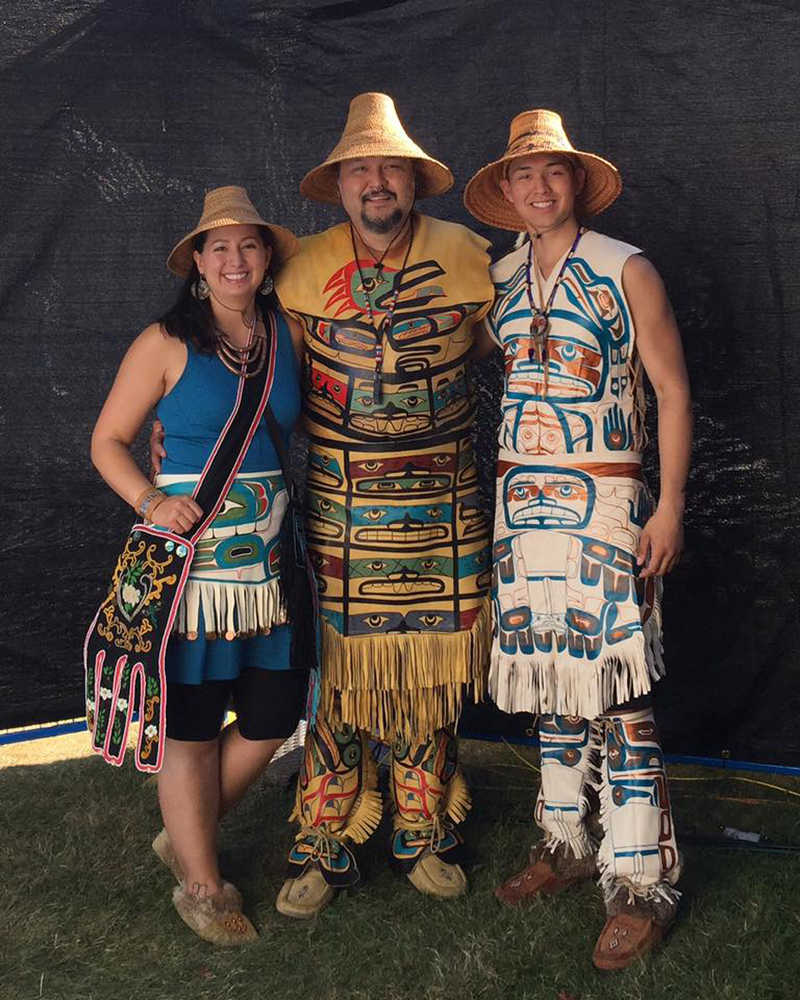
From right: Mique’l, Mike and Nick Dangeli. Mique’l Dangeli started as assistant professor of Alaska Native Studies at UAS this fall.

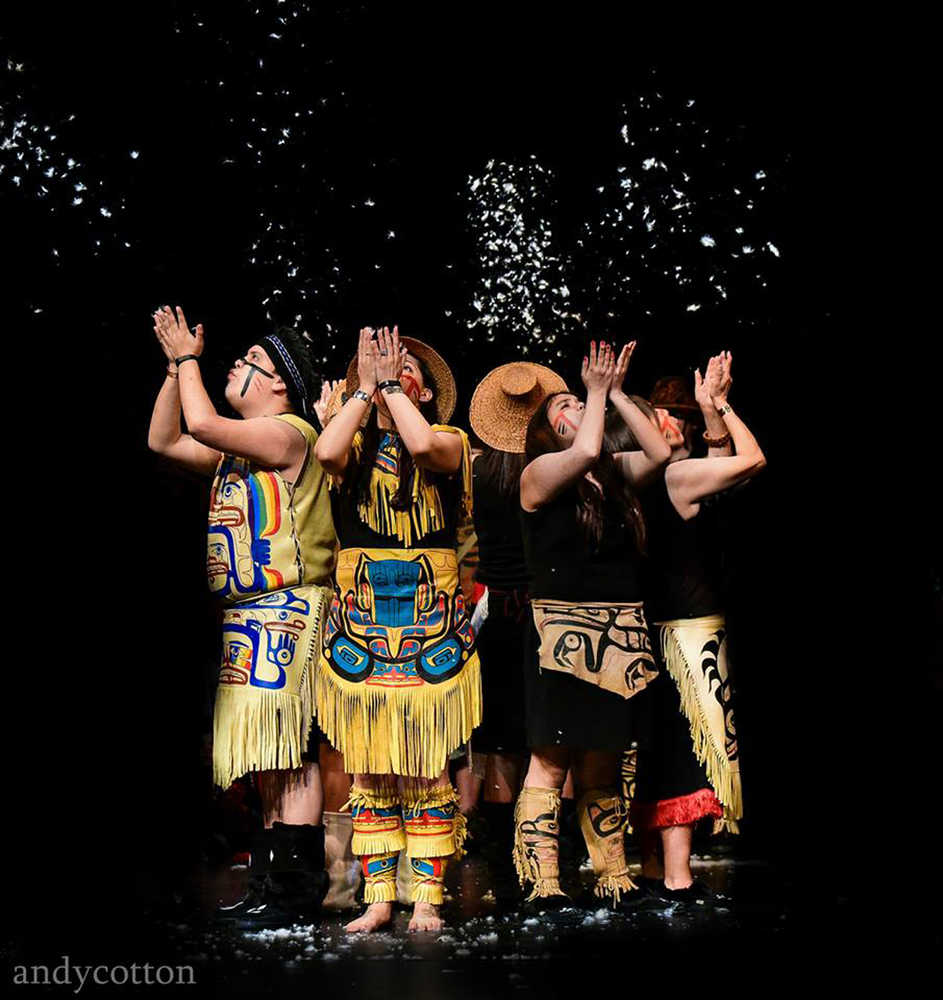
Mique’l Dangeli performs with the Git Hayetsk in March 2014 in Vancouver.
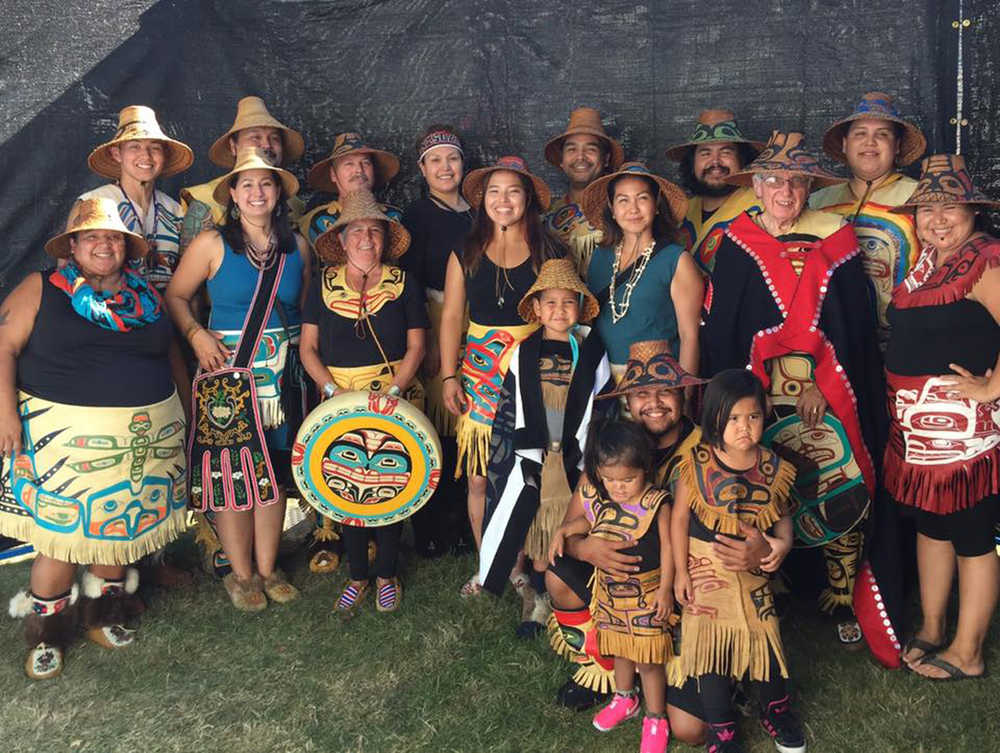
The Git Hayetsk dancers in August 2016.
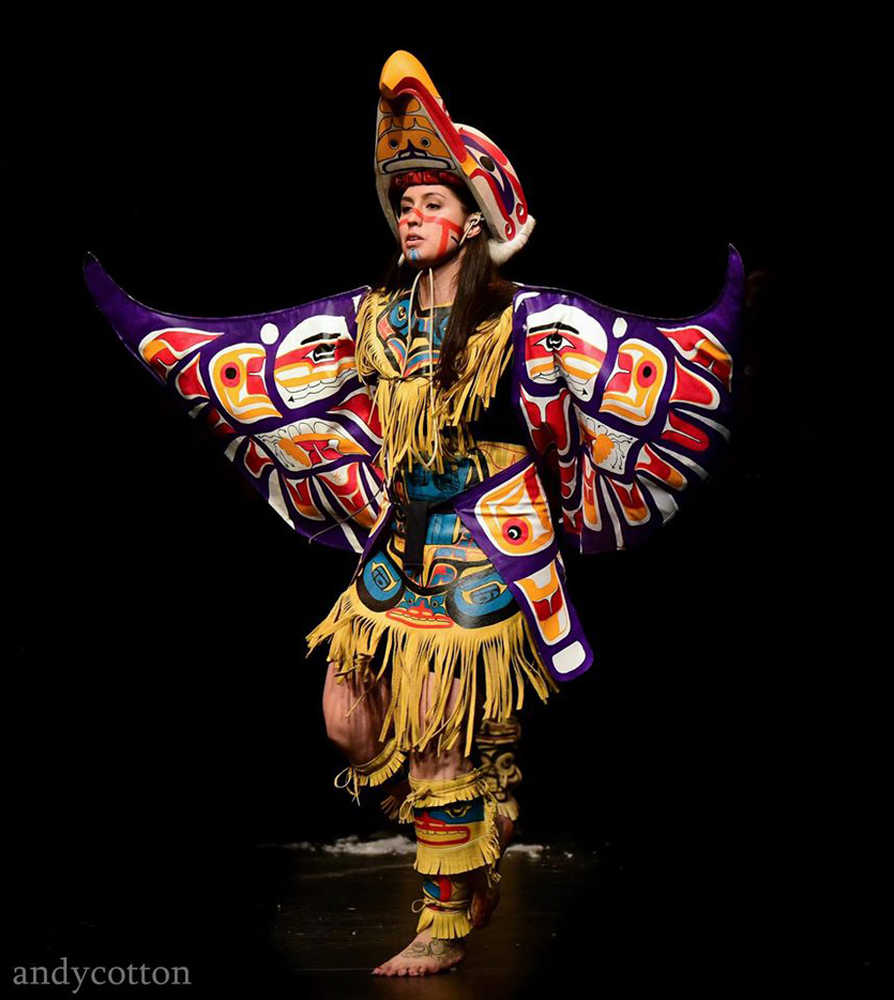
Mique’l Dangeli performs with the Git Hayetsk, the dance group she started with her husband Mike Dangeli, at a fundraising event in March 2015 in Vancouver. Mique’l Dangeli started as assistant professor of Alaska Native Studies at UAS this fall.
