
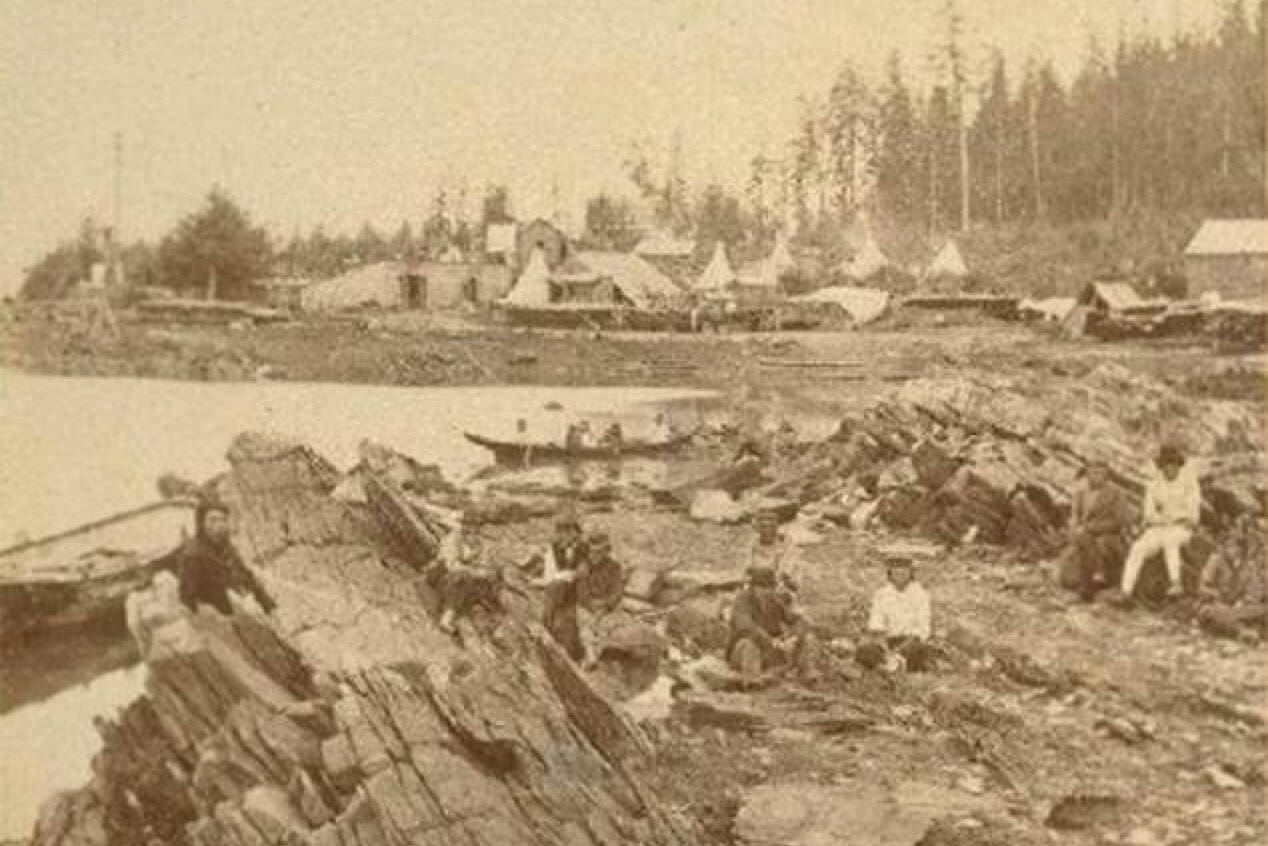
Sealaska Heritage Institute (SHI) will sponsor a lecture on the 1869 bombardment of Ḵaachx̱haan.áak’w in honor of Native American Heritage Month. Presented by Zachary Jones, Ph.D., the lecture will be given at noon on Tuesday, Nov. 7, at the Walter Soboleff Building and live streamed on SHI’s YouTube channel. The presentation is free and open to the public.
Jones’ lecture, titled “The U.S. Army’s 1869 Bombardment and Terrorization of the Tlingit Village of Ḵaachx̱haan.áak’w,” overviews the U.S. Army’s 1869 terrorization and attack of individuals from the Alaska Native community of Ḵaachx̱haan.áak’w, part of present-day Wrangell.
In December 1869 soldiers from Fort Wrangell shot individuals, used artillery on civilian houses, issued threats and ultimatums, and executed a community religious leader, Jones wrote in an abstract. The Tlingit took action to protect its civilian population, fight back, and deescalate the situation through negotiation. This story touches on the problems of military governance, the notion of invasion and occupation by a foreign power, the results of cross-cultural miscommunication, and the illegalities of military action.
Wrangell Bombing
In December 1869 soldiers from Fort Wrangell shot individuals, used artillery on civilian houses, issued threats and ultimatums, and executed a community religious leader, Jones wrote in an abstract. The Tlingit took action to protect its civilian population, fight back, and deescalate the situation through negotiation. This story touches on the problems of military governance, the notion of invasion and occupation by a foreign power, the results of cross-cultural miscommunication, and the illegalities of military action.
Kake Bombing
In Febraury of 1869, three Kake village sites and two forts were totally destroyed by the military. After the shelling, the soldiers went ashore and found each site to be deserted. They proceeded to set fire to the villages and destroyed all of the canoes and food supplies.
Angoon Bombing
In 1882, after the accidental death of a respected Tlingit shaman, Teel’ Tlein, the Tlingit detained two white crew members, seeking 200 blankets as compensation. The whaling superintendent claimed Angoon residents were rebelling. Reacting, US Navy’s Commander Merriman demanded 400 blankets and threatened Angoon’s destruction. The Tlingit provided only 81 blankets, leading Merriman to destroy the village, resulting in six children’s deaths and near-starvation for villagers that winter.
Jones, a historian and archivist based in Alaska, holds a Ph.D. in ethnohistory from University of Alaska Fairbanks. His research focuses on Northwest Coast art history and Tlingit history. Jones has published in history, anthropology, art history, museum, and archival science journals. He currently works for the National Park Service’s Museum Program in Anchorage.
A second Native American Heritage Month lecture, Hall of Famers in History: Decades of Leadership with Ed Thomas, is scheduled for Tuesday, Nov. 14.
Sealaska Heritage Institute is a private nonprofit founded in 1980 to perpetuate and enhance Tlingit, Haida and Tsimshian cultures of Southeast Alaska. Its goal is to promote cultural diversity and cross-cultural understanding through public services and events. SHI also conducts social scientific and public policy research that promotes Alaska Native arts, cultures, history and education statewide. The institute is governed by a Board of Trustees and guided by a Council of Traditional Scholars, a Native Artist Committee and a Southeast Regional Language Committee.
