
You never know what might be offered at a potluck supper, where you browse over a miscellaneous collection of dishes. This essay is a bit like that — an assortment of unrelated but potentially interesting observations and information.
Last week I mentioned the great abundance of mosquitos in June in the Interior. Mosquitoes can surely be a major nuisance and in some regions of the world they carry diseases and parasites. But is there another side to this coin? What good are mosquitoes?
Mosquitos are good bird food. Swallows and swifts catch them on the wing. Certain warblers and flycatchers dart out from a perch to catch them as they fly by. I’d bet that the female hummingbird swooping back and forth in my front yard catches some, too. Mosquito larvae are aquatic and provide good prey for small fish and for larger invertebrates that are also prey for fish. Dragonflies and damselflies feast on them.
Mosquitoes are more than unwilling prey, however; they are the principal pollinators of a diminutive-flowered plant called the small bog orchid. In Alaska, males and females of several species of mosquito are known to visit these orchid flowers and carry pollen from one flower to another (other insect visitors include small moths and flies, but their role in pollination is undocumented). As the mosquitoes poke into a flower, globs of pollen are slapped onto their eyes, where they stick until the mosquito goes to another flower, which is arranged in a way to pull off the pollen, leading to seed development. There may well be other kinds of small flowers that are pollinated by mosquitoes: male mosquitoes commonly live on nectar from flowers and even the blood-sucking females do, too, in some cases. Some of these visitations might achieve pollen transfer, but sometimes the mosquito might be just a nectar thief.
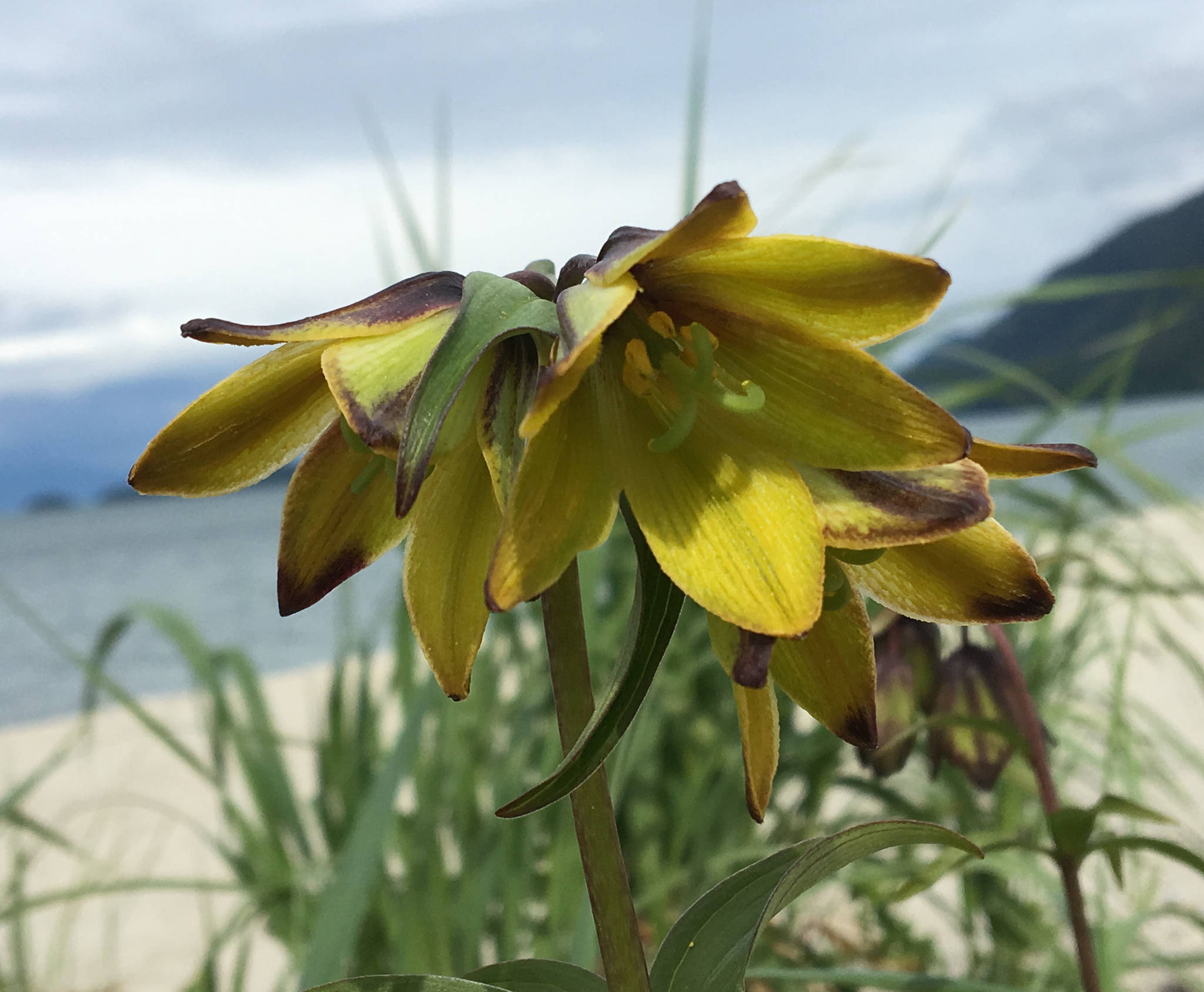
Flower color is one of the cues used by flower-visiting animals. Color helps identify the species, sometimes the age of the flower, and in some cases, whether or not it has already been visited by a pollinator. Usually, all the flowers of a particular species are the same color, or nearly so. But we see exceptions. For example, almost all of the chocolate lilies we see have brownish flowers, but very rarely we see one with yellowish flowers (photo). Wild lupines normally have blue to purple flowers, but in rare cases we find one with pink flowers. Occasionally, we’ve found white-flowered individuals of fireweed, northern geranium, shooting star, and bluebells (whose flowers are normally pink or blue). These very unusual flower colors are presumably the result of genetic mutations.
These mutants don’t seem to spread and become more common in their respective populations. But why? Do pollinators discriminate against those oddballs, leaving them unvisited, unpollinated, and without offspring? Or, maybe the (presumed) gene that controls flower color also controls something else in the plant’s life, something that interferes with some aspect of normal function. Multiple effects of single genes are common. As usual, a simple observation leads to more questions.
Bumblebees are very important pollinators of many kinds of flowers. They are the principal pollinators of monkshood, lupine, blueberries, iris, louseworts, and beach pea, which have flowers that must be manipulated in a certain way in order to achieve pollination. But the bees also join with a variety of other critters to pollinate roses, salmonberry, thimbleberry, goldenrod, and columbine (to mention just a few).
However, all across North America, from California to the east coast, populations of some bumblebee species have become very rare or even disappeared entirely. Because I have a very unscientific impression that I see fewer bumblebees on our wildflowers in the last two years than previously, I wondered if our bees may also have crashed. I asked the UAF expert, who said that a study currently underway in Denali is designed to detect major changes in bumblebee populations there, but as so often happens, these seem to be no scientific data for Southeast. We can hope that our bumblebees are in good shape, because so many of our wildflowers depend on them.
Finally, and just for fun (dessert at a potluck?): One day I walked through the Eagle Beach day-use area after a stroll on the beach. I spotted a big black bird sitting on a rock and holding a chunk of something red and drippy in its bill. Through binoculars, I saw that the raven held a succulent piece of watermelon. Just beyond the rock was a picnic table with several plastic containers, temporarily abandoned by a human family that was playing out on the intertidal sand flats. At least two of those containers had the lids removed (by the raven?) and one of them still held a chunk of melon. That family was in for a surprise when they came back to their table!
• Mary F. Willson is a retired professor of ecology. Her essays can be found online at www.onthetrailsjuneau.wordpress.com.
