
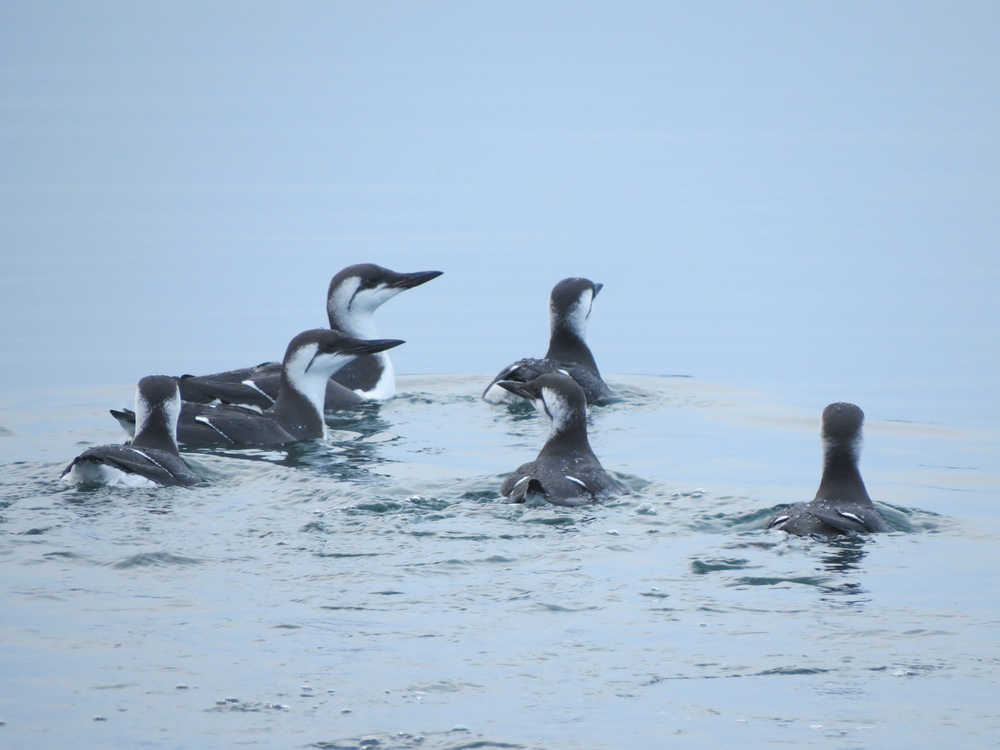
One of Alaska’s most common seabirds is dying off in unusually high numbers, and though the majority of common murres found dead have been in Southcentral Alaska, Southeast Alaska also is affected.
The most striking change is that Southeast Alaska is seeing a lot more murres than normal this winter, though dead birds also have been found.
“Usually this time of year, you shouldn’t really be seeing murres on coastal waters,” said Robb Kaler, seabird specialist and wildlife biologist with the U.S. Fish and Wildlife Service. “Over the winter, they go out on the continental shelf and winter out there.”
Juneau birder Gus van Vliet, who lives in Auke Bay, counted between 3,000 and 5,000 of the birds in the area in November and December, when vast numbers of birds, sea lions, seals and even two whales gathered in the bay and harbor to hunt large numbers of herring and juvenile pollock.
“I hate to say ‘unprecedented,’ but it certainly has been a long time since anyone has seen that, especially at that time of year,” van Vliet said.
People in Gustavus, around Glacier Bay National Park, are reporting thousands of live murres and some dead ones, Kaler said, with some dead birds also reported in Sitka.
“If there’s a spot in Southeast Alaska, I think, that is closest to what has been occurring in Southcentral, it seems to be there at the mouth of Glacier Bay,” van Vliet said.
In Alaska, Sitka is the farthest Southeast and Unalaska is the farthest west the USFWS has documented the event. They’ve also documented an increase in die-offs in California and the rest of the Pacific Coast, Kaler said.
Though he emphasizes that researchers have two main goals — assessing the geographic scope of the problem, and figuring out why the birds are starving — Kaler suspects it may have to do with sea surface temperatures in the Gulf of Alaska, where the birds normally spend the winter.
This is chalking up to be an extreme El Niño year, likely one of the top three since 1950, according to the National Weather Service Climate Prediction Center.
That combined with the warm “blob,” an unexplained patch of warm water in the gulf, has made for a different set of circumstances where the birds usually find their food.
In more than 100 birds the U.S. Geological Survey autopsied, no signs of damage were found but the birds weighed anywhere from about half to three-quarters what they should, with very little fat and empty stomachs, Kaler said.
Though murres are the most common, they’ve also autopsied other birds, like puffins, found dead.
Murres need to eat the equivalent of about 30 percent of their body mass each day, Kaler said, and don’t plunge for food, but rather chase fish while “flying” underwater. That means tight schools of fish are much more efficient sources of food for them.
“Whether it’s changes in the distribution of their food, changes in the abundance of their food, or changes in the behavior of their food… there’s a point at which the schooling of fish might not be concentrated enough for the murre to efficiently forage. These warmer ocean temperatures might be having an effect on the behavior of their prey. There are quite a few different factors going on that might be driving this,” he said.
Some alga blooms, which increased last year, may also be affecting the birds’ ability to consume food, he said.
The Bird Treatment and Learning Center (Bird TLC) in Anchorage, which has received an influx of murres, offers guidelines on its website, depending on whether the bird is found near water, near Anchorage, or farther inland.
“We’re encouraging people to let nature take its course,” Kaler said. “They’re going back into an ocean that doesn’t have any more food in it than when they left it.”
• Contact Juneau Empire Outdoors editor Mary Catharine Martin at maryc.martin@juneauempire.com.
To read an article about the unusually warm Gulf, go here: http://juneauempire.com/outdoors/2015-07-17/sea-changes-warm-gulf-leads-unusual-happenings-worried-scientists
To read about Auke Bay’s end-of-the-year profusion of wildlife, go here: http://juneauempire.com/outdoors/2015-12-04/auke-bays-wild-kingdom
To read an Associated Press article about the seabird die-off, go to http://juneauempire.com/state/2016-01-12/starvation-suspected-die-seabirds
Check out Bird TLC’s website here: http://www.birdtlc.net/
