
When I told my friend Jo (who blogs at www.alaskafloatsmyboat.com) that I was building an outdoor cooler to refrigerate my perishables she said: “When I was a kid we lived for a while in a house that had one under-counter cabinet that was a cooler. It had a screen-covered opening to the outside. It was alternatively a freezer, cooler, and warmer, and it took us a while to learn to manage it.”
We had one of those, too, when I was a kid, mounted to the wall in my parents’ floathouse. I thought about making one like that, but in the end decided I didn’t have the kitchen space to spare so the cooler would have to go outside. I’ve also used plastic coolers over the years but they have a tendency to mold and don’t work well with produce.
The problem was in getting material out here to build it, but that wasn’t a new issue. I did what we always do in these situations. I turned to what we had on hand: an old, weathered ladder; beachcombed dairy crates; weathered cedar shakes left over from an old project; and the remains of a shipwreck on a nearby beach.
After checking the homemade wooden ladder for rot and finding it still in good shape, my dad hand-sawed it in half, at an angle in order to give the cooler its own little roof. He cut it at high tide and said we’d have to wait for the tide to go out before he used his battery-powered screwdriver to attach the two pieces to the side of my house. We’ve learned, after losing various tools and other items overboard, to not build anything on the houses when they’re floating, if possible.
When the tide went out we arranged the two halves of the ladder at the side of my house that faces away from the sun. Even on the hottest days, it’s still cool on that side, especially when the tide is in. We measured the beachcombed dairy crates to find out how far apart we needed to put the ladder halves and then screwed them in place.
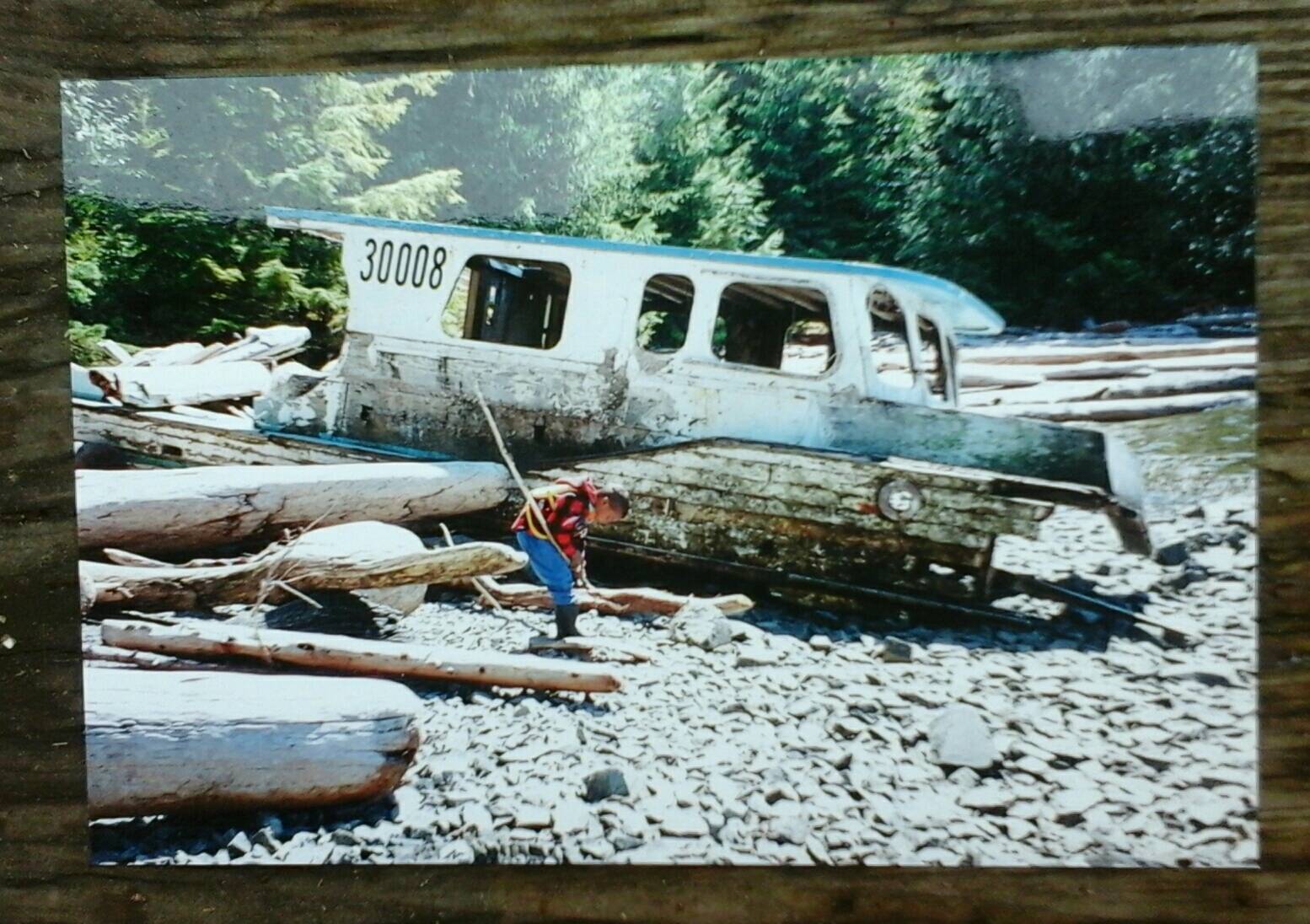
We had to take a few days off from the project as other things intervened. In the meantime, I gathered a T-shaped piece of wood that used to be part of the roof to a shipwreck—a commercial fishing boat named Daybreak that listed Petersburg on its battered stern as its home port.
I’ve heard conflicting reports on how it wrecked. Some say it tore its bottom out during a winter gale when the waves and tide were so high the owner couldn’t see the rock right outside where I live and ripped the bottom out. Another story says he was setting his gear, unaware of the rocks in this area — though the one he hit is on all the maps and is quite large, always visible even during the highest tides — and ran aground, holing his boat.
Whatever the case, nearby locals came to his rescue and pulled his boat off the rock. It started sinking and they beached it about a 10 minute walk from my house. He escaped with his life, but the boat was a dead loss. It’s been battered by successive winter storms and tides ever since and probably has only a few years left before it disappears entirely.
As I carried the piece I wanted for my cooler from the beach and through the woods, I thought how the owner of the Daybreak could never have imagined that a part of the roof above his head as he steered his boat, would one day become a part of some floathouse dweller’s outside cooler.
I measured and sawed the T-shaped end from the shipwreck and fitted it under the forward 2x3s of the two ladder sides to support it in front. Afterwards, I gathered up shakes that my dad had cut years ago — they were nicely weathered, to go with the weathered siding on my house.
As I gathered them I remembered when I was a kid watching my dad the first time I’d seen him cut shakes and how fascinated I’d been to see such perfectly flat rectangles fall at his feet from a round of wood. It was like watching a machine as he smoothly sliced, with a froe and mallet, through the rounds of cedar he called shake bolts. He could tell just by looking at a log whether it was good shake bolt material or not.
Now he picked through what I’d brought, considering how to place them as shelves and for the roof. It was like doing a jigsaw puzzle, and occasionally he had to trim a piece with his pocketknife before he screwed them in place on the rungs of the old ladder. Since they were old they’d warped quite a bit and I found that I had to shave them down in some places with my pocketknife in order for the dairy crates to slide across them without getting hung up.
But, at the end of the day, I had a new outdoor cooler to put my produce, dairy, and beverages in to keep them cool. On the hotter days I’ll put a jug of frozen water in with them to keep the temperature down. It may not be the ideal refrigeration system, but in the wilderness you make do.
Tara Neilson blogs from her floathouse at www.alaskaforreal.com.
• Tara Neilson blogs from her floathouse at www.alaskaforreal.com. Her column Alaska for Real appears in the Capital City Weekly biweekly.
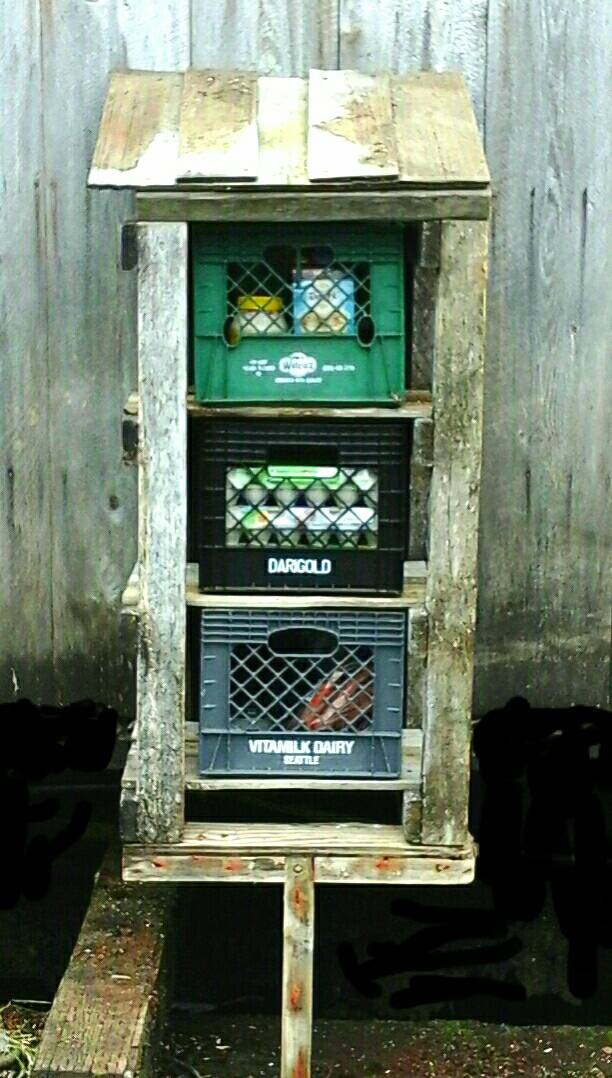
The finished outdoor cooler made from a wooden ladder, beachcombed dairy crates, handmade shakes, and part of a shipwreck.
