
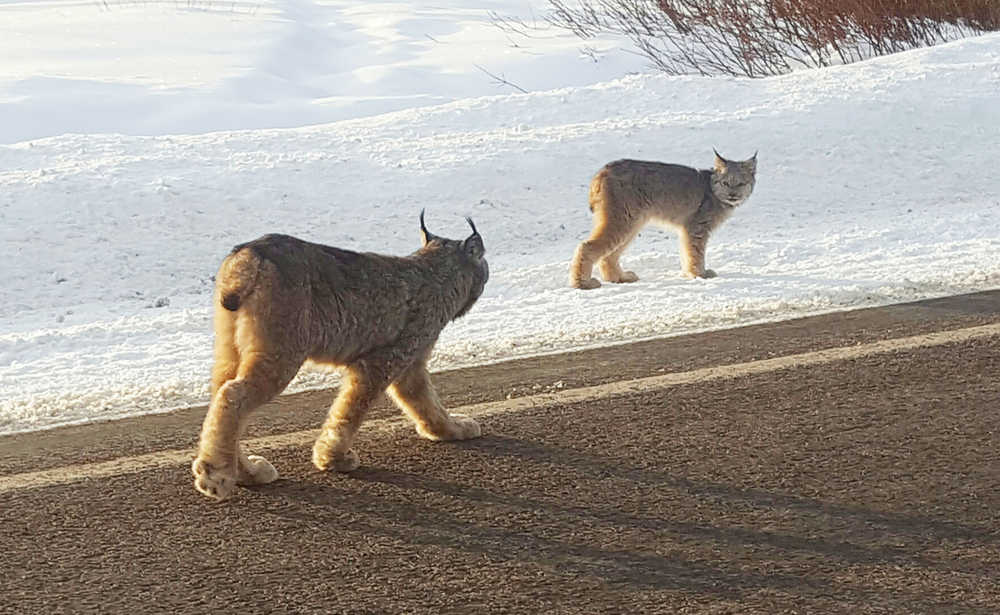
This Dec. 15 photo shows two lynx walking along a highway in Molas Pass outside of Silverton in southwestern Colorado. Only about 50 to 250 lynx are believed to be living in the wild in Colorado, and sightings are rare.

This Dec. 15 photo shows two lynx walking along a highway in Molas Pass outside of Silverton in southwestern Colorado. Only about 50 to 250 lynx are believed to be living in the wild in Colorado, and sightings are rare.

Lynx stroll past ski crowds in rare sightings

DENVER — Some elusive and charismatic lynx have been parading past awe-struck Colorado residents and visitors this winter, electrifying social media and giving biologists reason to smile.

One of the rare, fluffy-looking cats strolled nonchalantly across the Purgatory resort in southwestern Colorado last week, threading through a crowd of skiers and snowboarders who swerved around the animal and stopped to take videos.

Two weeks earlier, a pair of lynx loped along a mountain highway a few feet from Dontje Hildebrand’s car.

“My heart just about busted out of my chest when I realized what I was seeing,” said Hildebrand, who was driving over Molas Pass, about 15 miles north of the Purgatory resort, when he came upon a female lynx and her kitten.

Between 50 and 250 lynx live in the wild in Colorado, mostly in the southwestern corner of the state, biologists say. That’s down from previous estimates of 200 to 300, but officials cite better calculations, not a population decline.

They are protected under the Endangered Species Act in the contiguous 48 states.

Lynx, native to Colorado, virtually disappeared from the state by the 1970s because of hunting, poisoning and development. The state brought them back starting in 1999, transplanting lynx from Canada and Alaska.

The medium-size cats have tufted ears, short tails and broad paws that work like snowshoes, letting them walk across powdery snow. They can grow to nearly 3 feet long and 30 pounds.

Wildlife officials don’t know exactly how many live in Colorado because they are so hard to find, said Joe Lewandowski, a spokesman for Colorado Parks and Wildlife.

A few people report seeing them every year, but those sightings don’t help with the science of lynx reintroduction because they are anecdotal, Lewandowski said.

“But it’s encouraging,” he said.

The state documents where the animals live with a survey using automated cameras mounted in remote lynx country.

The sightings indicate the cats are getting comfortable in the high-altitude forests of southwestern Colorado, which are prime lynx habitat.

The lynx appearance at Purgatory on Dec. 28 was unusual because so many people saw it, Lewandowski said.

Jim Russell was snowboarding that day when he and dozens of others watched the lynx mosey across a ski run.

“For being a wild animal, it was pretty surprising to see him so relaxed around people,” Russell said.

He and others took cellphone video and posted it on social media, gaining broad attention.

“At first it kind of looked like a feral cat,” Russell said.

But then he remembered seeing Hildebrand’s photos of the Molas Pass lynx on the front page of the Durango Herald , “and pretty quick I was able to identify it.”

Lynx generally are not a threat to people, Lewandowski said.

They are docile, they eat mostly snowshoe hares and they likely would not take on anything as large as a human. But they also are unpredictable, and people should never approach them or feed them, he said.

More in Neighbors

Fred LaPlante serves the Juneau community as the pastor of the Juneau Church of the Nazarene. He is passionate about encouraging others to see life more clearly through faith in God’s Word.
Living and Growing: Love listens first

‘Loving people well requires more than speaking clearly; it requires listening carefully.’

Weekly events guide: Juneau community calendar for Feb. 9 – 15
Juneau Community Calendar

Weekly events guide: Feb. 9 – 15

Jeff Lund/contributed
The author would rather fish for steelhead, but he’ll watch the Super Bowl.
I Went to the Woods: Super Bowl spectacle

At some point on Sunday, dopey characters, hopelessly addicted to Doritos, will… Continue reading

Peggy McKee Barnhill (Courtesy photo)
Gimme a Smile: How much snow can one backyard hold?

Snow, snow, everywhere, and no place to put it!

The Spruce Root team gathers for a retreat in Sitka. Spruce Root, is an Indigenous institution that provides all Southeast Alaskans with access to business development resources. (Photo by Lione Clare)
Woven Peoples and Places: Wealth lives in our communities

Sustainable Southeast Partnership reflects on a values-aligned approach to financial wellness.

calendar
Weekly events guide: Juneau community calendar for Feb. 2 – Feb. 8

Visit Juneau Arts and Humanities Council at JAHC.org for more details on this week’s happenings.

Actors in These Birds, a play inspired by death, flowers and Farkle, hold ‘flowers’ during a performance at the UAS Egan Library on Saturday, Jan. 31. (photo courtesy Claire Richardson)
Living and Growing: Why stories of living and dying in Juneau matter

What if we gave our town a safe space to talk about living and dying with family and friends?

calendar
Weekly events guide: Juneau community calendar for Jan. 26 – Feb. 1

Visit Juneau Arts and Humanities Council at JAHC.org for more details on this week’s happenings.

Courtesy photo
Adam Bauer of the Local Spiritual Assembly of Bahá’ís of Juneau.
Living and Growing: Surfing into the future

Many religious traditions draw strength from the past.

calendar (web only)
Weekly events guide: Juneau community calendar for Jan. 19-25

Visit Juneau Arts and Humanities Council at JAHC.org for more details on this week’s happenings.

(web only)
Weekly events guide: Juneau community calendar for Jan. 12-18

Visit Juneau Arts and Humanities Council at JAHC.org for more details on this week’s happenings.

Four members of the Riley Creek wolf pack, including the matriarch, “Riley,” dig a moose carcass frozen from creek ice in May 2016. National Park Service trail camera photo
Alaska Science Forum: The Riley Creek pack’s sole survivor

Born in May, 2009, Riley first saw sunlight after crawling from a hole dug in the roots of an old spruce above the Teklanika River.