
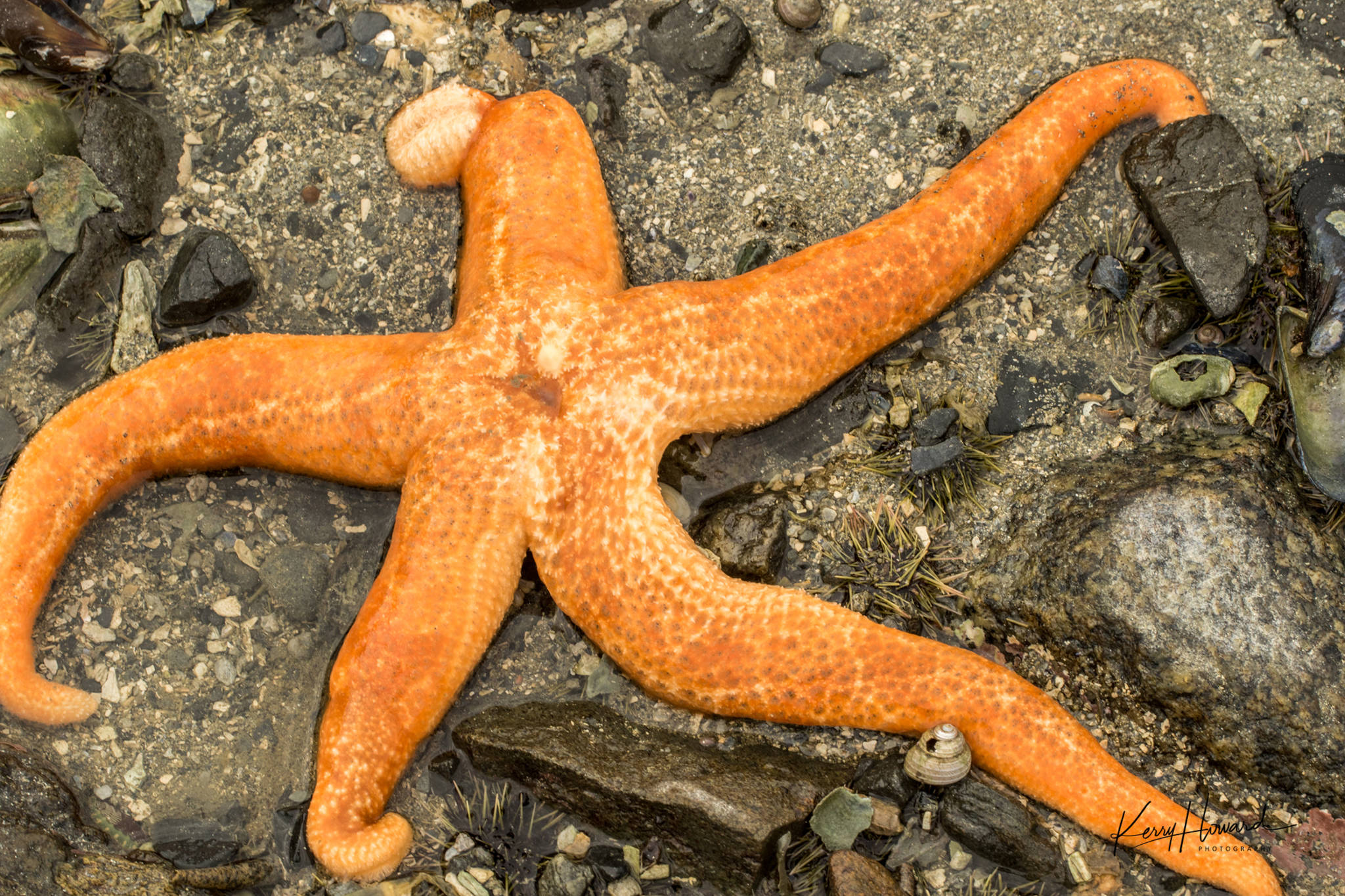
June brought some good low tides, lower than minus four feet, so out we went to look at the rocky intertidal zone. This is always a little voyage of discovery, seeing some old “friends” and finding some new ones. But I sure wish that some nice intertidal biologist would come with us, to answer our many questions!
We went out on two consecutive days, to two different sites. These two places differed greatly in the composition of the invertebrate community. For instance, at one site, the false white sea cucumber was overwhelmingly abundant, but at the other site, it was very rare … although the big orange sea cucumber was common there. The little black “tar-spot” cucumbers were extremely plentiful at the first site, but they were not common at the second one. Crabs were hard to find at the first site but common, and of several different species, at the other. Such differences might be due, in part, to the difference in the amount of exposed bedrock habitat versus cobbles, but a real intertidal biologist could probably suggest some other possible explanations for the differences.
I picked up a big whelk shell and had a brief look at a bright red hermit crab rapidly retreating into the top of the shell’s spiral. This Pacific red hermit had found a shell so big that it could disappear entirely from view. Nice for protection, but the shell was so big compared to the crab that there was no way the crab could move its big house from one place to another.
Carefully turning over rocks, we often exposed small fish called pricklebacks. People erroneously or confusedly call them all sorts of names: blennies, eels, snakes, worms, wigglers, flippers and whatnot. Pricklebacks, and the much less common crescent gunnels, can survive a low tide in damp, protected spots (such as under rocks, where ravens and gulls can’t grab them), because they can breathe through their skin.
Among the several kinds of crab were some brown ones totally covered with short bristles (helmet crabs, I think). We picked up one, only to find that it was an empty shell — the crab was gone. The shell was undamaged, but it was easy to lift open the back of the shell and view the interior. This crab had molted its old shell (along with the barnacles clinging to the legs), pulled its legs and eye and other parts free, and backed out. Now it had to produce a new hard shell, which must take some time, leaving the soft-bodied crab very vulnerable to predators. And the cost of making a new hard shell must be considerable. But a critter with a hard external skeleton can only grow by shedding the old one and making a new one.
Perched among the stubby fronds of an alga were several hairy snails — not very big, with very bristly shells. Something new for us! The usual kind of hairy snail appears to have a short life. After a larval stage, a young snail is male for the first year of its adult life. In its second year, it becomes female (while retaining the penis, just behind one eye), mates with a young male, lays eggs, and dies. An interesting way to go about things — I have to wonder what factors favored the evolution of this life history.
At one site, we found several crumb-of-bread sponges, yellowish in color, encrusting the rock. They break apart easily, hence their common name. I’ve read that a good diagnostic feature is their odor, said to smell like exploded gunpowder. Sponges are multicellular animals that have a very long fossil record, back to the earliest evolution of animals. They feed by pumping in water through small pores and passing water currents though the body, filtering out microorganisms. Several volcano-like structures are scattered over the body of this sponge; water currents and undigested food exit the sponge via these openings. The body is laced with glassy spicules made of silica but, nevertheless, it is eaten by various molluscs and other things. It simply can spread over the rock, but it can also reproduce sexually. However, unlike most sponges, this one has separate sexes.
Under a few flat rocks, there were several small, grub-like animals with no visible appendages that we’d not seen before. With long-distance help from an expert, these were identified as sandpeanuts, a kind of polychaete worm. It usually lives in the sediment below the mid-tide level and feeds on small bits of debris caught by its little tentacles. Without a hand-lens, we could not see the numerous tiny bumps and hairs that are distributed all over the body, nor did we discern the many ill-defined body segments. The feeding apparatus and gills at the front end can be retracted, so they are not visible when the animal is exposed by a low tide. No wonder we had a hard time figuring out what it might be!
I came upon a charming scene — a father with two small children (and a friendly dog) had found a small rock crab. The father carefully picked it up, showing the kids how to avoid the big pincers at the front end. After they all looked at the crab, it was gently placed back where they found it, and it wedged itself tightly between two rocks. What a good example of how to teach exploring kids.
• Mary F. Willson is a retired professor of ecology. “On The Trails” is a weekly column and appears every Friday. Her essays can be found online at onthetrailsjuneau.wordpress.com.
