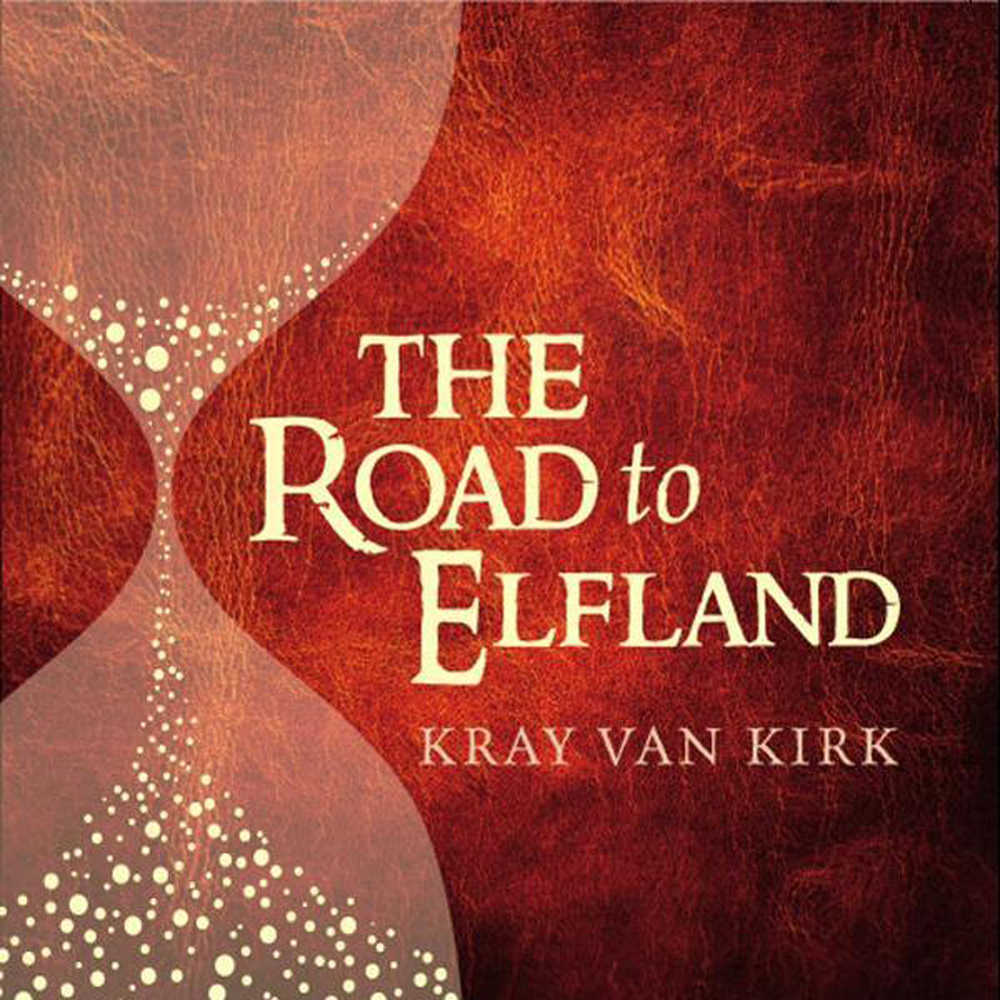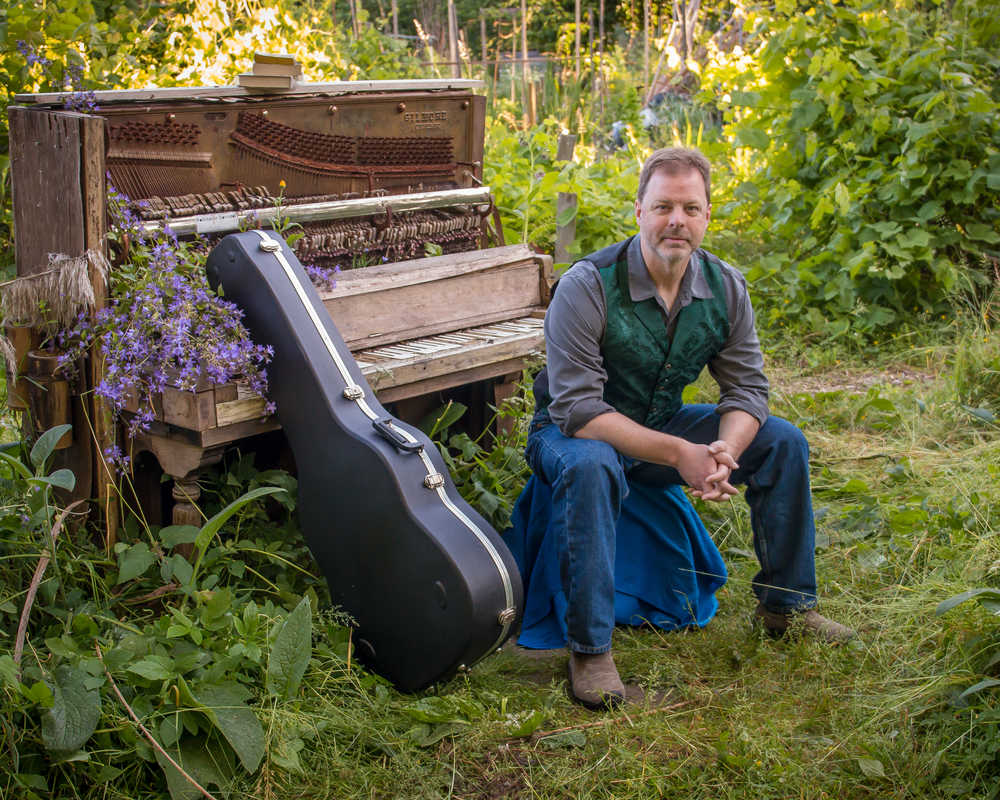
Juneau musician Kray Van Kirk is very conscious of the path he walks and what kind of a trace he’ll leave. That’s part of the reason, perhaps, that he fits such big ideas into his most recent 12-song album, “The Road to Elfland.”
Van Kirk describes his songs as “an invitation to unabashedly feel.”
“They’re a repackaging of the ability to be vulnerable and idealistic and feel, in almost a very childlike or unsophisticated way,” he said.
Van Kirk is what guitar aficionados know as a “finger stylist.” He plays both six and 12-string guitar.
As a kid, he wanted to play either the ukulele or the guitar (the ukulele got edged out) but “didn’t do well” with guitar lessons, he said.
It wasn’t until he was in college and was stunned by a live performance by finger stylist Chris Proctor, a national champion, that he realized music was something he really wanted to make.
For about five years in the early ‘90s, he lived out of his van, booking gigs ahead of time via pay phone and touring primarily in the West. It was on tour that he first came to Alaska, where he had a multi-performance gig at a Sitka hotel.
“The Road to Elfland” is Van Kirk’s third album, but though he’s kept making music in the last two decades, it’s his first CD in 20 years. He didn’t want to contribute to the proliferation of “stuff” in the world, he said.
“I don’t want to leave a mess,” he said. (He also makes his music available for free downloads on his self-programmed website — this CD is, as well — along with a “donate” button that “hardly anybody uses, but that’s okay,” he said.)
“There’s this whole thing that we have these days where we only measure something’s worth by how much money it can produce,” he said. “I think that is not only just wrong, but it’s obscenely destructive. This was a little coin in the wishing well to say ‘Oh, f*** that.’ If you guys like this music, take it.”
He’s also the single dad of a now 19-year-old daughter, something that moved him from a life on the road to as a job as a statistician with the Alaska Department of Fish and Game.
Though he doesn’t think about it consciously during the creative process, much of what he wants to do in his music is rewrite myth, he said.
“The Queen of Elfland,” the video for which is available on his website, is an example of that rewriting. The video, and song, is a version of the story of Thomas the Rhymer, who is invited by the queen of Elfland to visit her in her land for three days — the equivalent of seven years, Thomas’ time. In the myth, she gifts him the ability to see the future and gives him an apple that allows him to speak nothing but the truth for the rest of his life.
In the re-telling via the video, Van Kirk follows the “queen” onto a subway car and a magical space in a more modern-day land.
“We have a deep need to rewrite myth,” Van Kirk said, referencing Jungian archetypes.
The first song on the CD, “I am a Knight,” refers back to the archetype of the warrior hero.
“We’ve had thousands of years of the warrior mythos, and the warrior hero, and that’s fine. There’s nothing wrong with that. But we can’t afford to have it anymore. Because if all we do is elevate the ability to go kick somebody’s ass, and that’s our idea of a hero — well, that’s what we’ve been doing for several thousand years, and clearly it hasn’t gotten us anywhere. But we have these incredible emotional responses to that driver, and I think there’s a need to rewrite that myth. Let it die and be reborn, like a new phoenix, so we give that same emotional response to somebody who runs a homeless shelter,” he said.
People feel lost in today’s world, he said, in large part because of “the loss of an awareness of myth as our driver.”
Superimposing old myths on our everyday lives “allows us to respond to it again,” he said. “We know that if we follow the yellow brick road, we’re going to end up in Chicago, not Oz.”
He may title his next album “The Hero with a Thousand Faces,” after Joseph Campbell’s famous work of the same name, an examination of myth across the world, interpreted through the lens of modern psychology.
He’d like to make more videos to the songs on “The Road to Elfland,” is working on a children’s book, and is booking gigs for 2016 and 2017.
“The ability to feel, and feel deeply, is not a weakness,” he said. “It’s a critical necessity in today’s world. The difficulty is, as soon as you feel, you become vulnerable to pain. Maybe this (album) is an attempted response to that.”
Van Kirk’s website, where his music is available, is www.krayvankirk.com.
• Contact Capital City Weekly staff writer Mary Catharine Martin at maryc.martin@capweek.com.