
We often think of land and sea as totally separate entities, and this is commonly reflected in separate governmental jurisdictions. But the biological reality is that the two “entities” are very closely linked, and here in Southeast Alaska that connectedness is very evident.
Perhaps the most well-known ecological link between sea and land is told in the story of the “salmon forest.” Spawning salmon return to freshwater streams, bringing marine-derived nutrients (and pollutants) in their bodies. The spawners die or are eaten by predators such as bears, wolves, and eagles. Smaller consumers, including mink, otters, and some song birds, also nibble on the carcasses. The fish-eaters sometimes drag the carcasses into the forest and all the consumers deposit digested fish and the contained nutrients on the landscape, sometimes quite far from the streams. Flies and other insects lay eggs on the carcasses and aquatic insects have bountiful dinners; the flourishing abundances of insects are consumed by birds that contribute to the spread of nutrients over the landscape. These animals help fertilize the surrounding land.
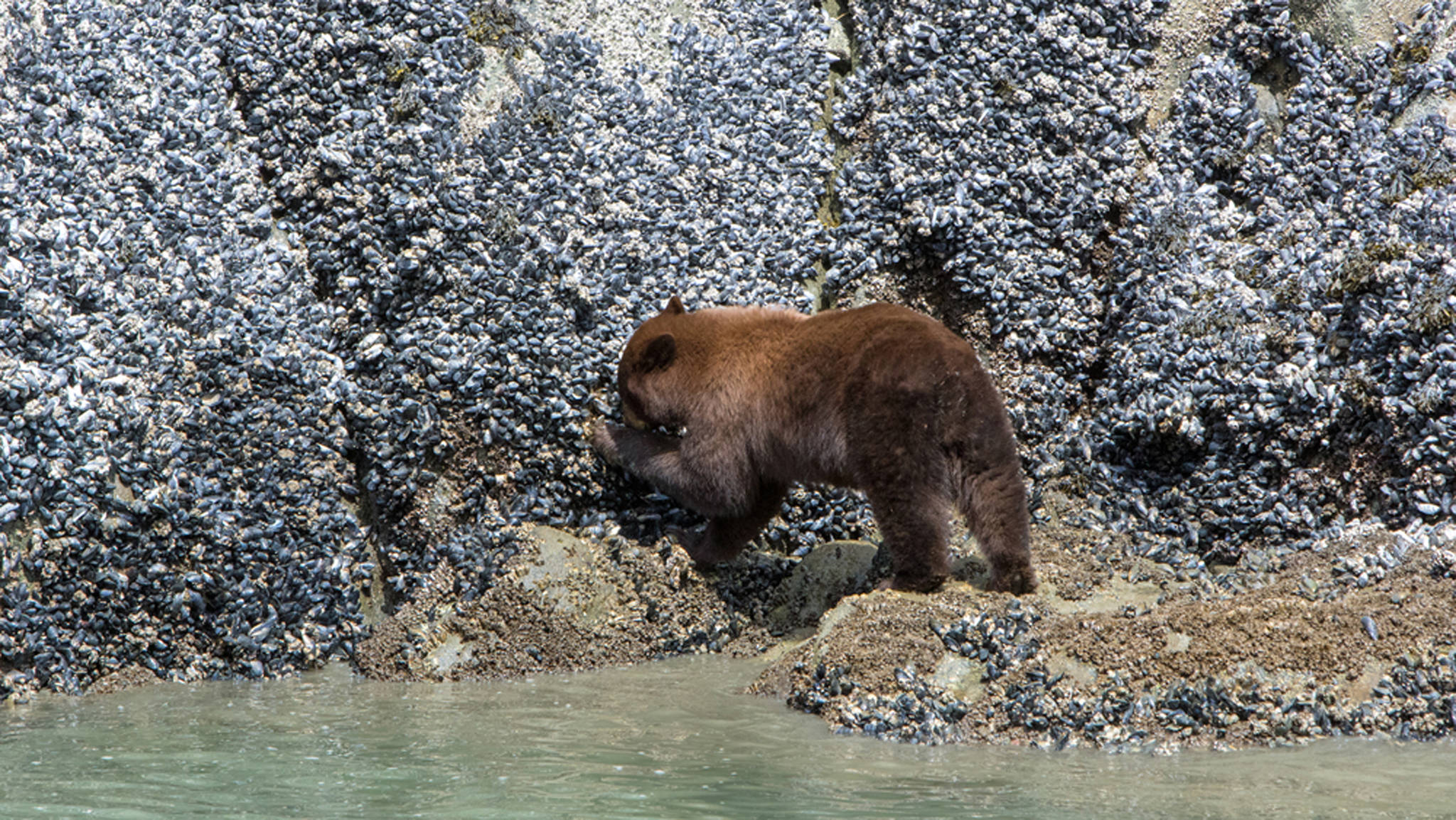
But there are also many other channels by which marine-derived nutrients reach land. Less spectacular, perhaps, than the salmon runs and the attendant consumers, these other links make their contribution to the connection between sea and land. Lots of critters forage at the edge of the sea and then move up into the forest and meadows, where they deposit their digested dinners. Bears dig clams in muddy intertidal zones and gnaw barnacles off rocks. Bears, geese, and probably our beach marmots graze in the sedge meadows. Deer graze on sedges and intertidal plants. Ravens dig up sand lance and clams from the sediments. Eagles harvest herring and sand lance, and sometimes capture marine birds. Crows and ravens prey on sea urchins and small crabs and, during a eulachon run, these birds are known to store captured fish in grass tussocks and in trees.
It’s not all one-way, of course; it’s a two-way connectedness. The land has some major influences on the sea. Run-off from rain and snow-melt regularly carry the products of erosion, including sediment, fallen trees, and some dissolved nutrients, eventually to the sea. Glacier-fed streams send a rich supply of minerals and organic nutrients to the sea, feeding the plankton that feeds the herring and the whales and lots of other organisms.
Human activity can have some major effects too. A recent excursion to Hawk Inlet on Admiralty Island made this abundantly clear. This was a Southeast Alaska Conservation Council cruise, so the emphasis was on what the mining activities near the inlet are probably doing to things in the sea. Waste products from the mine are pumped out into the lower inlet, where some sink to the bottom and some are swirled about by the incoming and outgoing tides. Leachates from the tailings piles ooze downhill toward the beach. The situation there came to our attention when a harbor seal, harvested in that area and eaten by humans, was found to be heavily laden with toxic chemicals. Then the levels of various toxic metals (e.g., lead, selenium, and several others) in blue mussels, shrimp, crabs, clams, and cockles from the inlet were found to be several times higher than in other parts of Alaska. Perhaps not coincidentally, local herring spawning aggregations and littleneck clams have recently disappeared; so has a run of king salmon. The initial concern has been for humans that harvest wild food in this area.
However, if mussels, clams, shrimp, and cockles are picking up high levels of contaminants, it’s a sure thing that many other organisms are too, leading to ramifying consequences throughout the food chains. Contaminants, such as the toxic metals of direct concern here, get passed up the food chain, accumulating at higher and higher levels, until the top predators get really big doses. Even before the contaminant concentrations become lethal, sub-lethal levels (sometimes very small amounts) can change body chemistry in serious ways, including growth rates, behavior, and even the gender of some consumers. Such changes would be reflected in population sizes of the consumers and that, in turn, would affect the populations of their predators.
On this cruise, we saw some of the spectacular wildlife for which Southeast is famous. There were brown bears foraging on sedges in beach-side meadows. Dall’s porpoises dashed past the boat. Humpback whales cruised by and dove. A group of killer whales moseyed back and forth, sometimes making impressive vertical leaps out of the water. All of those species depend on resources that could be affected by contaminants. To take just one example: Killer whales are top predators that could accumulate high levels of contaminants from their prey. Resident killer whales eat fish, those that eat plankton directly and those that eat plankton-eaters, while transient killer whales eat marine mammals that eat fish that …
The other animals we observed could also be exposed to some level of potentially toxic mine effluent. Even though the effluent from the inlet presumably gets diluted in the larger channel, sometimes a little bit can have huge impacts. It is unlikely that anyone will look to see if that occurs, so it would be wiser to prevent it from happening in the first place.
• Mary F. Willson is a retired professor of ecology. Her essays can be found online at www.onthetrailsjuneau.wordpress.com
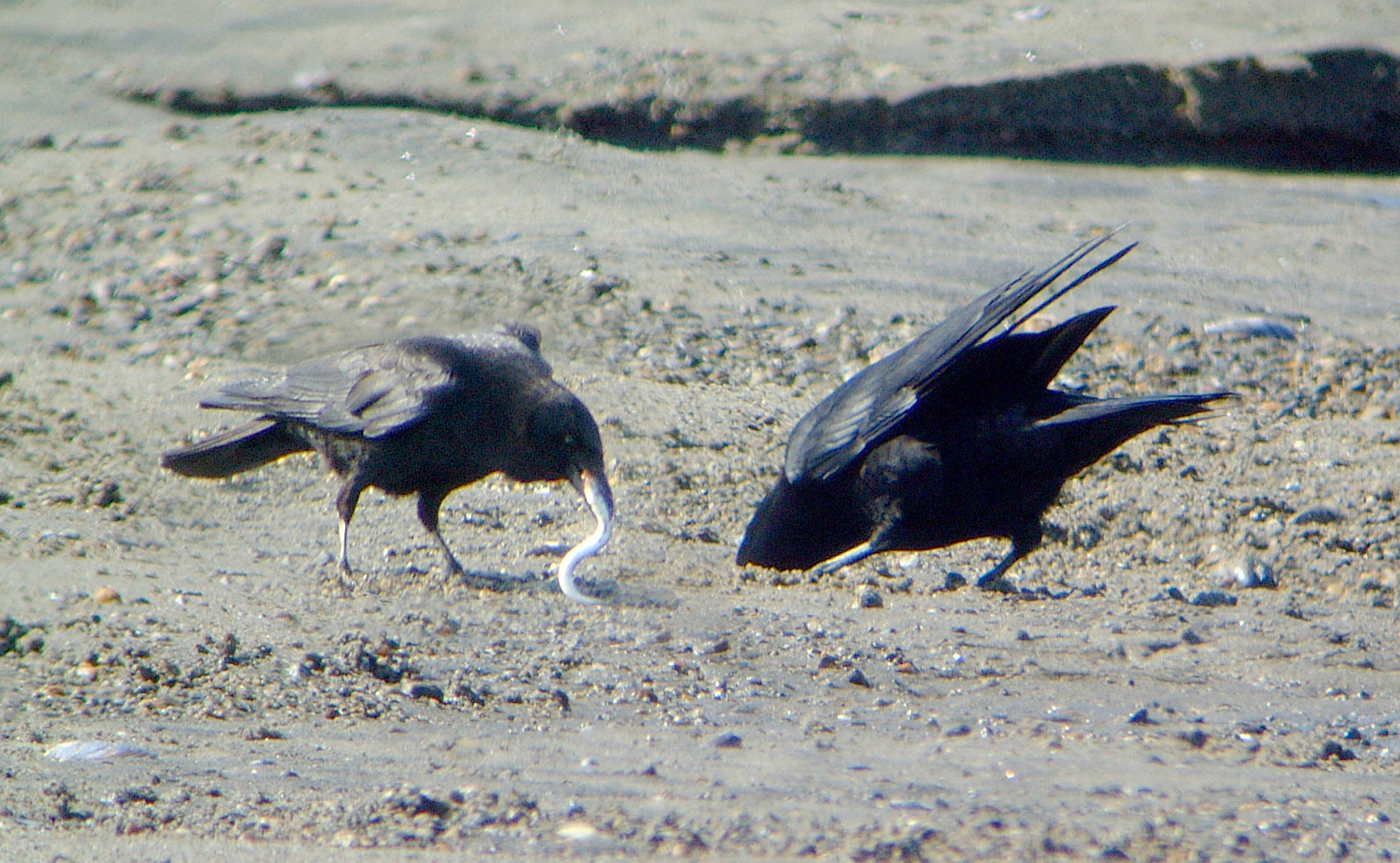
Northwestern crows dig up sand lance from the tide flats. (Photo by Bob Armstrong)
