
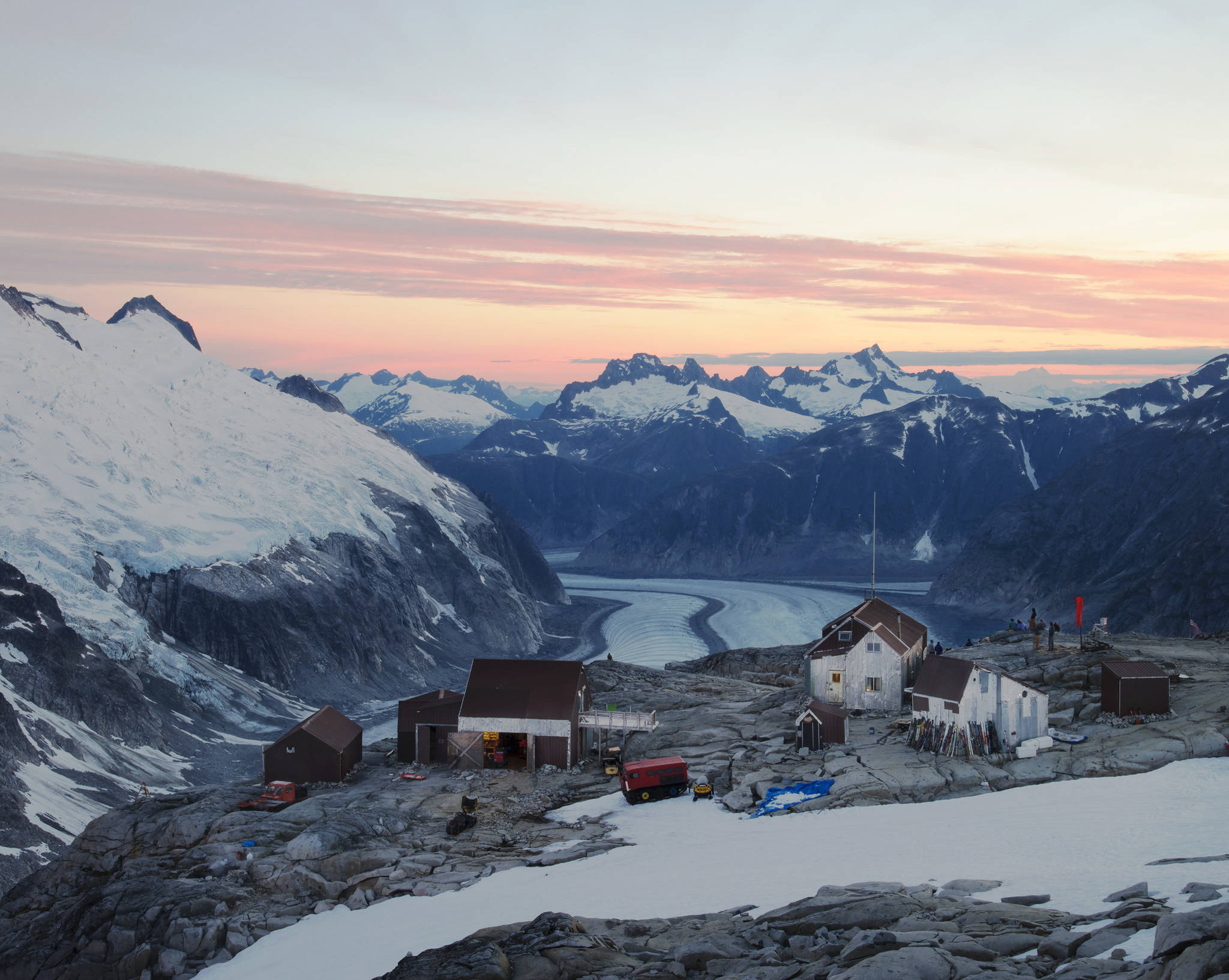
This summer, a group of about 30 students will step into the most unique classroom they will ever have: the Juneau Icefield.
Every year, students hike to Camp 17, which straddles the Ptarmigan and Lemon Creek glaciers, and from there, spend eight weeks traversing the Juneau Icefield until they reach Atlin, British Columbia. During the journey from camp to camp, the students learn science relating to glaciers as well as assist researchers in their work. When the students reach Atlin, they present their findings to the community; then once they’ve returned to Juneau, they present again at the Mendenhall Glacier Visitor Center.
Juneau Icefield Research Program (JIRP) has allowed students, scientists and other researchers opportunity to study glaciers and the climate for more than 70 years since the program’s inception during World War II. Faculty, ranging from experts in hydrology and geochemistry to geobotany all have something to offer the students, who are mainly undergraduates, though there have been high school students and graduate students in attendance too. In recent years, JIRP began providing an additional lens to view the ice through: art.
Juneau photographer Ben Huff joined the program as art faculty two seasons ago. When he discovered Camp 17 and sought answers to its purpose, he learned of JIRP and became intrigued, joining as faculty to the program soon afterward. Huff spends one to two weeks with the students as they journey to Atlin (all the faculty rotate, helicoptered in on a schedule), and finds that time invaluable.
It’s his mission to empower “students to look at the landscape in a different way, to have a way to talk about it, to have a way to describe it, to feel that it exists outside but runs parallel to the science they are actively engaged in,” he said.
He feels so strongly about the program that he is selling prints from his time on the ice at Amalga Distillery for a First Friday show to fundraise for the program. He does this alongside prints by Hannah Perrine Mode, an Oakland-based artist who was the first official artist-in-residence of JIRP. Being able to participate with JIRP in 2017 was one of the “greatest joys” of her career, she said.
Mode created a series of cyanotype photographs, prints of which will be on sale for First Friday, while on the Juneau Icefield. Cyanotype photos use a light-sensitive chemical that turns blue in the sunlight, creating a unique way to document the passage of time, light intensity, and glacial melt, she explained. She left each photo exposed for an entire day at each base camp to take advantage of the vast amount of sunlight reflecting off the glacier, she said. Though she was limited on the amount of materials she could bring for the residency, she still spent time painting with watercolors, filming video, snapping digital photos as well as writing and sketching.
She too participated in the science component of the program, and likewise shared her artistic knowledge with the students. To her, scientists and artists are two sides of the same coin — they’re both explorers.
“I believe that art can be a powerful tool for science communication; it is another way to tell the story of the Earth and our relationship with our planet. Art gives us opportunities to connect with hyperbolic, abstract ideas of climate change in a more intimate, experiential way, offering us a different lens with which to explore geologic forces, scientific research, and exploration,” she said.
Huff and Mode are fundraising not only because of their belief in the importance of the program and a desire to bring awareness about it, but running a program like JIRP isn’t cheap. The program is supported by an almost entirely volunteer staff save three core employees, one of them being the program manager Annie Boucher. The yearly operating budget for JIRP is $250,000, and covers rent of the camps, helicopter costs, basic facilities maintenance, $35,000 in student scholarships, food, and fuel for field operations. The program costs $7425. Boucher said while the Director of Academics and Research Dr. Seth Campbell is actively pursuing grants to offset costs and reduce the amount charged to students, it doesn’t cover everything. Twenty percent of JIRP’s operating costs are covered by donations, she said. She’s grateful for all the support the program receives.
Boucher, a graduate of the JIRP program herself, said the program is a great opportunity to build connections in their fields of study.
“You can find JIRP alumni in most university glacial science programs in North America, in research stations across both polar regions, in the White House, at NASA, on local weather stations, and in classrooms across the country,” Boucher said. “This is a rich resource for our young alumni looking for next steps in a variety of careers in climate science and related fields.”
Students of earth science and related fields can learn about glaciers in classrooms through remote methods, like satellite imagery, field data, photography, and other tools but nothing beats understanding a glacier than spending substantial time on one, she said.
“JIRP students gain an intuitive understanding of glacier dynamics not just by sitting in lecture, but also spending time in snow pits, skiing over the many glaciers of the Taku system, and eating dinner looking out over the Gilkey Trench,” Boucher said.
The JIRP art show will be at the Amalga Distillery from 4:30-7 p.m. on First Friday, April 6. Huff will be on hand to answers questions folks may have about the program. Prints of his and Mode’s work will be on sale with all proceeds going to JIRP. Donations will also be accepted.
Learn more about the JIRP at www.juneauicefield.com.
Editor note: This story has been updated to correct that Mode is based in Oakland, not San Francisco. Also the spelling of the special photographs she takes is “cyanotype.”
• Clara Miller is the Capital City Weekly editor. She can be reached at cmiller@capweek.com.
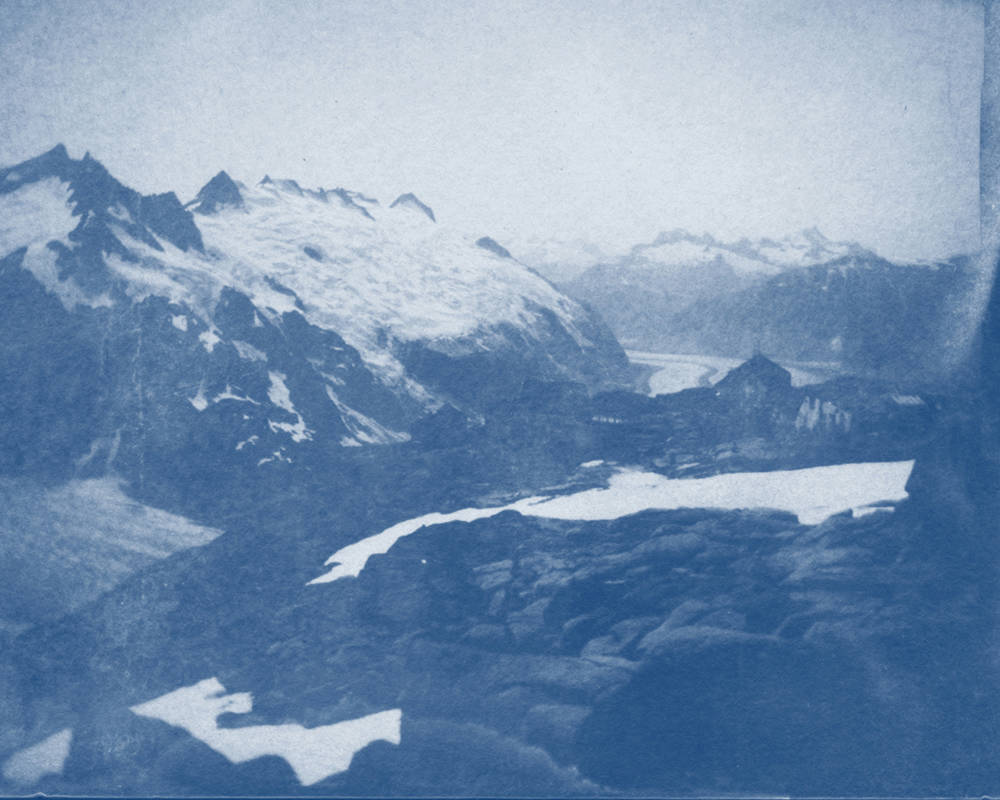
Cyanotype photograph by Hannah Mode. Cyranotype photos use a light-sensitive chemical that turns blue in the sunlight, creating a unique way to document the passage of time, light intensity, and glacial melt.
