
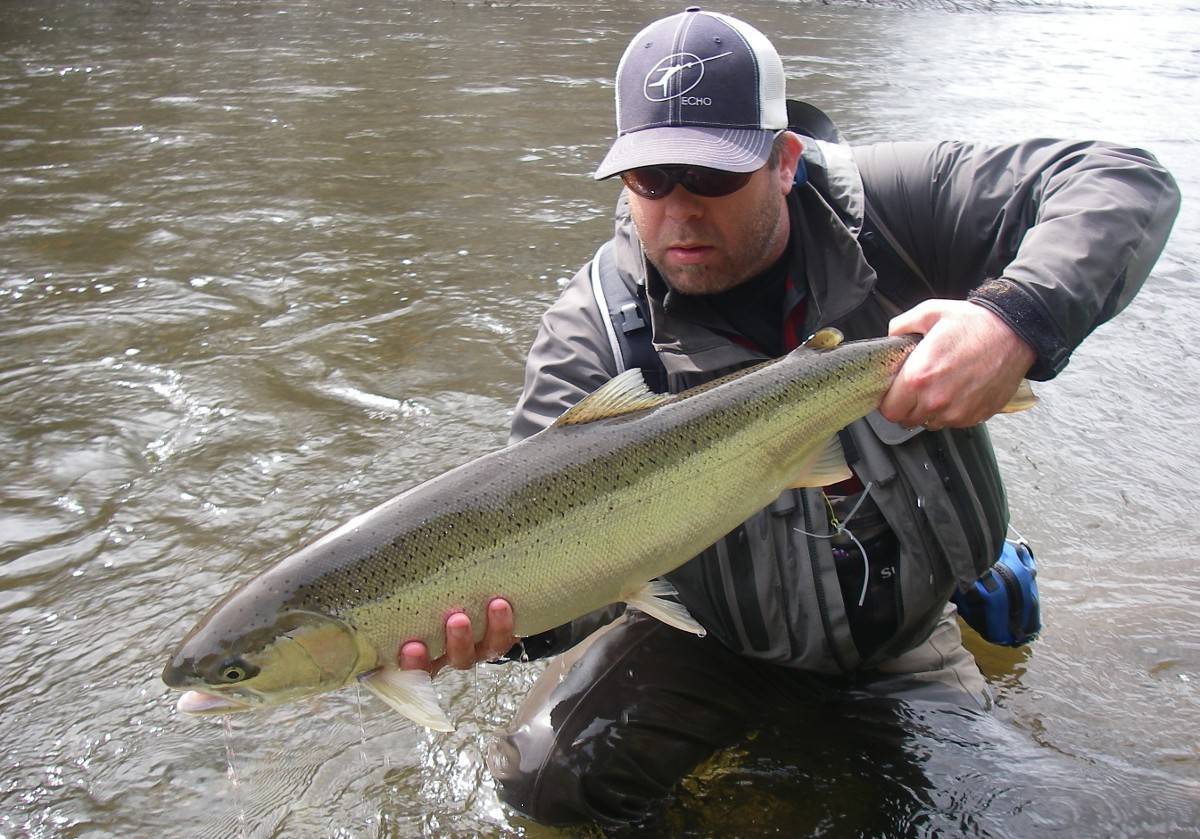
For most people, steelhead — sea-run rainbow trout — are “the fish of 10,000 casts.” To catch them, you stand waist-deep in a spring-melt river, growing numb with cold as you cast … and cast … and cast.
Trout Unlimited sportfish outreach coordinator and Bear Creek Outfitter fishing guide Mark Heironymus says it doesn’t have to be that way. A better word than “fishing” for steelhead, he said, is “hunting.” You might go hours between casts, but once you line everything up right, you get your fish.
Though they’re as far north as the Copper River, 319 of the 340 or so steelhead watersheds listed in the Alaska Department of Fish and Game’s Anadromous Waters Catalogue are in Southeast Alaska, Heironymus said. (If you count streams, rivers and lakes individually, said J. Johnson, the Alaska Department of Fish & Game’s anadromous waters catalog project biologist, there are 892 in Alaska as a whole “that we know of.”)
Heironymus said he fishes in at least a dozen unlisted streams a half hour’s flight from Juneau. Listed or unlisted, most see fewer than 200 spawning adults every year — though one river, the Situk in Yakutat, has thousands.
A different fishery
University of Alaska Southeast marine biology student Nick Whicker, 22, has caught a lot of salmon in four seasons as a purse seiner, but this spring, through a “Salmon, Sport and Society” class with University of Alaska Southeast Associate Professor of English Kevin Maier, he caught his first steelhead.
It’s partly commercial fishing, Whicker said, that led him to want to catch and release steelhead.
“The fact that I’m able to … go out and harvest thousands of salmon to sustain myself — that may be what inspired me to get into this conservation, catch and release fishery,” Whicker said.
Though Heironymus is a fishing guide, he doesn’t often take out people looking for steelhead — it’s too different from the average Lower 48 fishery. That’s part of what he likes about it.
“There’s days you catch a bunch. Days you throw stuff at them and they do nothing. But I think it’s everything surrounding it. The places you have to go to find (steelhead), for the most part, are not average or boring places. (They’re) wild fish living in wild places,” he said.
While most steelhead return to their natal rivers in the spring, some also return to their birth rivers in the summer, some in the fall, and some over the course of the winter. According to ADF&G, most anglers on Alaska’s most prolific steelhead river, the Situk, fish from April to June (the peak is May). Some fishermen like the challenge of winter fishing, as well.
Around 25 percent of steelhead in Alaska return to spawn more than once — some up to five times. This makes them pretty resilient to natural changes in their habitat, but they’re still “fairly easy to extirpate, because they need water quality,” Hieronymus said. “If you don’t get the water quality, you don’t get the fish.”
Steelhead once ran on rivers like the Columbia and as far south as Los Angeles, but development, overharvest and hatcheries have mostly pushed them out, Hieronymus said.
Wild places
One of Hieronymus’s most memorable sights in his years of fishing is coming across a huge clearing created by bears on Chichagof Island. In the center? A bear skeleton. Because it was early spring, everything was still visible.
“Two bears were fighting last fall, shredding the place, and there was the result of that contest,” he said.
Other times, melting slabs of ice had scoured the bark from the trees like they do in the interior — an unusual sight in Southeast.
“It’s like the river is doing the yawn, stretch, wake up-sort of thing and getting on with the summer,” he said.
Even if you are casting 10,000 times, “it’s not about catching fish. It’s more about engaging with place, and I think steelhead sort of embody that,” Maier said.
Whicker agreed. “It wasn’t until last days of our trip, after I had caught a steelhead, that it came into light. If you really care about a resource — this natural resource, which is salmon and steelhead — you want to take care of that…. The Situk River itself is unlike anywhere else on the planet. It’s just so natural. Once you go there, you understand why it’s one of the most productive steelhead rivers on the planet, if not the most productive on the planet.”
If you’d like to nominate a steelhead-bearing stream for inclusion in ADF&G’s catalog, you can do it here: https://www.adfg.alaska.gov/sf/SARR/AWC/
• Mary Catharine Martin is an award-winning science and outdoors writer and the communications director of SalmonState.
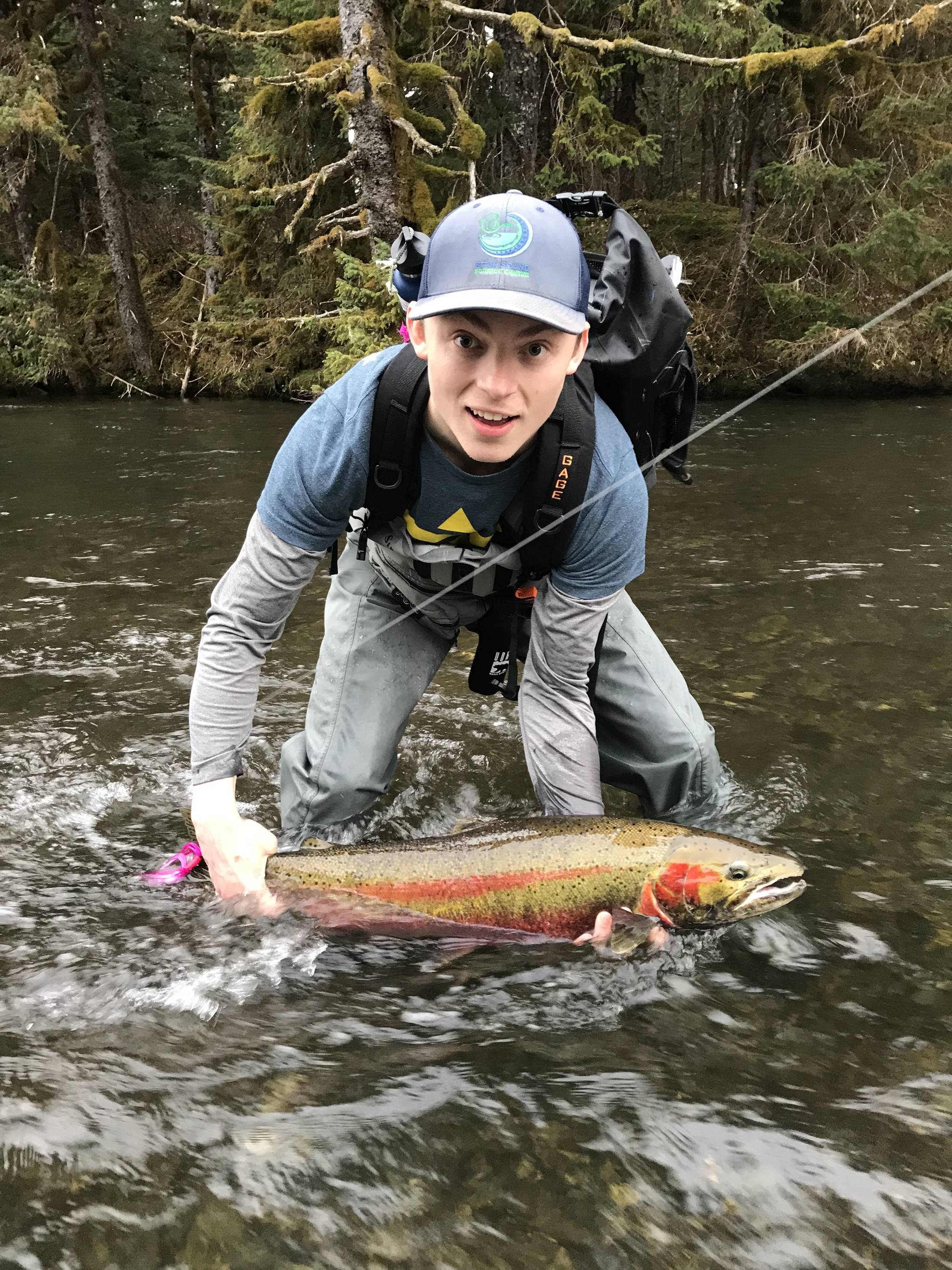
Nick Whicker poses on May 10, 2018 with his first steelhead, caught on the Situk River in Yakutat with a UAS Outdoors studies class taught by professor and Salmon Fellow Kevin Maier. The fish bit onto a fly Whicker had tied that morning (it already had a hook in its tail.) (Photo by Triston Chaney)
