
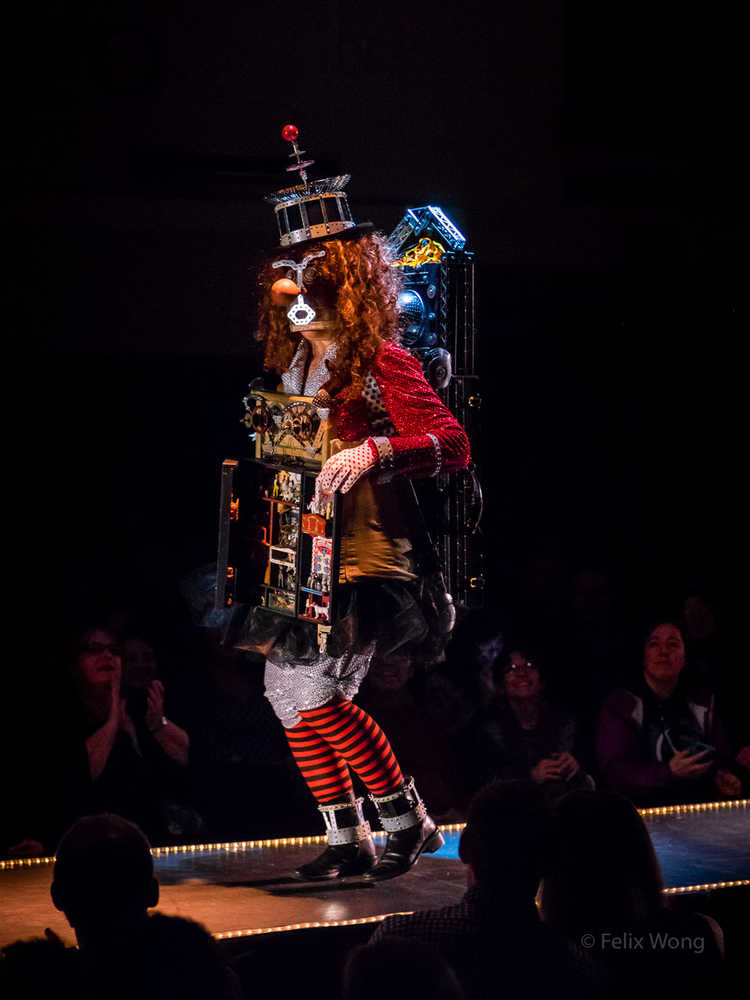
Thirty years ago, in 1986, Ketchikan artist Halli Kenoyer participated in Ketchikan’s (and Southeast Alaska’s) first wearable arts show, but she didn’t yet “get” it.
“For the first 10 years of our wearable arts show, there were some unusual pieces but I didn’t really connect with any of them,” she said. “No one was doing weird stuff 20 years ago.”
It was fun and creative but the first show was “kind of a rushed little thing,” said wearable artist Diane Palmer, who was instrumental in getting that first show started, and has participated in every show since. Models modeled the wearable art, then it got put on a mannequin and then the wall, and the cycle continued.
Then, in the mid 1990s, the show moved into a bigger space. They started using themes — the first one was “Art as Armor.”
Artist Lezli Morgan said “we’re not thinking big enough,” Kenoyer remembers. Then: “Holy cow. It exploded.”
Kenoyer created mosquito armor — a model wore a big, circular hat with lights to attract mosquitoes, and mosquito netting. It was delicate, and worn with a leotard, and “looked awesome on the runway,” she said.
“I said ‘Oh! It’s more about entertainment… it’s about having a good time. I know how to do that. And I just started making big, bold pieces.”
Another important component of the show, Kenoyer realized, was “not taking ourselves too seriously, because my God, we’re Ketchikan, which is kind of like Tijuana, Alaska. We’re a border town. There are no pretensions, and we have a really good time down here. There’s nothing stuffy about it.”
Palmer has won awards in the biggest wearable art competition in the world — World of WearableArt, in New Zealand, first held in 1987.
In 2002, Palmer entered a double-sided mask in the competition and won third place in the “American Express Open” section of the show.
Ketchikan’s show isn’t judged, and both artists said they like it that way.
“We always felt that by leaving it an open show, really, people didn’t feel like they weren’t good enough,” Palmer said.
“We don’t (judge), and I think that’s part of our special flavor,” Kenoyer said.
Both Palmer and Kenoyer regularly, maybe once or twice a month, find gifts of discarded items on their porches, or hanging from their front door. Kenoyer’s gotten 1000 test tube tops from the hospital, for example, or tomato cages, which are always useful. Palmer’s dental hygienist saved her the little red polish containers hygienists hold on their fingers.
For Palmer, her pieces grow from what people give her and what she finds — the theme gets incorporated later, if it does.
This year, in an homage to that first themed, inspirational year, Kenoyer made a six-part rhinoceros based on a woodblock etching by Albrecht Dürer, an artist who in 1515 had never seen a rhinoceros, but had created one based on the description of someone who had. That image was on the invitation for the armor-themed show 20 years ago.
“This year I just feel like the quality of everybody’s pieces, even first-year applicants, it was amazing,” Palmer said. “People took a lot of time and it was really amazing how these first-time people were putting together these beautiful, beautiful, structured pieces. This year just struck me like ‘Wow, everyone’s stuff is just great.”
What happens to the pieces afterwards? Well, this year, Palmer dismantled some of her previous pieces and used them. The theme was “Alchemy,” so that melding fit with the theme, too. It ended up looking steampunk, she said.
Kenoyer offers them to her models first. And she’ll usually burn her biggest piece at a solstice party in Juneau. One model turned a seahorse inspired by the edge of a 1500s map into a lamp. Another piece is at the public library.
The models, Kenoyer said, are integral.
“I can make this stuff and I can toil away at it in my studio one day at a time, but it’s a hunk of paper and a bunch of wire until you put a model in it,” she said. “The model takes it to the next level. They’re the one that interprets it and gives it a freaking life.”
This year she was “full of despair” about the initial attempt to create the rhinoceros out of six separate pieces. “They just kept working at it, and they made it work,” she said. “They absolutely made the piece.”
Palmer works as a Certified Public Accountant, and she gardens and does assemblage and found art the rest of the year. For her, wearable art is a seasonal thing.
“I don’t start wearable art until November each year. It’s dark, and rainy, and it’s a really good inside thing,” she said.
“At the heart of winter when the wind is terrible, and the rain is just ridiculous… that’s when we all put our heads together and talk about wires, building frames, different kinds of ways to bond fabric… not five or 10 people, but more like 30 or 40,” Kenoyer said.
Palmer loves the kids’ involvement. Elementary school kids come during the Saturday matinee, and this year, kindergartners did a song and dance with wearable art hats. Other kids participate in the main show.
“It gives kids that young — they get a little bit more confidence, out on the stage,” Palmer said. “They might be scared at first, but there are older people in the back, and models cheering them on, trying to build up their confidence. It’s great, because they just blossom when they’re out there.”
Kenoyer also works with middle-schoolers at Ketchikan Charter School on their wearable art, which has led to some unusual, creative thinking, she said.
“I think that’s cool for me, because it’s like you realize this thing is going to live on, because we’re starting out young,” Palmer said.
“For a town that supports the arts the way Ketchikan does, it’s my way of saying ‘thank you’ back,” Kenoyer said.
Next year’s theme in Ketchikan is “Con-fusion.”
• Contact staff writer Mary Catharine Martin at maryc.martin@capweek.com.
