
What an incredible spring. Although I am always happy to see the end of winter, I like the anticipation of waiting for things to turn green. My friend who moved north bemoans the fact that spring arrives in two days and then becomes summer. She, too, misses the trickle of magic that comes with the next flower that pops up or the slow budding of the trees when spring comes in a fast procession.
Spring foraging connects me to this place. I look forward to the first emerging greens. There is something wonderful about the first taste of something that hasn’t been transported thousands of miles. Eating locally, whether it is vegetables that you’ve grown or foraged, creates a bond with the land and to all the people that have relied upon it for numerous generations.
Some plants allow us to harvest them more thoroughly. Picking back nettle growth slows the process by which they produce a flower stalk and doesn’t hurt the plant. Other plants, like devil’s club shoots, require thoughtful foraging as they can be susceptible to overharvesting.
The general rule is to pick one plant in ten to harvest. Within that one plant, only harvest one-third of the leaves. This allows the plant to recover somewhat. When looking at devils club, select a plant that has at least three leaf buds. This can be a plant that has three offshoots on it or you can look at a plant that might spread out from a central base root. Selective harvesting allows the plant to recover.
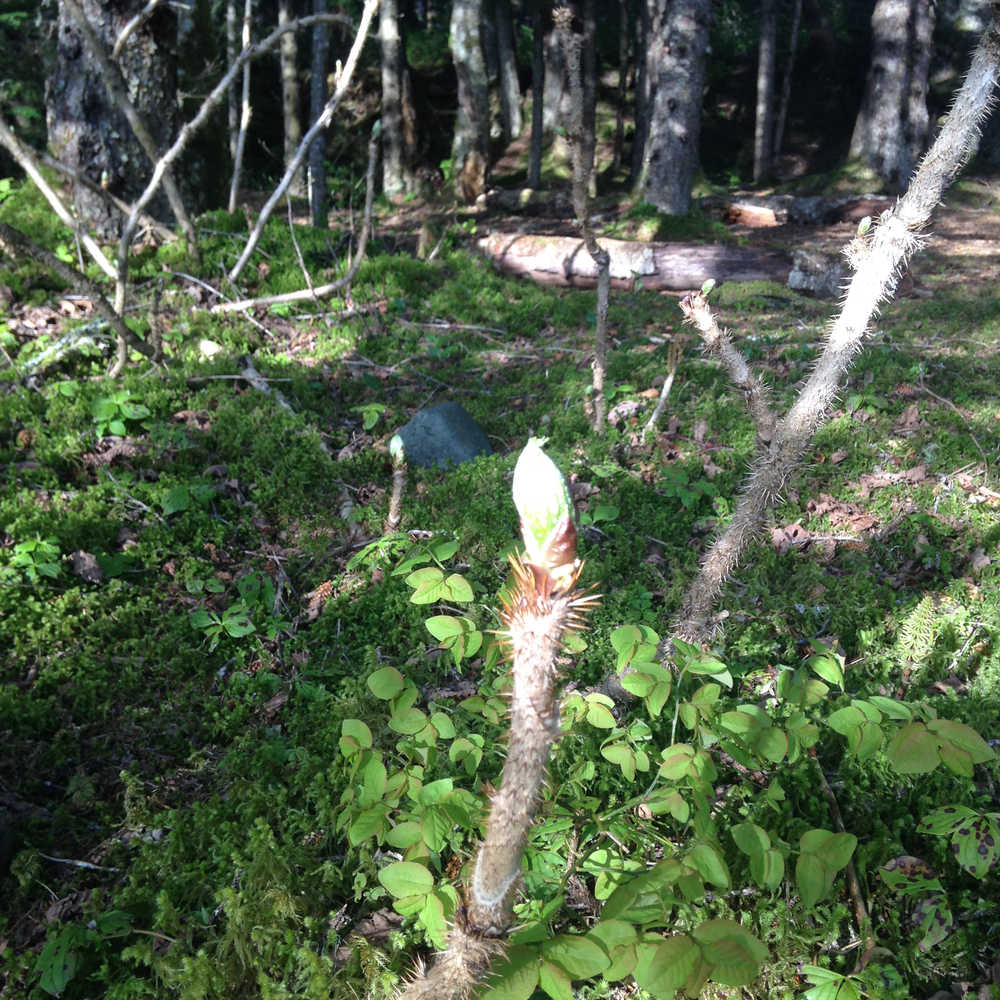
In the lower areas near sea level, devil’s club shoots are probably past prime this year. You’ll need to go up in elevation to find the ones that are just emerging. Harvest when they are one or two inches. When they get bigger, the leaf begins to unfurl. The spikes that are found on the leaf become harder when that happens. If you’ve ever had a devil’s club spine poke you, you can understand the desire to not want to eat one.
If you find one the right size, grab onto the shoot about a half an inch above where it emerges from the woody stem. If you grab it too close, you’ll probably get a thorn or two stuck in your hand. Grip it firmly and twist it, pulling it upwards until it breaks off.
Feel free to try it raw. It’s a great trailside snack. Devil’s club shoots are unlike anything else. I’ve heard them referred to as like a spicy carrot, but they have a bit of a pine taste as well. When I first tasted them, I was overwhelmed by their flavor, but since then I’ve begun to appreciate those complex components.
I tend to not harvest much, so use devil’s club shoots mainly as a side flavor. I like to put it with other things in a stir fry or dice it small with garlic and add it to salad dressings. I know some people who sautée the shoots in butter and garlic.
The Tlingit call devil’s club Ts’íihlanjaaw. As we connect with this land, it’s important to remember who came before, to honor those that showed us how to use the plants, and to value how they respected and cared for them so that they can continue to feed us.
• Corinne Conlon is a freelance writer based out of Juneau. She can be reached at dirtgirlgardening@gmail.com. For an April column about harvesting nettles, see http://bit.ly/1T5OXR4
