
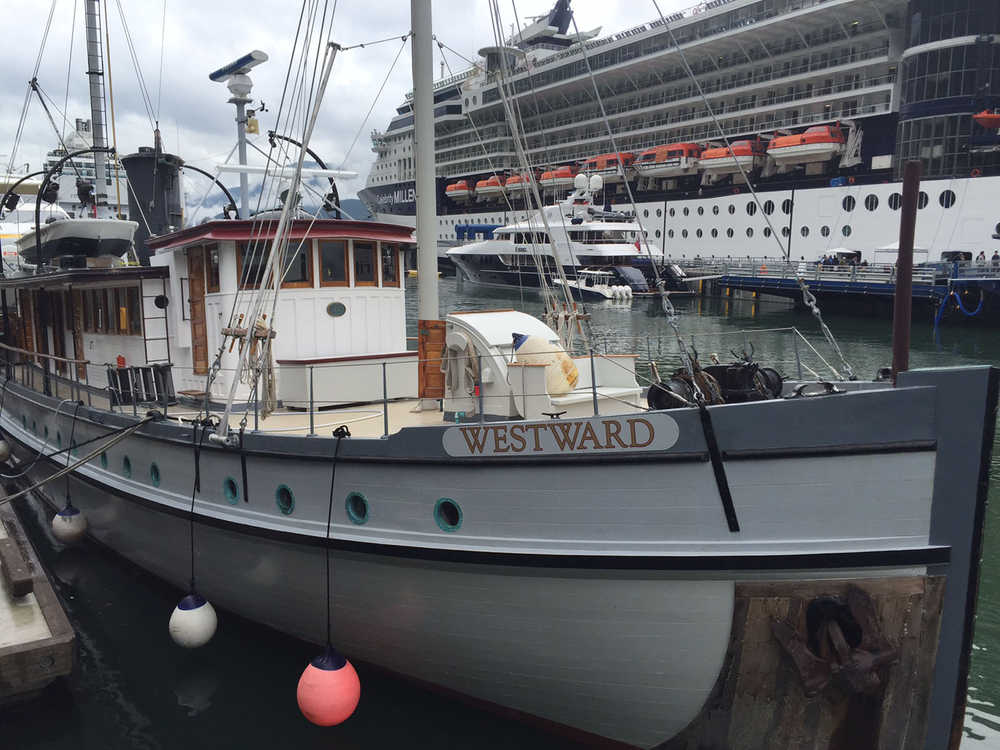
Once upon a 90-year distant time, the M/V Westward carried cruise ships passengers hunting humpback whales, mountain goats and brown bears through Alaska’s waters.
Almost 100 years later, the 86’ vessel is captained by owner Bill Bailey, and it no longer has harpoon mounts — but the yacht, with only four guest rooms, a guest roster of between eight and 12, a fire crackling in its living room fireplace, and an original diesel engine from 1923, retains an old-world feel.
“It’s a neat, deep connection that goes back a long time,” Bailey said.
In the years it hasn’t visited Alaska, the boat has crossed the Pacific Ocean. It was requisitioned for military use in World War II. It’s spent time at a maritime museum.
In recent years, however, it has returned to Alaska during the summer.
The Westward was built in Washington state on Maury Island at John Martinolich’s shipyard; it was designed by Ted Geary. It was launched in January 1924 and was the first boat “built specifically to convey charter guests in Alaskan waters,” according to the company’s website. It cruised to Alaska that same summer.
“This boat was the missing link in Geary’s power boat designs,” Bailey said. “After this boat, he went on and designed these beautiful, famous fantail yachts.”
Campbell Church, who owned and commissioned the Westward, made a lot of promotional films even back in the 1920s — and a video compilation of some of them, created by John Sabella, is available on YouTube.
“Cruising was different in the old days. Church’s clientele was a who’s who of the rich and famous,” a video voiceover says, showing clips of a dressed-up guest lighting a pipe.
Allen Hasselborg, the “Bear Man of Admiralty Island,” strides nonchalantly across the black and white screen, perhaps working as a guide. A man in an old-fashioned bathing suit clambers from the sea onto floating ice.
“The real lure of an Alaskan excursion to the consciousness of 1920s America was blood sport,” adds the voiceover.
Two men hold a dead mountain goat up to the Westward’s rail.
“Another thrilling sport is made possible by the whaling outfit installed aboard the Westward,” says a voice that appears to be from the original film. “Thar she blows! And keen excitement follows. The chase! The intense moments just before the shot! The harpoon hitting true! Splashing and boiling water!” On screen, a man shoots a humpback with a harpoon. “The tackle includes a Norwegian whale gun shooting harpoons fitted with time-fused bombs! …and all of the accessories for scrapping it out with 50-ton whales, any one of which can furnish a week’s excitement between sunrise and sunset,” the announcer finishes.
How passengers now interact with humpback whales may be strikingly different from those scenes 90 years ago, but the boat is still powered the exact same way — by its 110-horsepower 1923 Atlas Imperial diesel engine. Someone has to hand-apply oil to 118 spots on the engine every three hours, Bailey said. The boat’s cruising speed is around eight knots.
Bailey has two boats in Pacific Catalyst II, Inc., his charter company. They are the Westward and the M/V Catalyst, which is another interesting piece of Pacific Northwest history — it was the University of Washington’s first research vessel, Bailey said.
When the Capital City Weekly interviewed Bailey, the Westward was crewed by incoming naturalist Caroline Olson, cook Tracie Triolo, and departing naturalist Sarah Drummond, an artist. Shane Blair, the Catalyst’s engineer, and engineer and master woodworker Randy Good are also Alaska crew members.
Bailey and team recently refurbished the Westward with Good’s help, replacing new planking in the keel (the old planking was fine, but the new had rotted), plumbing and electricity, and better fitting the architecture of the staterooms to the design of the time period (over the boat’s long history, they’d been altered) — while on the way to Baja, where the boat, which is based in Washington, spends its winters.
“It was nothing short of miraculous,” Triolo said of the timing of the refurbishment.
Sitka is the company’s hub for its adventures in Southeast Alaska. Right now, they offer two Southeast trips — one between Sitka and Juneau and back, and one between Sitka and Petersburg and back, each about eight days.
As a clearly historical vessel — it’s listed with the National Register of Historical Places — “the boat’s kind of a skeleton key to … be welcomed in some places,” Bailey said. A passenger load of fewer than 12 can help with that, too.
“We want to meet real people and hear their real stories,” he said.
Pacific Catalyst’s website is http://www.pacificcatalyst.com/. To watch the YouTube video, go to https://www.youtube.com/watch?v=uZVGjZ4jYl4.
• Contact Capital City Weekly managing editor Mary Catharine Martin at maryc.martin@capweek.com.
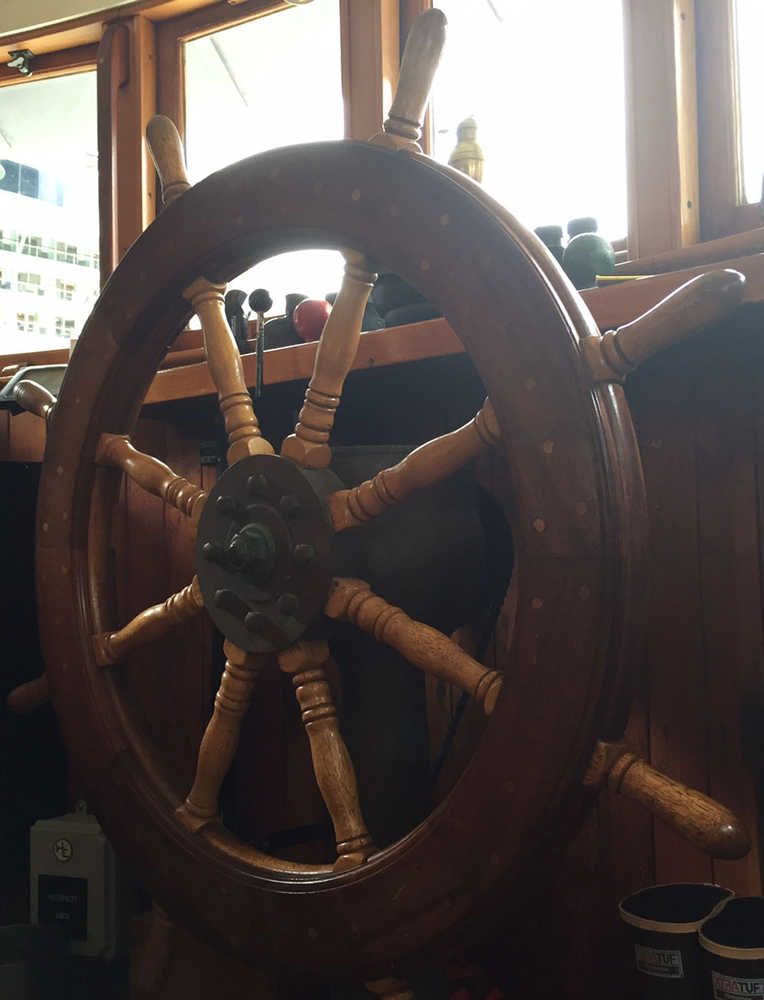
The wheel of the M/V Westward.
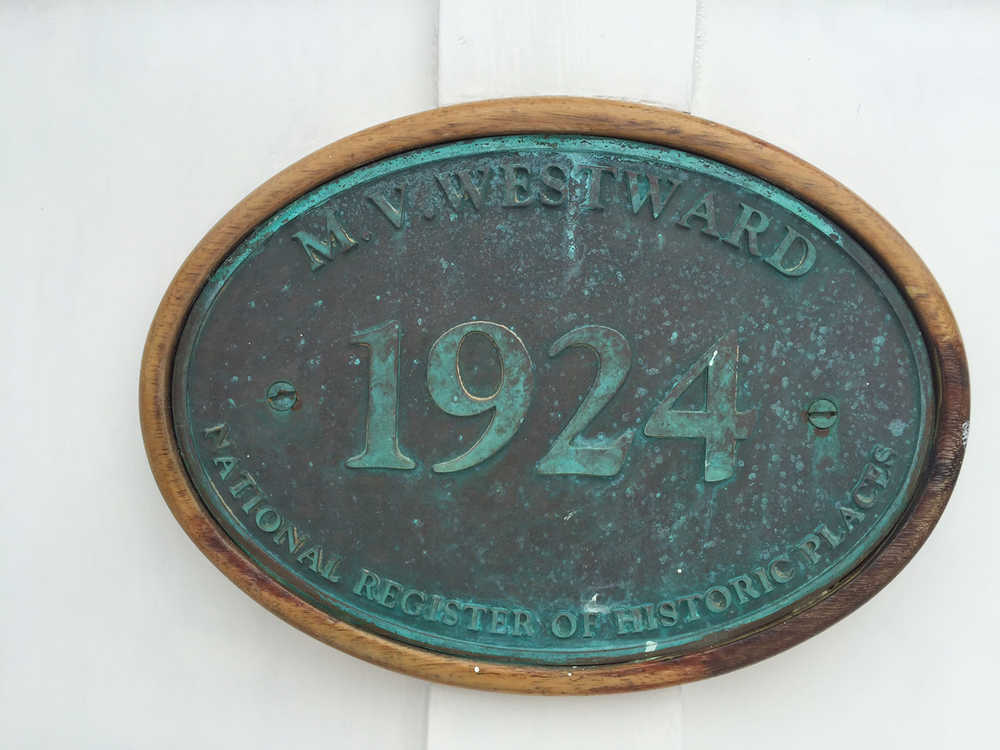
The M/V Westward, first launched in 1924, is on the National Register of Historic Places.
